

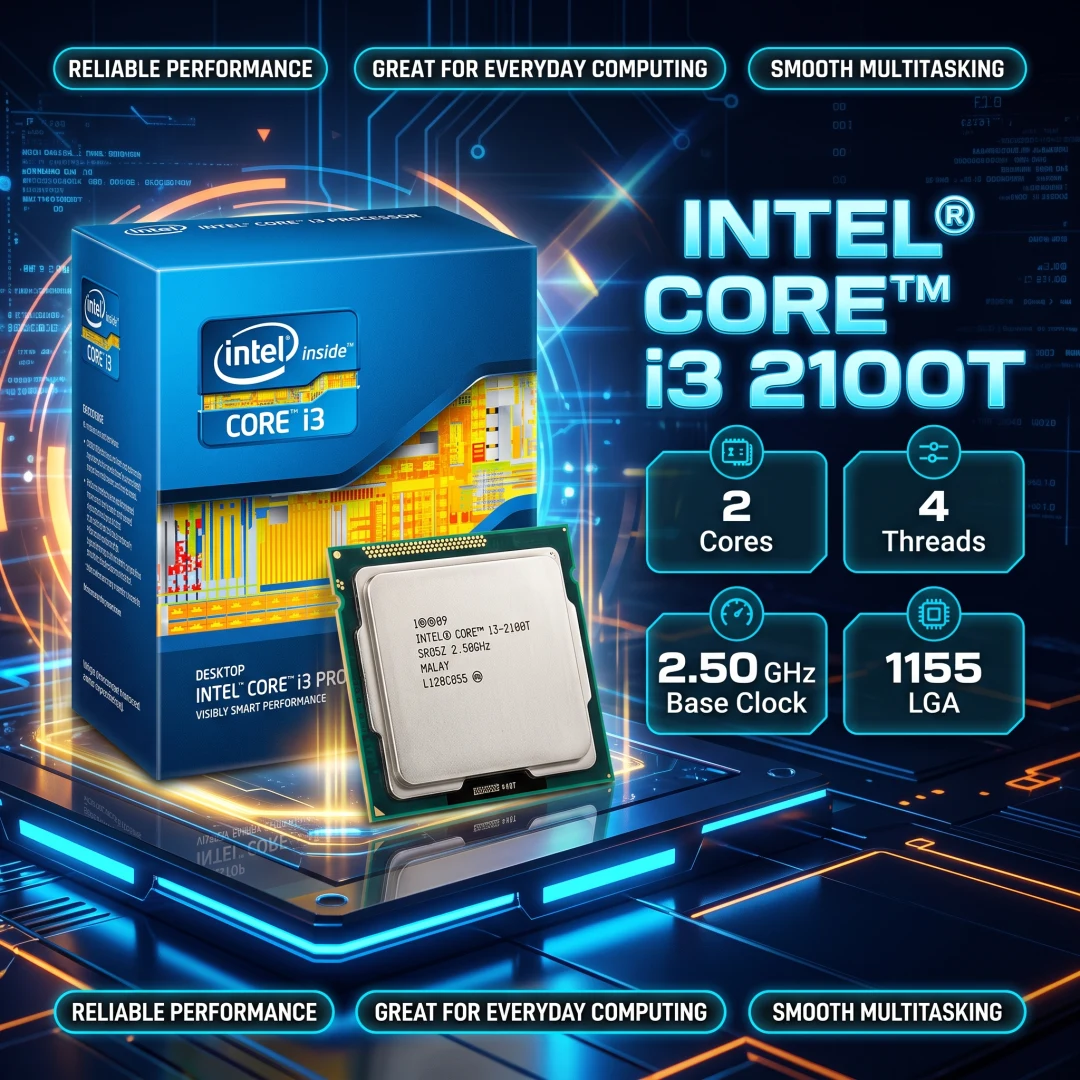
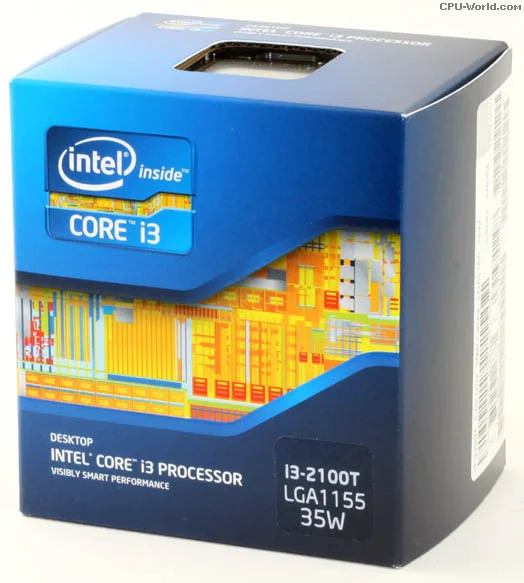
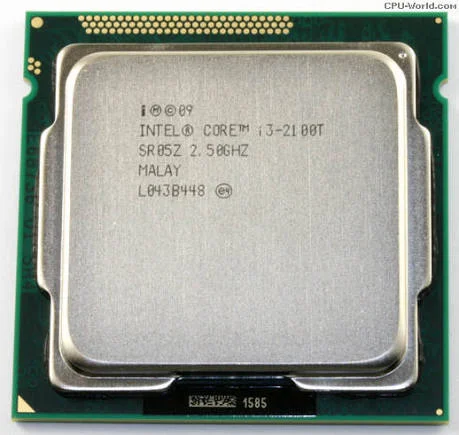
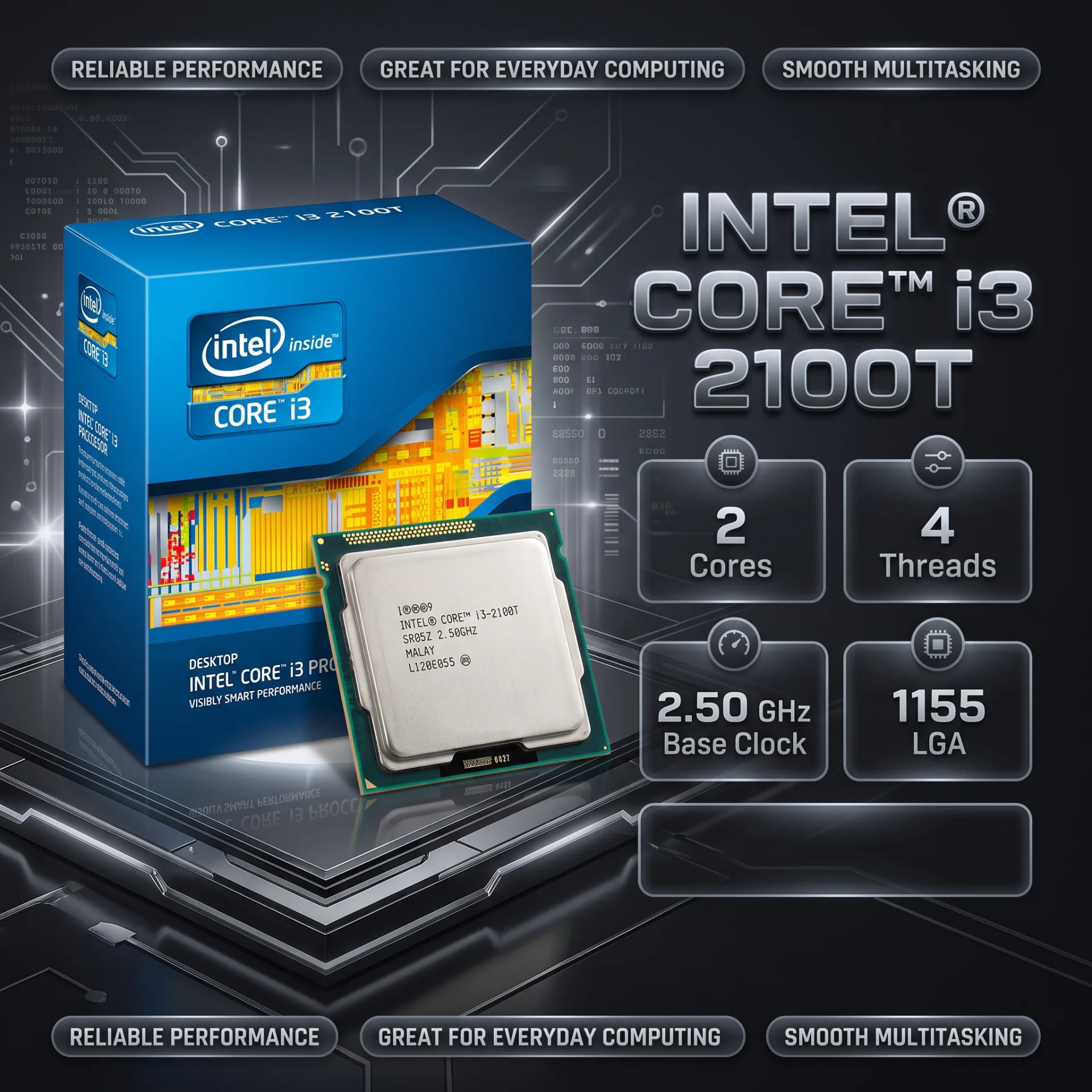
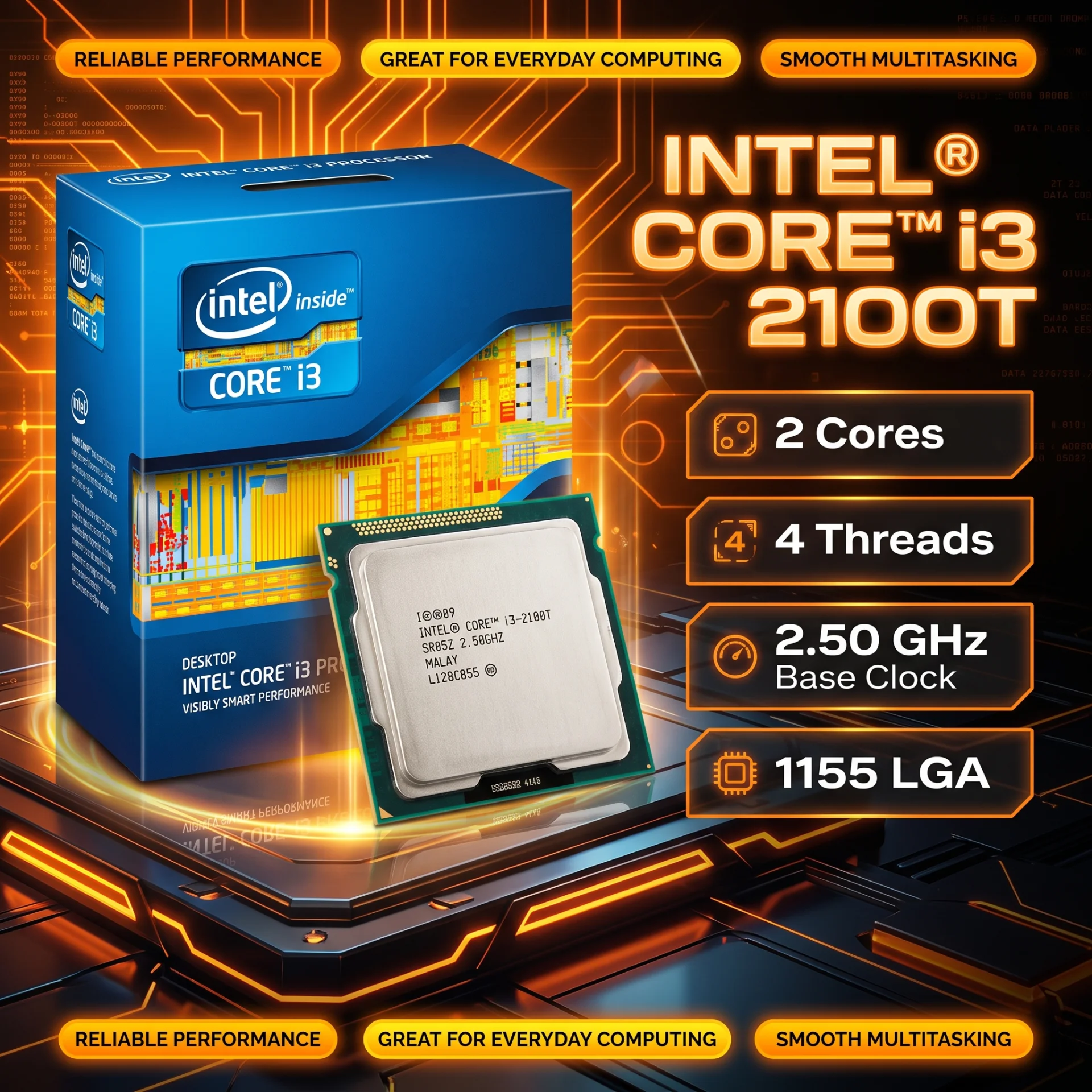
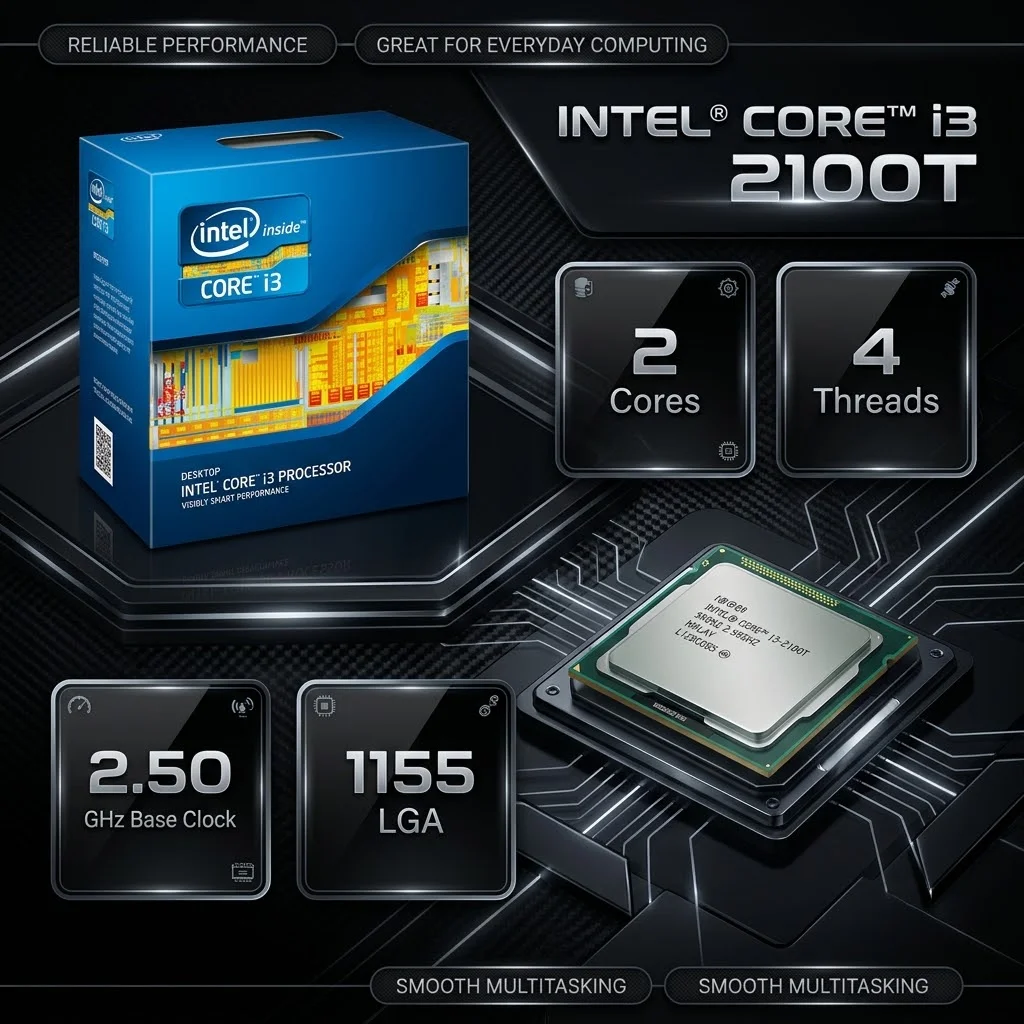
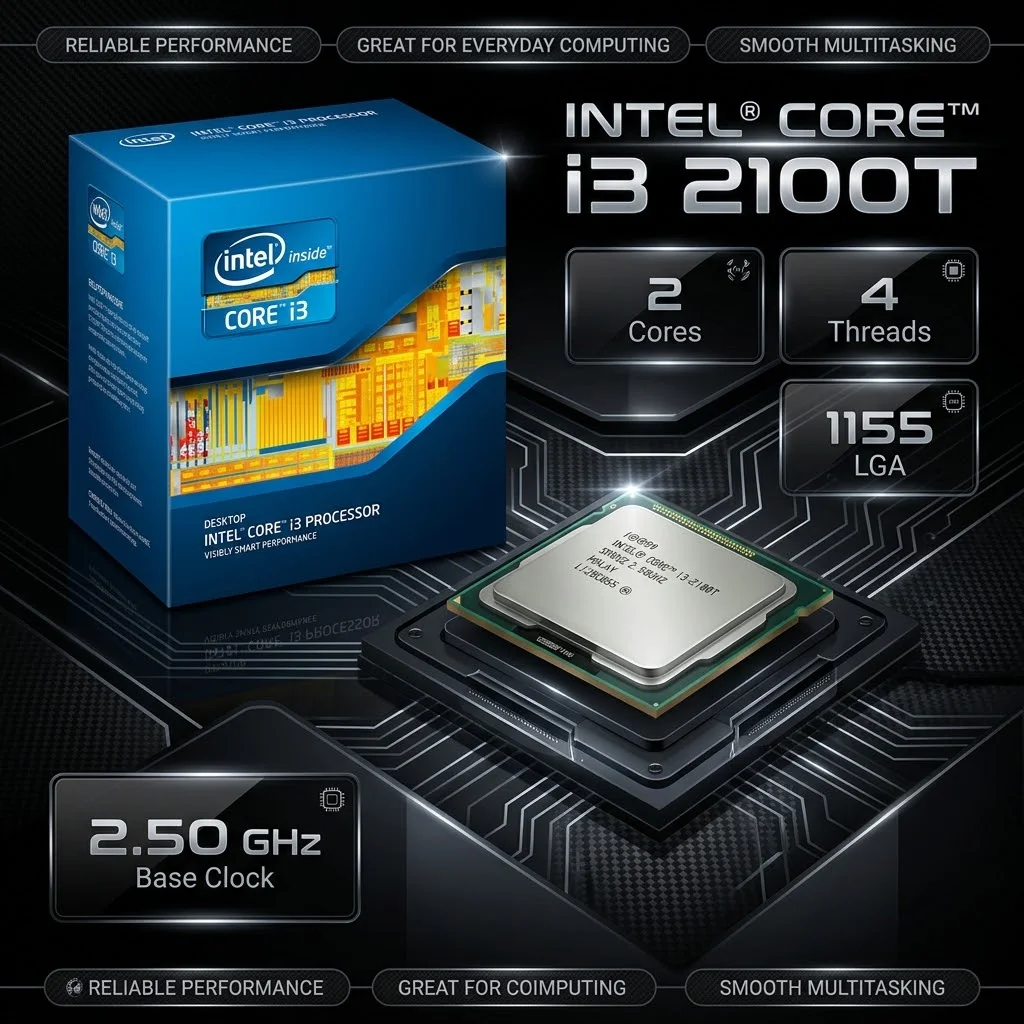
Intel Core i3-2100T 2.50 GHz Dual-Core Processor
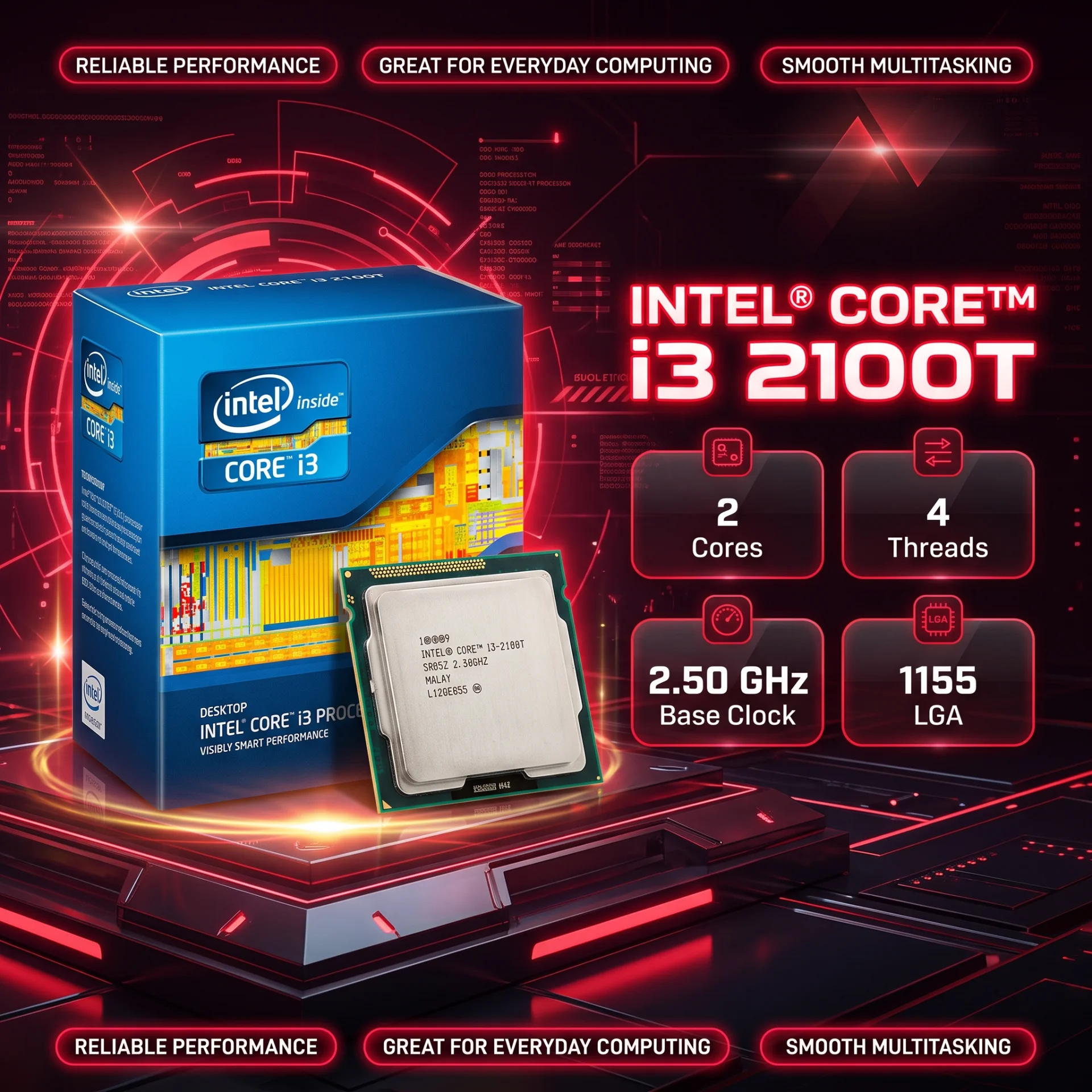
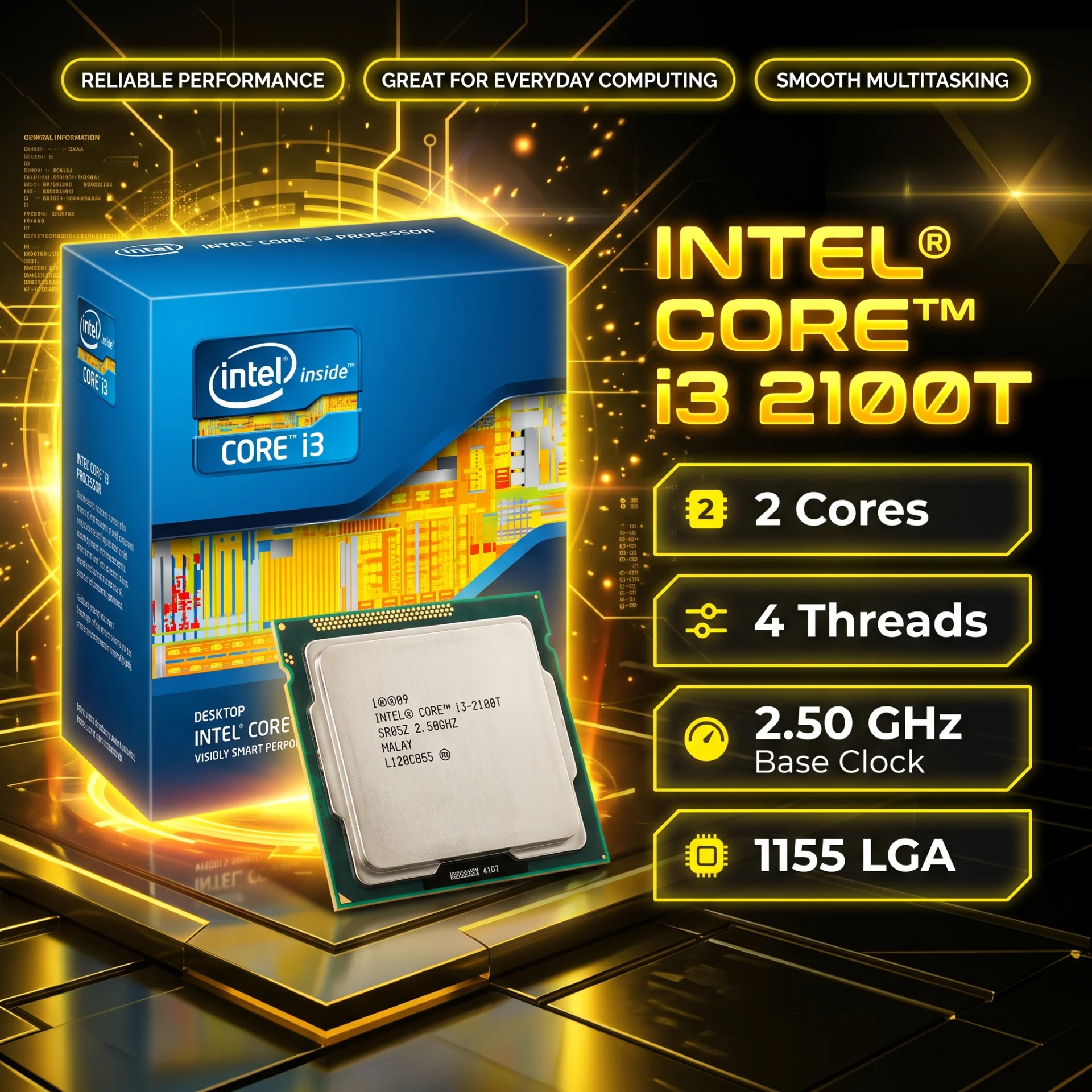
- 2 Cores and 4 Threads with Hyper-Threading
- 2.50 GHz Base Frequency
- 3 MB Intel Smart Cache
- 35W Low TDP for energy-efficient setups
*Approximate regional retail guide prices. Pixahunt is an informational catalog.
CPU Benchmark Scores & Performance Analysis
TESTEDCinebench R23, Geekbench 6, PassMark CPU Mark scores & real-world gaming/office suitability tests.
Technical Specifications
Comprehensive hardware architecture and specifications
General
| Series | Core i3 |
| Model | i3-2100T |
| Cpu Cooler | Not Included |
| Code-Name | Sandy Bridge |
| Generation | 2nd Gen |
| Sockets Supported | FCLGA1155 |
Performance
| Base Frequency | 2.50 GHz |
| Turbo Frequency Max. | N/A |
| Core | 2 |
| Threads | 4 |
| CPU Cache | 3 MB |
| L1 Cache | 64 KB per core |
| L2 Cache | 256 KB per core |
| L3 Cache | 3 MB shared |
| TDP | 35 W |
| Lithography | 32 nm |
| Multiplier | 25.0x |
| Multiplier Unlocked | No |
| Processor Type | Core i3 |
Memory Support
| Memory Max. | 32 GB |
| Memory Type | DDR3 1066/1333 |
| Memory Speed | 1333 MT/s |
| Memory Channel | 2 |
| Max Memory Bandwidth | 21 GB/s |
| ECC Memory Supported | No |
Graphics
| Built-in GPU | Yes |
| Processor Graphics | Intel HD Graphics 2000 |
| Graphics Base Frequency | 650 MHz |
| Graphics Dynamic Frequency | 1.10 GHz |
| Graphics Core Count | N/A |
| Max Video Memory | N/A |
| Max Resolution | N/A |
Technical Info
| DirectX Support | N/A |
| OpenGL Support | N/A |
| Approx. Power Consumption | 35 W |
| Compatible Products / Chipsets | Intel Z77, Z75, Q77, H77, Q75, B75, Z68, P67, H67, Q67, B65, H61 |
| PCI Express Version | 2.0 |
| PCI Express Lanes | 16 |
| Thermal Solution (MPK / Box) | N/A |
| Max. Operating Temperature (Tjmax) | 65.0°C |
Warranty
| Manufacturing Warranty | N/A |
Additional Info
| Specialty | Intel Hyper-Threading Technology, Intel Virtualization Technology (VT-x) |
| Others | Discontinued Product |
| Country Of Origin | N/A |
| Made in/ Assemble | N/A |
Editorial Overview & Review
In-depth insights, architecture summary, and performance evaluation
Introduction & Overview
In the vast timeline of consumer computing, certain processors leave an indelible mark by defining a sweet spot for efficiency and reliability. Enter the Intel Core i3-2100T, a proud representative of Intel's legendary 2nd Generation "Sandy Bridge" microarchitecture. Launched as a low-power variant of the ubiquitous desktop dual-core lineup, the i3-2100T was engineered from the ground up for a very specific market segment: energy-conscious desktop users, small-form-factor (SFF) enthusiasts, and those building always-on systems like home servers or media PCs.
Positioned below its higher-wattage sibling, the standard i3-2100, this processor traded a modest amount of clock speed for a dramatic reduction in thermal design power (TDP). While the computing landscape has evolved leaps and bounds since its debut, examining the i3-2100T offers a fascinating look at how purposeful engineering can yield a remarkably durable and functional computing experience.
Architecture, Performance & Key Technologies
At the heart of the Intel Core i3-2100T is the 32nm Sandy Bridge lithography, a manufacturing node that revolutionized the desktop CPU market with its monolithic design combining CPU cores and graphics on a single die. The chip operates at a fixed base frequency of 2.50 GHz (lacking turbo frequency capabilities, as denoted by the "T" suffix) and features 2 physical cores and 4 threads thanks to the inclusion of Intel Hyper-Threading Technology.
- Cache Architecture: Equipped with 64 KB of L1 cache per core, 256 KB of L2 cache per core, and a generous 3 MB of shared L3 cache to keep data pipelines flowing smoothly.
- Power Efficiency: The crown jewel of the "T" series is its ultra-low 35 W TDP, making it remarkably easy to cool and a favorite for passive or ultra-quiet setups.
- Integrated Graphics: It features Intel HD Graphics 2000, operating at a base frequency of 650 MHz with a dynamic frequency scaling up to 1.10 GHz, capable of handling basic display outputs and hardware-accelerated media playback.
- Platform Compatibility: Built for the FCLGA1155 socket, it enjoys broad motherboard compatibility spanning 6-series and 7-series chipsets (such as H61, H67, Z68, and B75), offering plenty of affordable legacy board options on the secondary market.
Furthermore, memory support encompasses dual-channel DDR3 running at speeds up to 1333 MT/s, delivering a maximum memory bandwidth of 21 GB/s across up to 32 GB of system RAM.
Real-World Use Cases
While modern gaming rigs demand upwards of eight or sixteen cores, the Core i3-2100T shines brilliantly in its designated lanes. Thanks to the quad-thread capability via Hyper-Threading, everyday productivity tasks—such as web browsing with multiple tabs, office document processing, and running lightweight applications—are handled with crisp responsiveness.
In the realm of home entertainment and home labs (such as running a Plex media server or a lightweight Network Attached Storage solution), this processor punches well above its weight class. Its 35-watt footprint means electricity bills won't spike from leaving the system running 24/7. While it is certainly not built for modern AAA gaming or heavy video rendering, older games, retro emulation, and basic 1080p video streaming are well within its operational comfort zone.
Strengths & Potential Considerations
As with any hardware review, looking at the pros and cons helps put the product into perspective, especially given its status as a discontinued, legacy component.
- Strengths (Pros):
- Exceptional energy efficiency with a minimal 35 W TDP.
- Runs remarkably cool, allowing for silent or low-profile cooling solutions.
- Supports Intel Virtualization Technology (VT-x) for basic hypervisor and virtual machine tasks.
- Inexpensive and widely available on the used market.
- Considerations (Cons):
- Discontinued product with no active manufacturer warranty or support.
- Lacks Turbo Boost technology, locking the processor at its baseline 2.50 GHz.
- PCI Express is limited to version 2.0.
- Incapable of handling modern, resource-heavy gaming or intensive content creation workloads.
Final Buying Verdict
The Intel Core i3-2100T is a nostalgic yet remarkably functional piece of silicon. It represents an era when Intel was refining IPC (instructions per cycle) efficiency and bringing robust multi-threading to mainstream budgets. For the average consumer looking for a high-performance modern gaming machine, this processor has long since passed its prime.
However, if you are a DIY enthusiast looking to build an ultra-budget retro gaming rig, a low-power home server, a quiet office workstation, or an experimental lab machine using spare LGA1155 parts, the i3-2100T remains a charmingly capable and remarkably green little workhorse. It delivers just enough computational muscle while keeping power consumption down to an absolute minimum.
OUR RATING CONSENSUS
The overall rating is based on review by our experts & industry benchmark suites
Quick Snapshot
- Overall Rating
- 4.8 / 10
- Brand
- Intel
- Category
- Processor
- Catalog Model
- i3-2100T
- Status
- Published
- Release Date
- Oct 10, 2026
Pixahunt Tech Community
Connect with hardware enthusiasts, compare benchmarks, and explore real user setups.
Explore Full Newsfeed →Related Gadgets
- 3.20 GHz Dual-Core Clock Speed for Reliable Everyday Computing
- Intel Hyper-Threading Technology Enabling 4 Parallel Threads
- Built-in Intel HD Graphics for Integrated Display Support
- 2 cores and 4 threads with Intel Hyper-Threading Technology
- 3.10 GHz base processor frequency
- 3 MB Intel Smart Cache
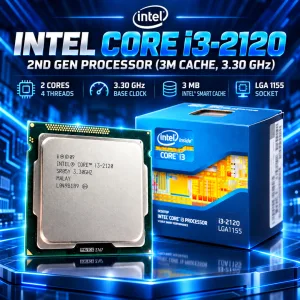
- 2 Cores and 4 Threads with Intel Hyper-Threading Technology
- 3.30 GHz Base Clock Frequency with 3 MB Intel Smart Cache
- Includes Intel HD Graphics 2000 integrated graphics
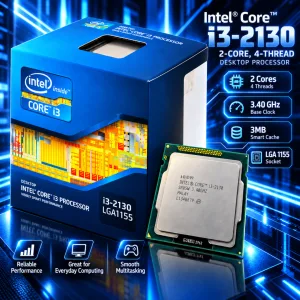
- 2 cores and 4 threads with Intel Hyper-Threading Technology
- 3.40 GHz processor base frequency with 3 MB Intel Smart Cache
- Integrated Intel HD Graphics 2000