

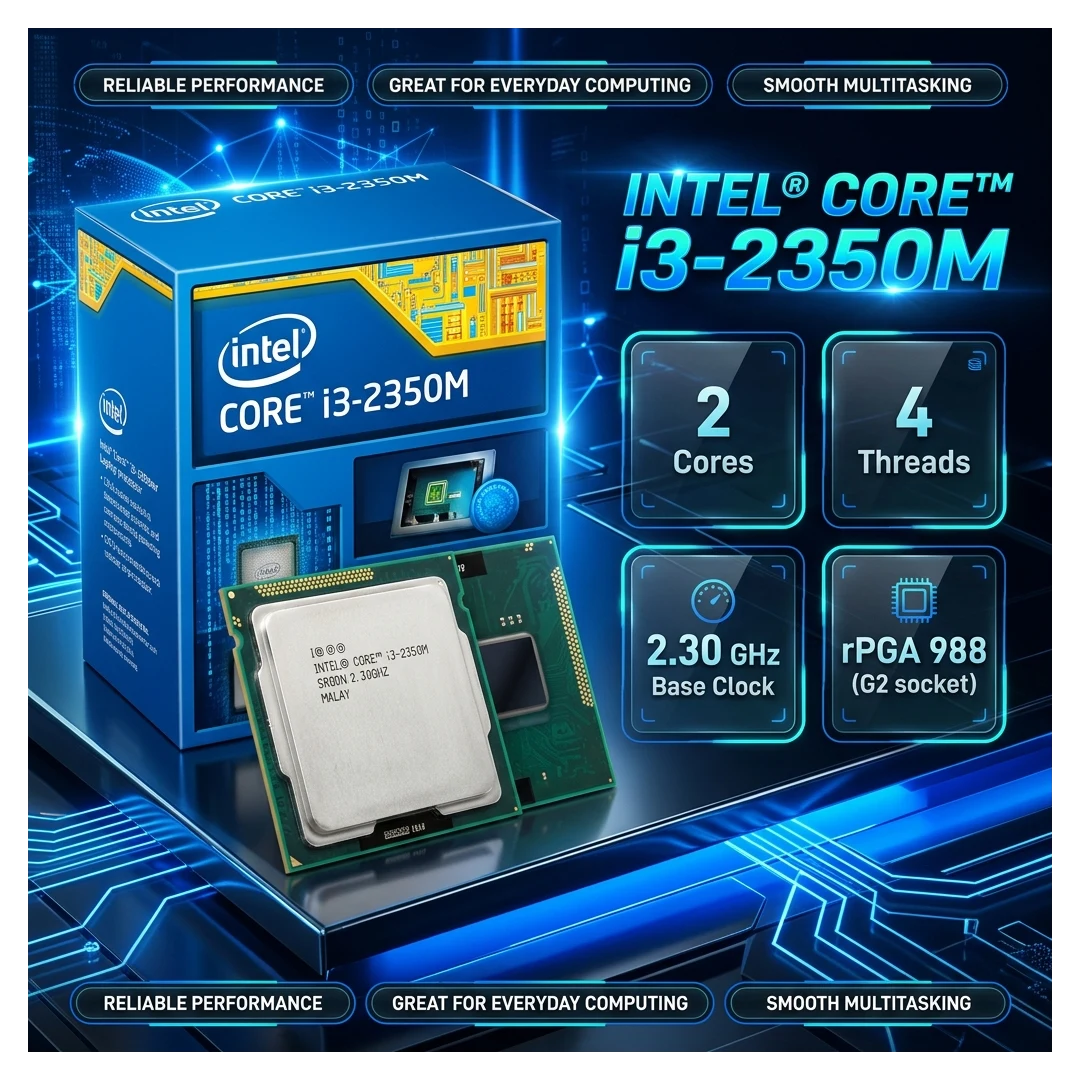
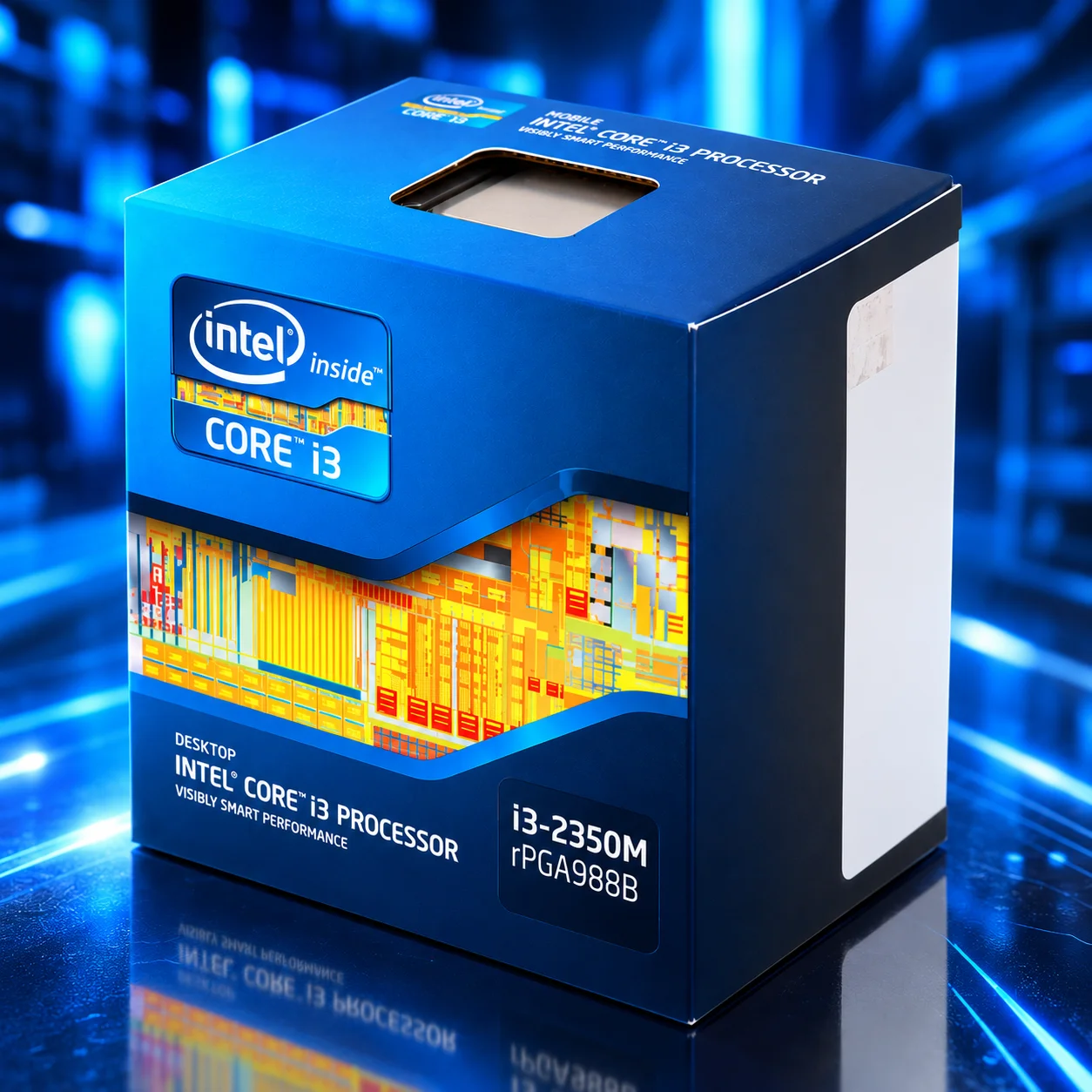
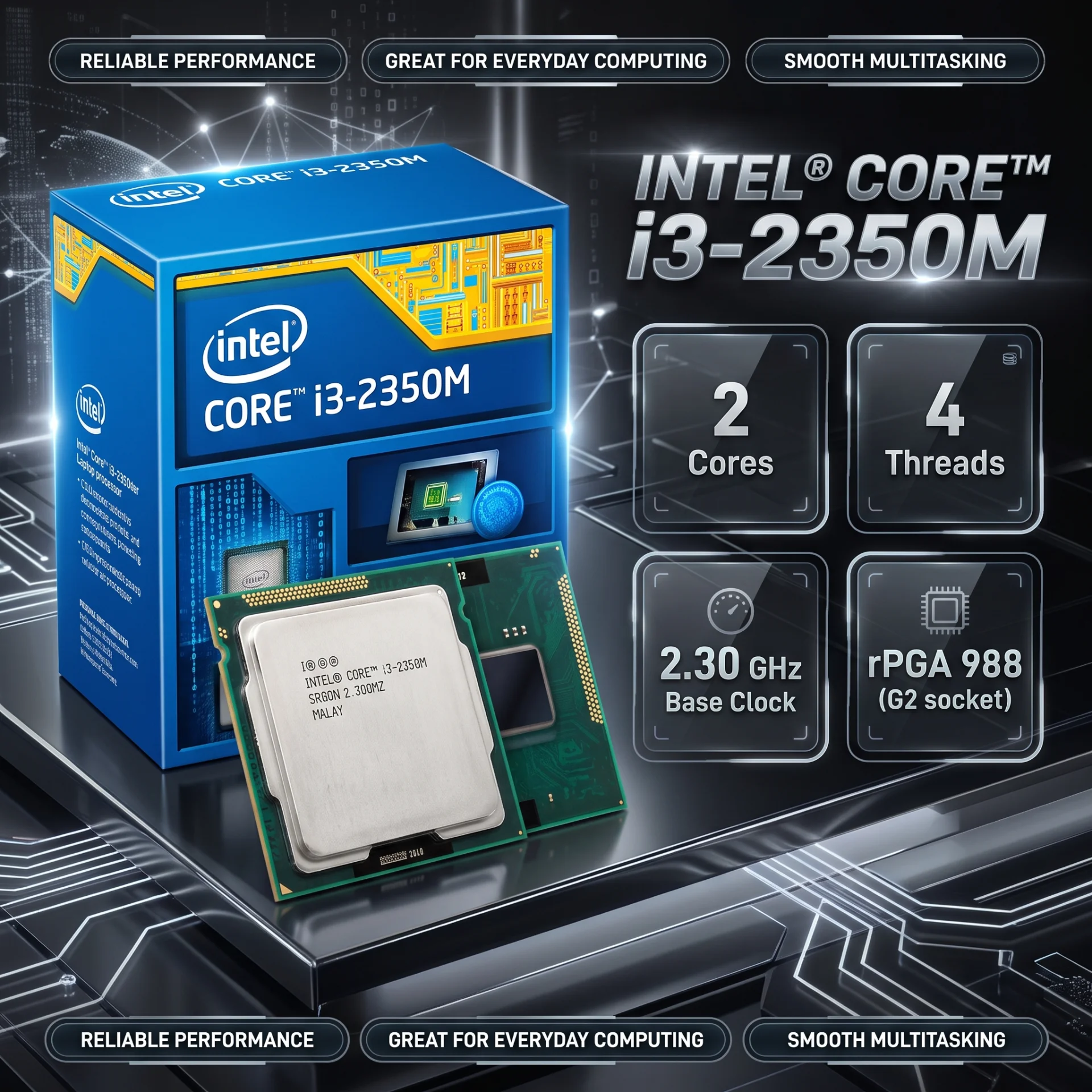
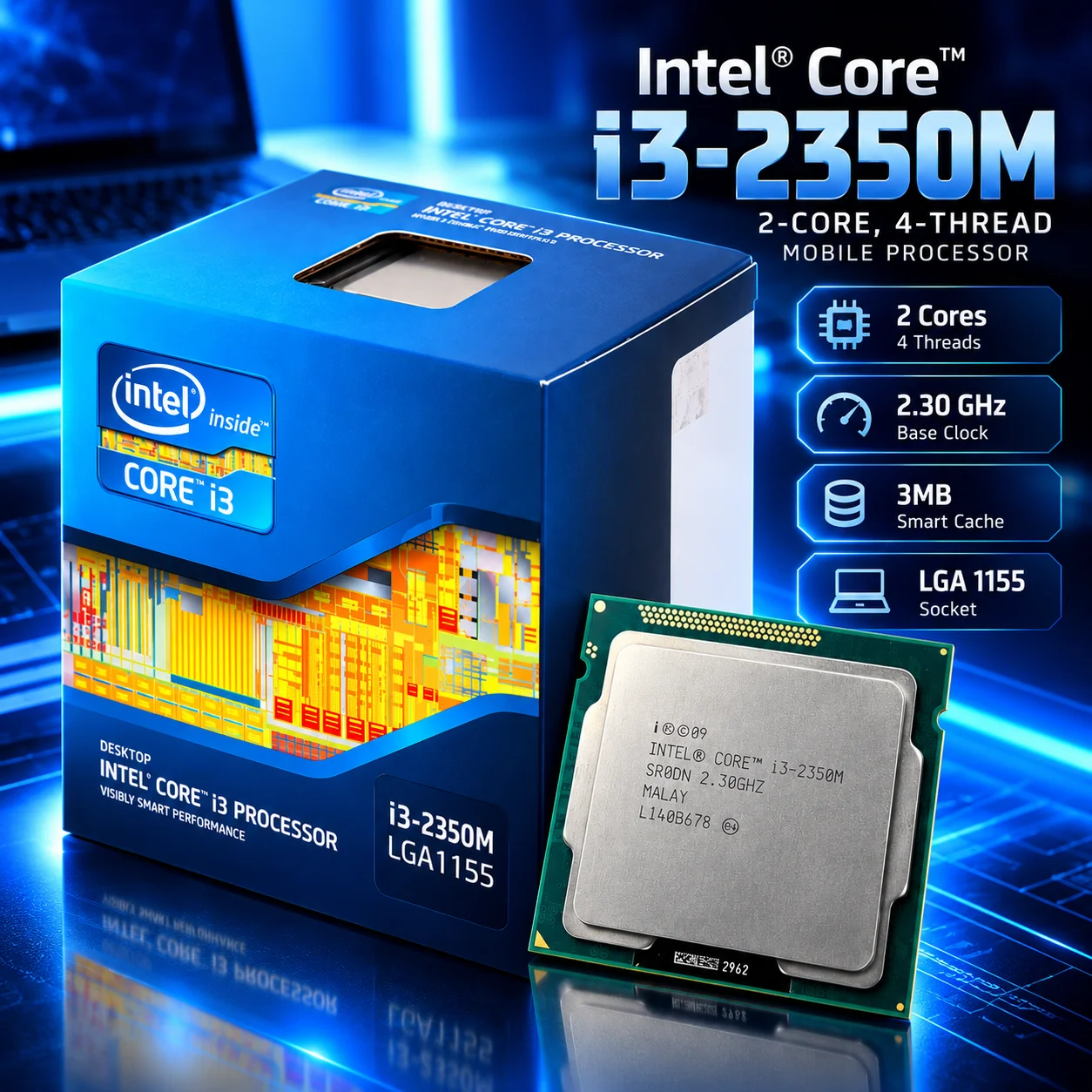
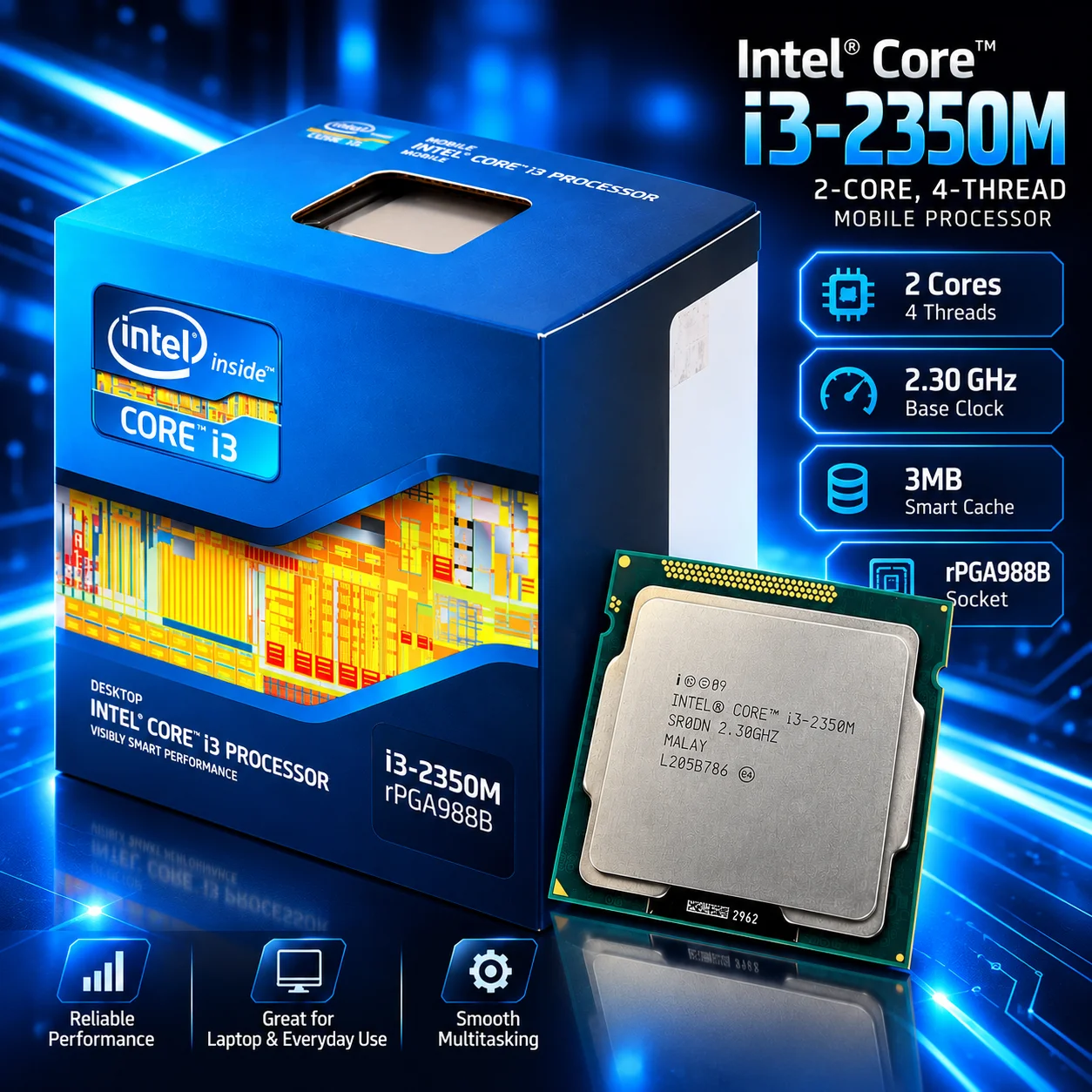
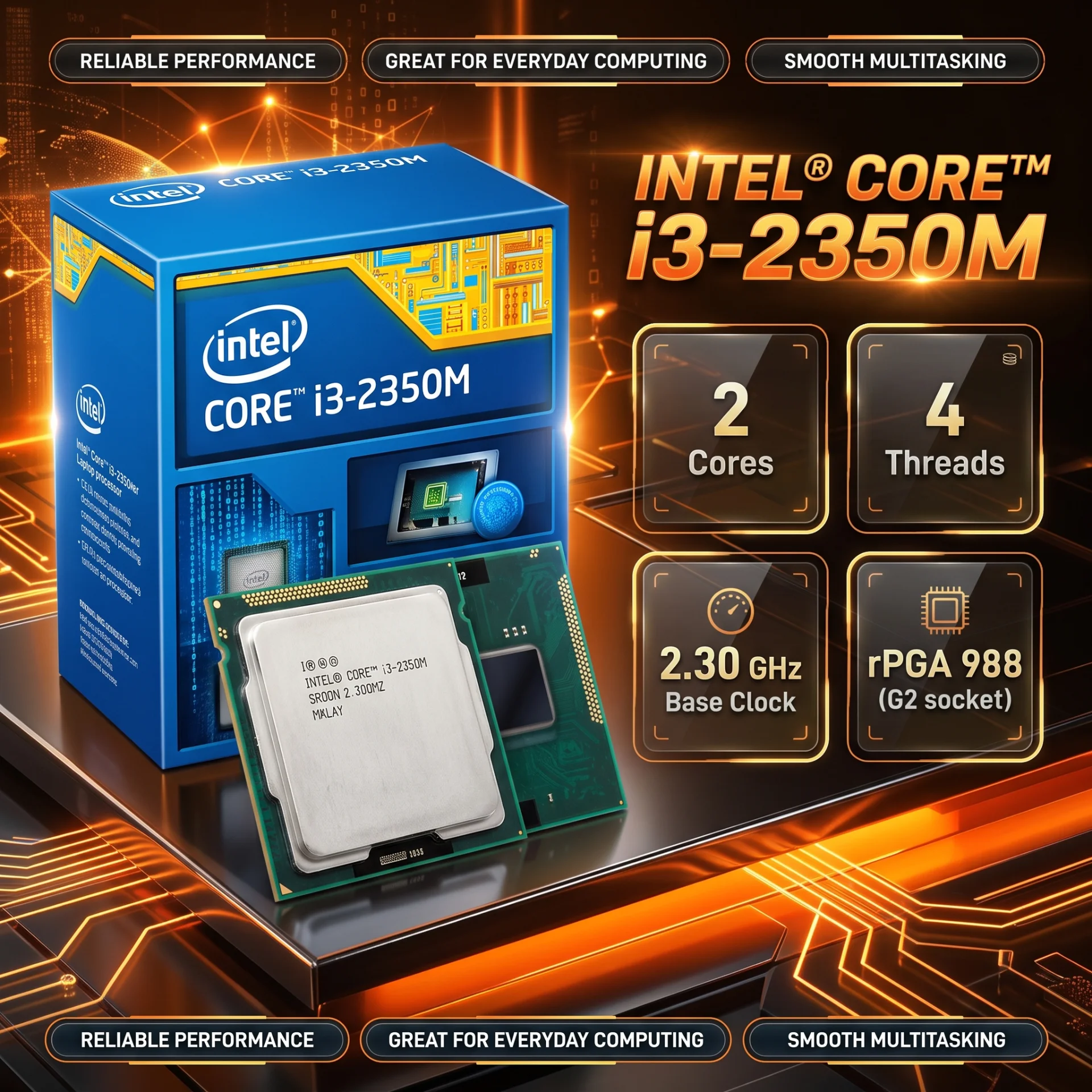
Intel Core i3-2350M 2.30 GHz Dual-Core Mobile Processor
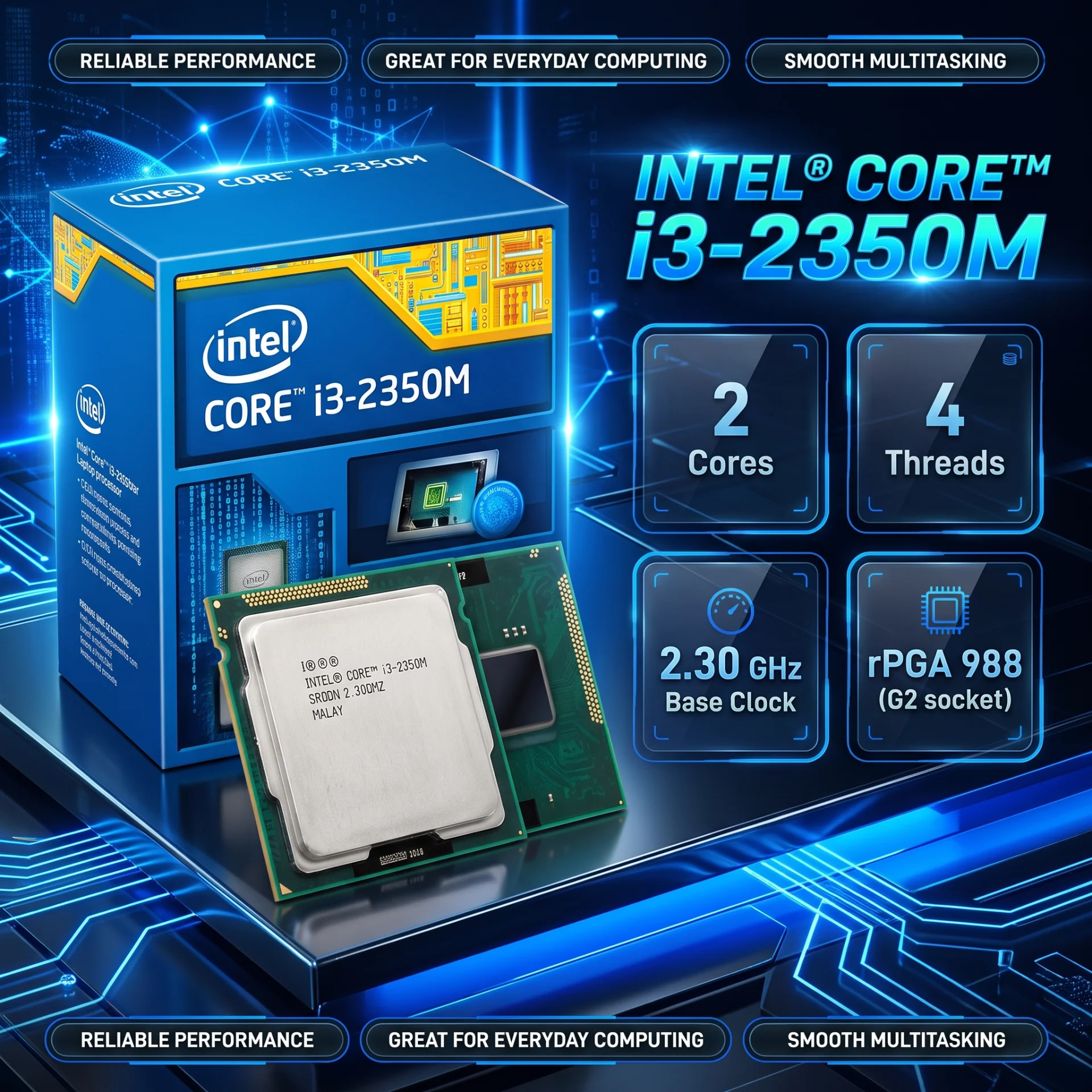
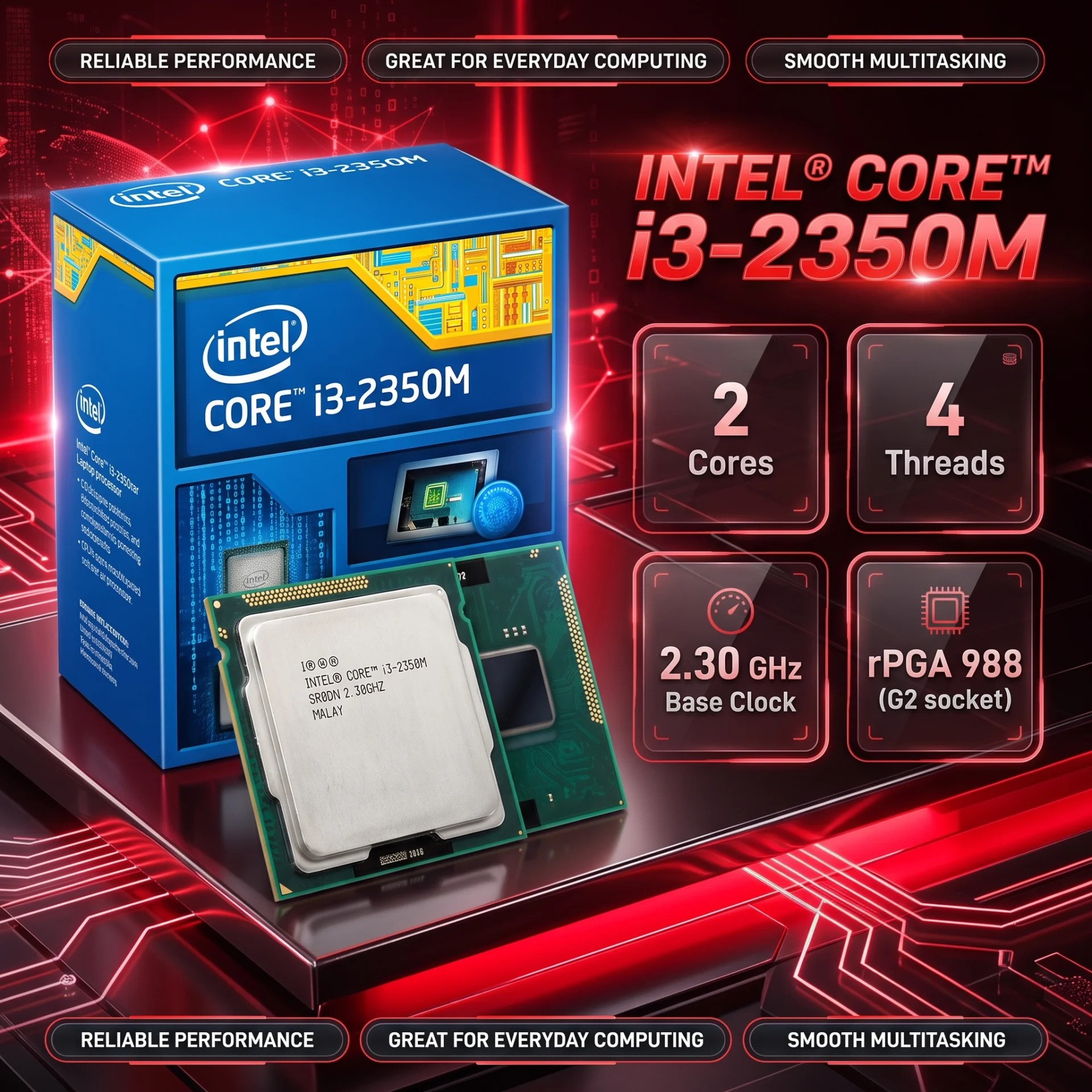
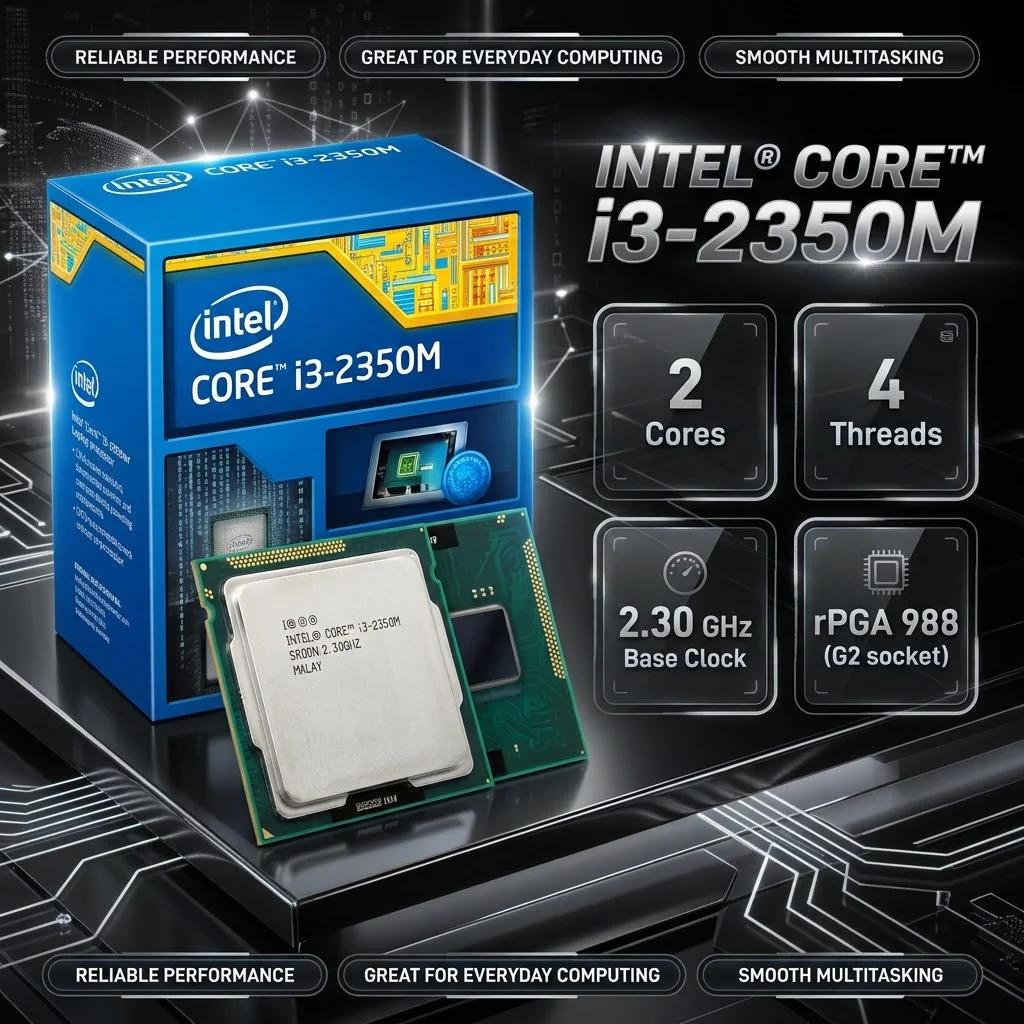
- 2 Cores and 4 Threads with Intel Hyper-Threading Technology
- 2.30 GHz Base Frequency with 3 MB L3 Cache
- Integrated Intel HD Graphics 3000
- 35W Thermal Design Power (TDP) optimized for mobile devices
*Approximate regional retail guide prices. Pixahunt is an informational catalog.
CPU Benchmark Scores & Performance Analysis
TESTEDCinebench R23, Geekbench 6, PassMark CPU Mark scores & real-world gaming/office suitability tests.
Technical Specifications
Comprehensive hardware architecture and specifications
General
| Series | Core i3 |
| Model | i3-2350M |
| Cpu Cooler | Not Included |
| Code-Name | Sandy Bridge |
| Generation | 2nd Gen |
| Sockets Supported | FCBGA1023, PPGA988 |
Performance
| Base Frequency | 2.30 GHz |
| Turbo Frequency Max. | N/A |
| Core | 2 |
| Threads | 4 |
| CPU Cache | 3 MB Intel Smart Cache |
| L1 Cache | 64 KB (per core) |
| L2 Cache | 256 KB (per core) |
| L3 Cache | 3 MB |
| TDP | 35W |
| Lithography | 32 nm |
| Multiplier | 23.0x |
| Multiplier Unlocked | No |
| Processor Type | Core i3 |
Memory Support
| Memory Max. | 16 GB |
| Memory Type | DDR3 1066/1333 |
| Memory Speed | Up to 1333 MT/s |
| Memory Channel | 2 |
| Max Memory Bandwidth | 21.3 GB/s |
| ECC Memory Supported | No |
Graphics
| Built-in GPU | Yes |
| Processor Graphics | Intel HD Graphics 3000 |
| Graphics Base Frequency | 650 MHz |
| Graphics Dynamic Frequency | 1.15 GHz |
| Graphics Core Count | N/A |
| Max Video Memory | Shared |
| Max Resolution | eDP/DP/HDMI/SDVO/CRT |
Technical Info
| DirectX Support | 10.1 |
| OpenGL Support | 3.1 |
| Approx. Power Consumption | 35W |
| Compatible Products / Chipsets | Intel Mobile Chipset series |
| PCI Express Version | 2.0 |
| PCI Express Lanes | 16 |
| Thermal Solution (MPK / Box) | Not Included |
| Max. Operating Temperature (Tjmax) | 85C (PGA); 100C (BGA) |
Warranty
| Manufacturing Warranty | Discontinued / OEM Product (No active standard warranty) |
Additional Info
| Specialty | Intel Hyper-Threading Technology, Intel Virtualization Technology (VT-x) |
| Others | 64-bit Instruction Set, Intel AVX |
| Country Of Origin | USA |
| Made in/ Assemble | China / Malaysia |
Editorial Overview & Review
In-depth insights, architecture summary, and performance evaluation
Introduction & Overview: The Workhorse of an Era
When looking back at the hardware that shaped modern mobile computing, few architectures hold as much nostalgic and practical significance as Intel's 2nd Generation Core processors. Codenamed Sandy Bridge, this generation brought monumental leaps in efficiency and integrated graphics performance. Sitting squarely in the accessible performance tier is the Intel Core i3-2350M, a mobile dual-core processor launched to dominate the mainstream notebook and laptop market.
Positioned as a cost-effective, highly reliable solution for everyday users, students, and office professionals, the i3-2350M was engineered to deliver snappy multitasking without draining the battery or requiring complex cooling solutions. Built on a 32nm lithography and featuring a standard 35W Thermal Design Power (TDP), it became a staple in countless mid-range laptops, offering a sweet spot between price, power consumption, and day-to-day responsiveness.
Architecture, Performance & Key Technologies
At its core, the i3-2350M is built upon the robust Sandy Bridge microarchitecture. It features 2 physical cores and leverages Intel Hyper-Threading Technology to expose 4 logical threads to the operating system, allowing for smoother handling of concurrent background tasks. Operating at a fixed base frequency of 2.30 GHz (lacking Turbo Boost technology, which is reserved for its Core i5 and i7 siblings), it relies on a steady, predictable clock speed combined with 3 MB of Intel Smart Cache to manage workloads.
Despite lacking a dynamic turbo frequency, the processor manages its power envelope exceptionally well within its 35W TDP. Memory handling is robust for its class, supporting up to 16 GB of DDR3 memory across dual channels at speeds up to 1333 MT/s, yielding a maximum memory bandwidth of 21.3 GB/s. On the graphics front, the chip integrates Intel HD Graphics 3000, featuring a base frequency of 650 MHz that dynamically scales up to 1.15 GHz. While it doesn't support DirectX 11 (maxing out at DirectX 10.1 and OpenGL 3.1), it provides reliable hardware acceleration for operating systems, video playback, and basic display output across eDP, DP, HDMI, and CRT.
Furthermore, the i3-2350M includes enterprise-friendly and enthusiast features such as Intel Virtualization Technology (VT-x) and Intel AVX (Advanced Vector Extensions) instruction support, enhancing floating-point calculations and data-parallel applications.
Real-World Use Cases: Where Does It Shine?
How does a classic 2nd Gen Core i3 hold up in practice? In environments dominated by daily productivity—such as word processing, managing heavy email chains, web browsing with dozens of open tabs, and streaming 1080p video—the i3-2350M performs admirably. Thanks to Hyper-Threading, switching between applications feels fluid, and background updates rarely bottleneck the foreground experience.
When it comes to content creation and gaming, expectations need to be managed. Heavy 4K video editing, 3D rendering, and modern AAA gaming are well beyond the design scope of this processor and its integrated HD 3000 graphics. However, it handles light legacy gaming (such as titles from the early 2010s like Minecraft, League of Legends on lower settings, or Counter-Strike: Source), casual photo editing, and standard spreadsheet crunching without breaking a sweat.
Strengths & Potential Considerations
- Pros:
- Reliable multi-threaded performance via Intel Hyper-Threading (4 threads).
- Efficient 35W thermal profile ideal for standard laptop cooling designs.
- Solid memory subsystem supporting up to 16GB of dual-channel DDR3.
- Includes virtualization support (VT-x) and AVX instructions for enhanced compatibility.
- Integrated Intel HD 3000 graphics handle basic display and media decoding tasks smoothly.
- Cons:
- No Turbo Frequency support; maximum clock is locked at 2.30 GHz.
- Graphics limited to DirectX 10.1 and OpenGL 3.1, restricting modern API support.
- Socketed/BGA architecture means it is largely non-upgradable in modern contexts.
- Now classified as a discontinued/legacy product with no active retail warranty.
Final Buying Verdict
The Intel Core i3-2350M is a testament to durable silicon engineering. While it has long since passed its prime as a modern gaming or high-performance workstation CPU, it remains a fantastic budget-friendly option for reviving older laptop hardware, setting up a secondary Linux test machine, or handling basic, distraction-free office work and web browsing. If you encounter a machine powered by this Sandy Bridge processor at a rock-bottom price, it offers surprisingly capable baseline performance for fundamental computing tasks.
OUR RATING CONSENSUS
The overall rating is based on review by our experts & industry benchmark suites
Quick Snapshot
- Overall Rating
- 4.3 / 10
- Brand
- Intel
- Category
- Processor
- Catalog Model
- i3-2350M
- Status
- Published
- Release Date
- Oct 10, 2026
Pixahunt Tech Community
Connect with hardware enthusiasts, compare benchmarks, and explore real user setups.
Explore Full Newsfeed →Related Gadgets
- 3.20 GHz Dual-Core Clock Speed for Reliable Everyday Computing
- Intel Hyper-Threading Technology Enabling 4 Parallel Threads
- Built-in Intel HD Graphics for Integrated Display Support
- 2 cores and 4 threads with Intel Hyper-Threading Technology
- 3.10 GHz base processor frequency
- 3 MB Intel Smart Cache
- 2 Cores and 4 Threads with Intel Hyper-Threading Technology
- 3.30 GHz Base Clock Frequency with 3 MB Intel Smart Cache
- Includes Intel HD Graphics 2000 integrated graphics
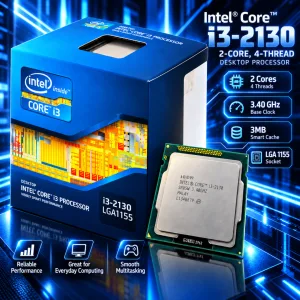
- 2 cores and 4 threads with Intel Hyper-Threading Technology
- 3.40 GHz processor base frequency with 3 MB Intel Smart Cache
- Integrated Intel HD Graphics 2000