

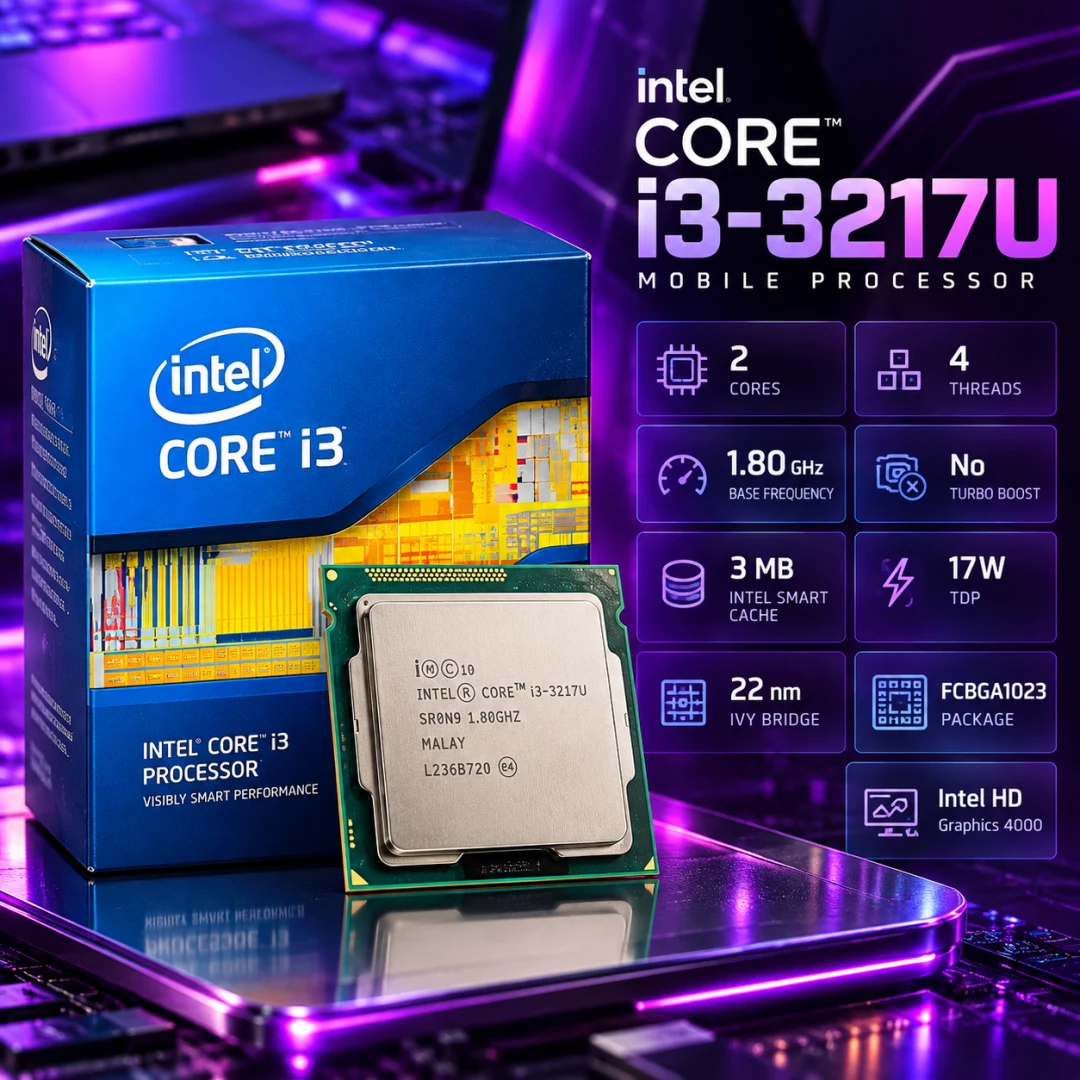
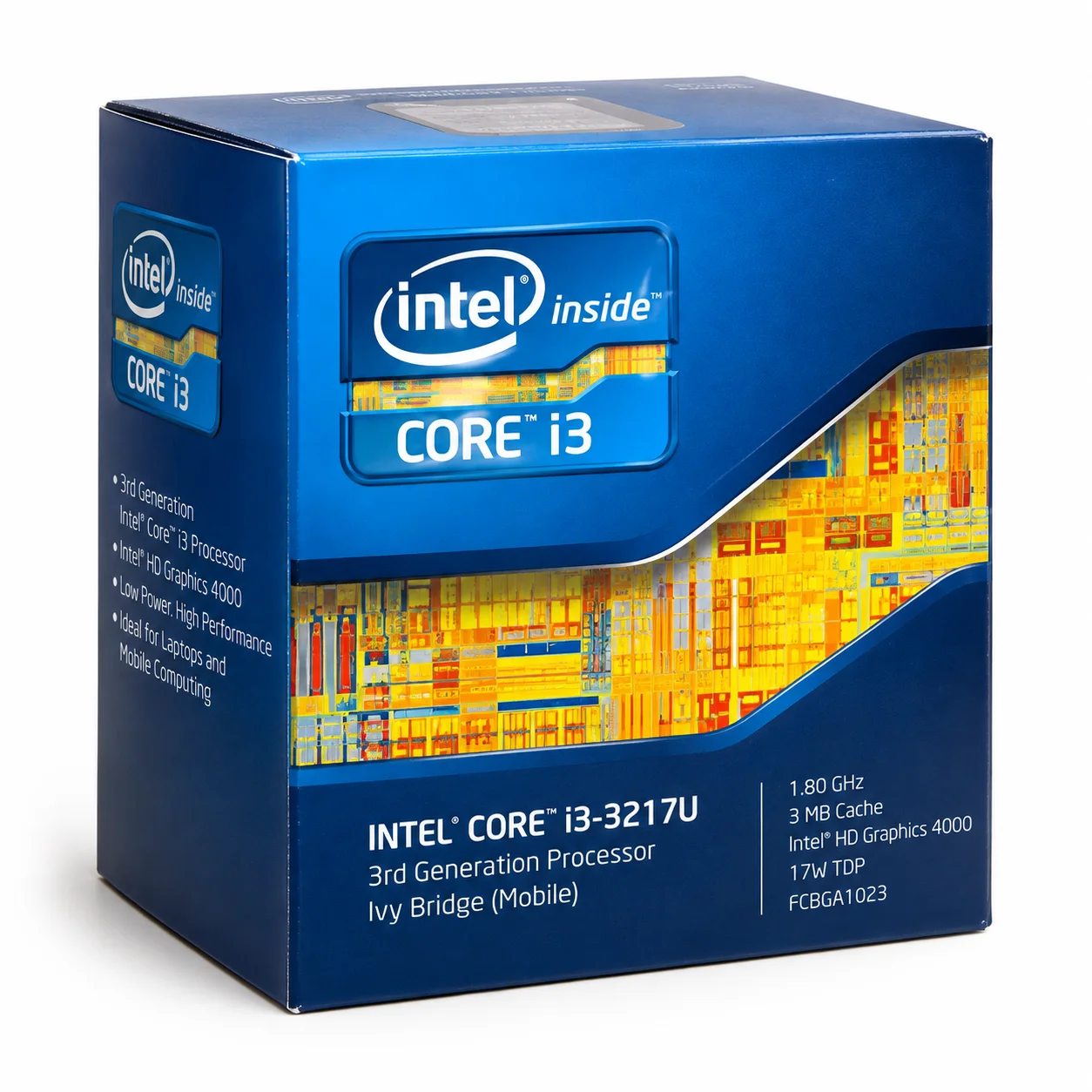
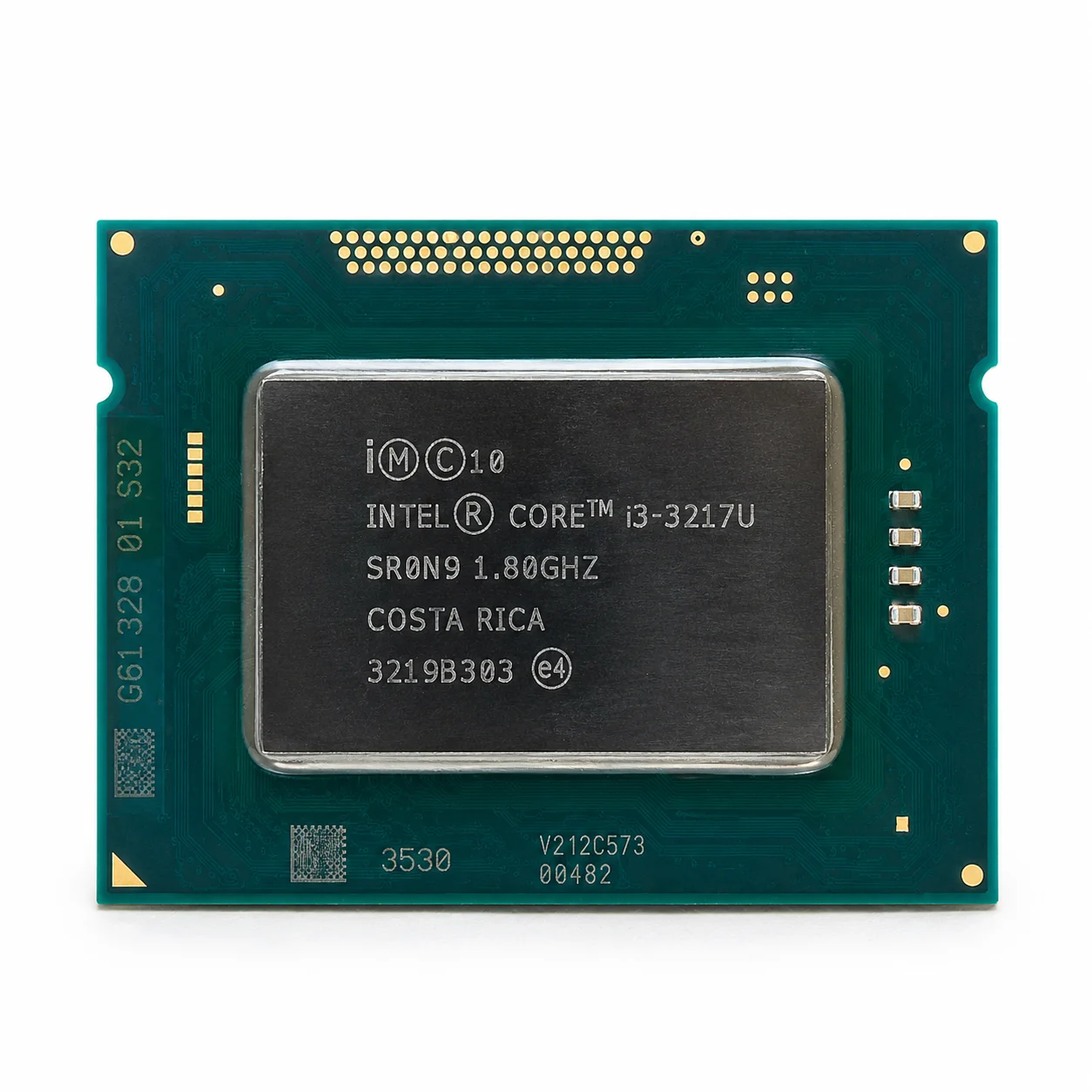
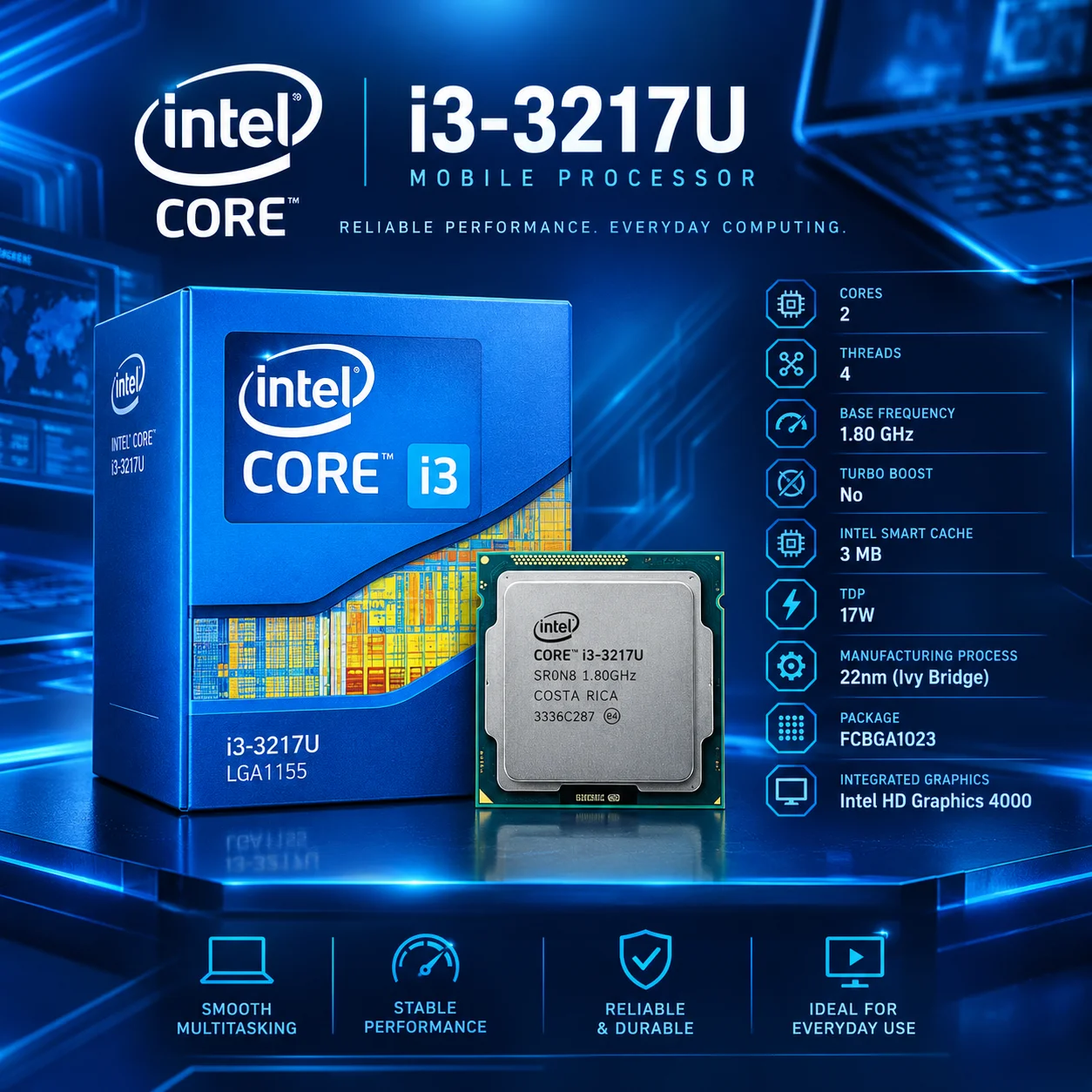
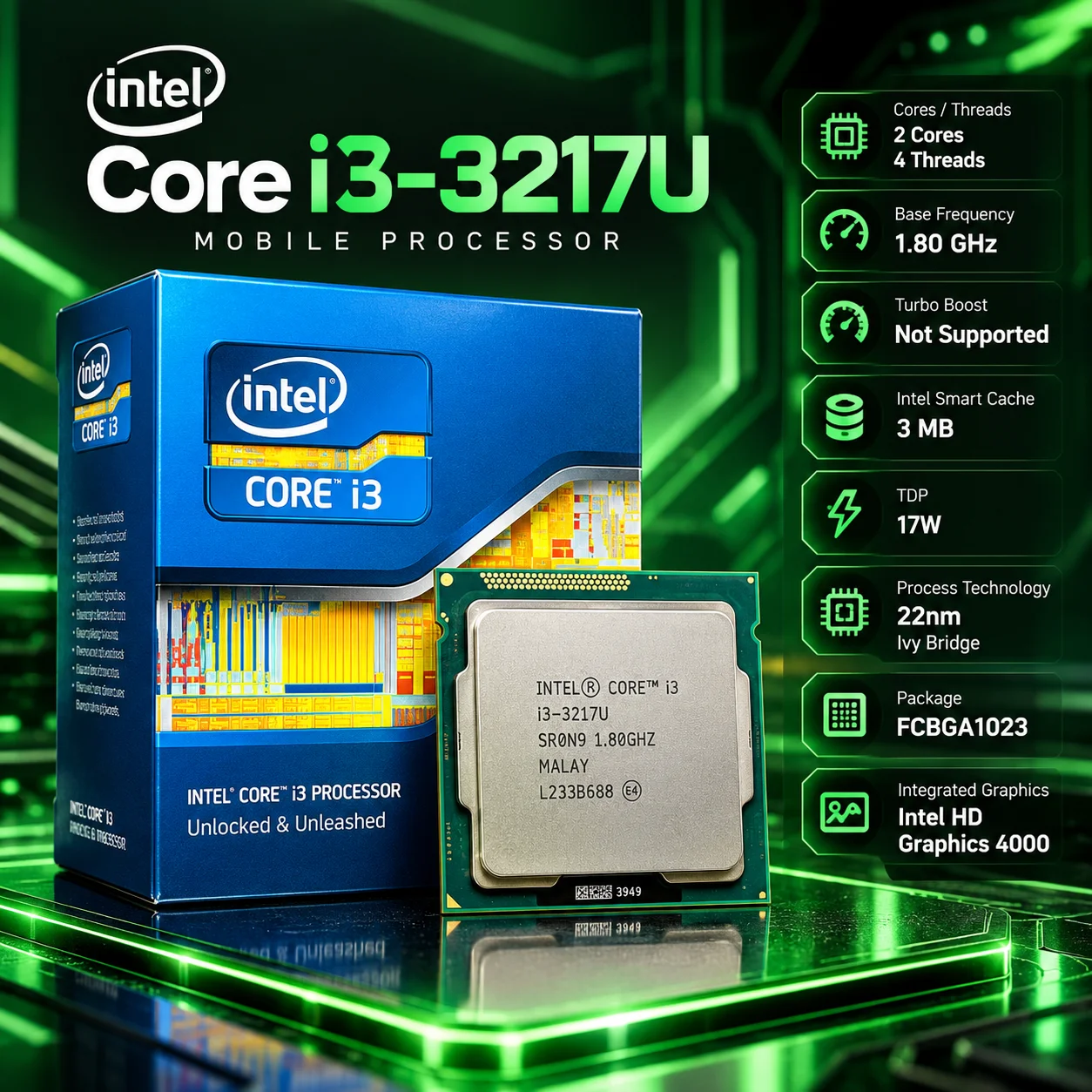
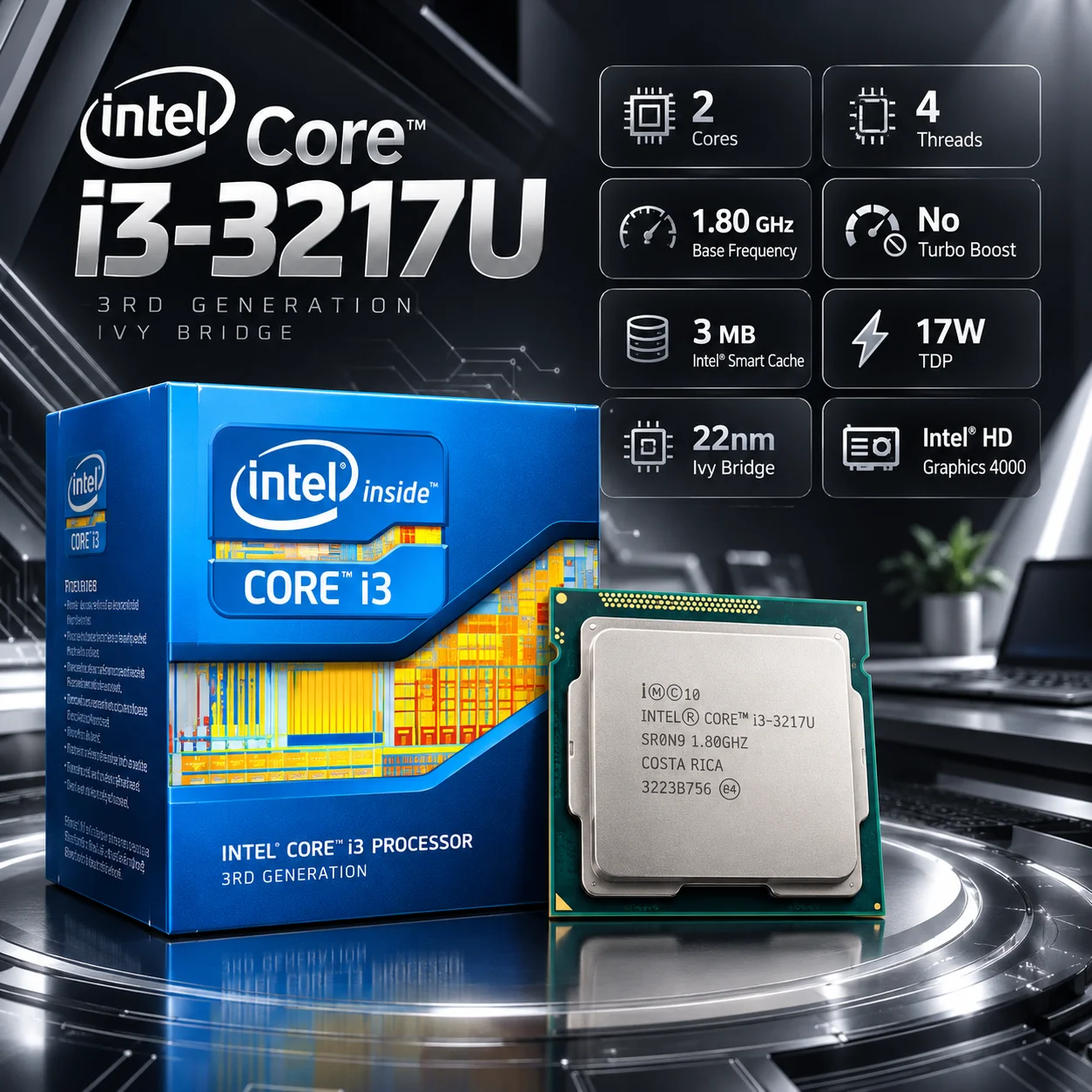
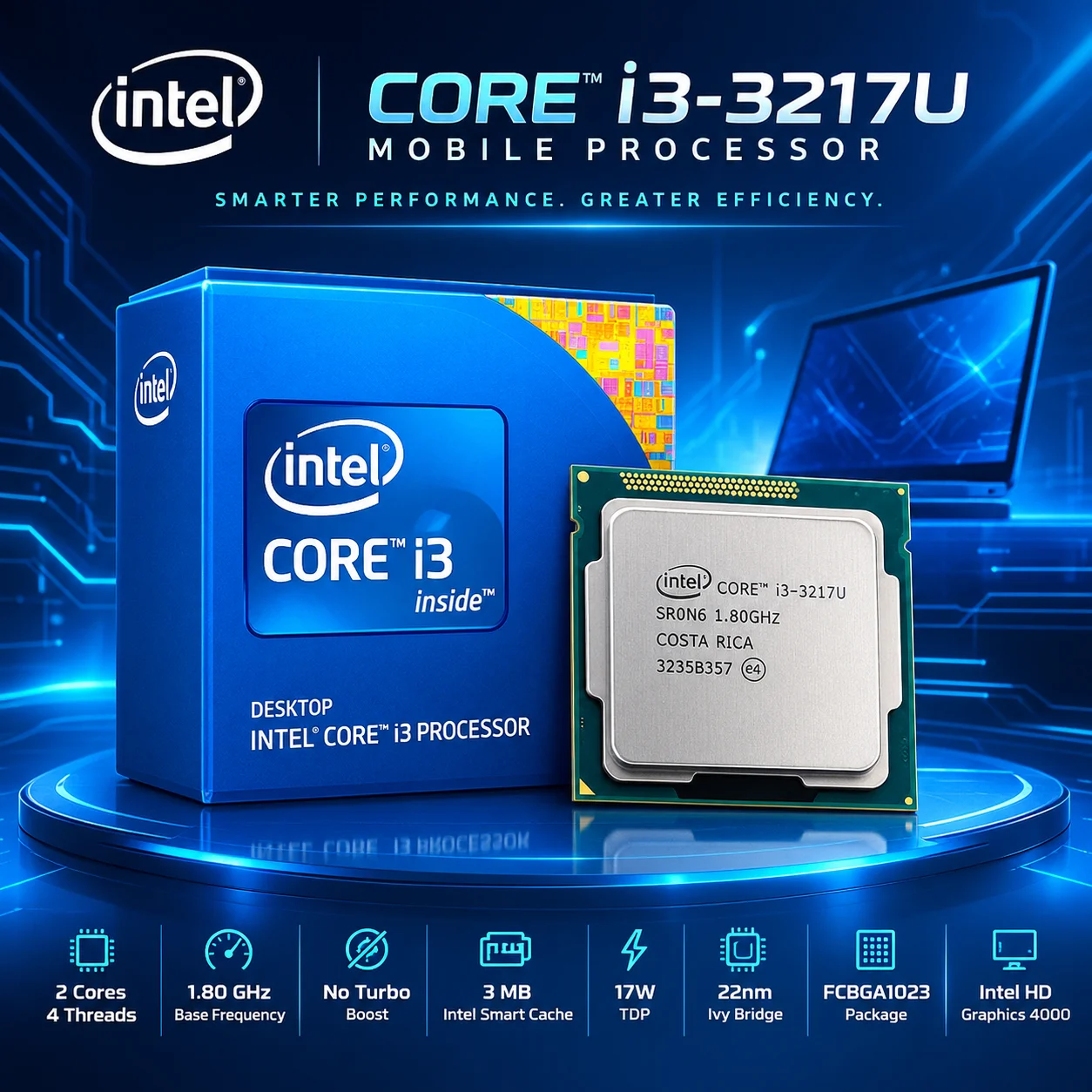
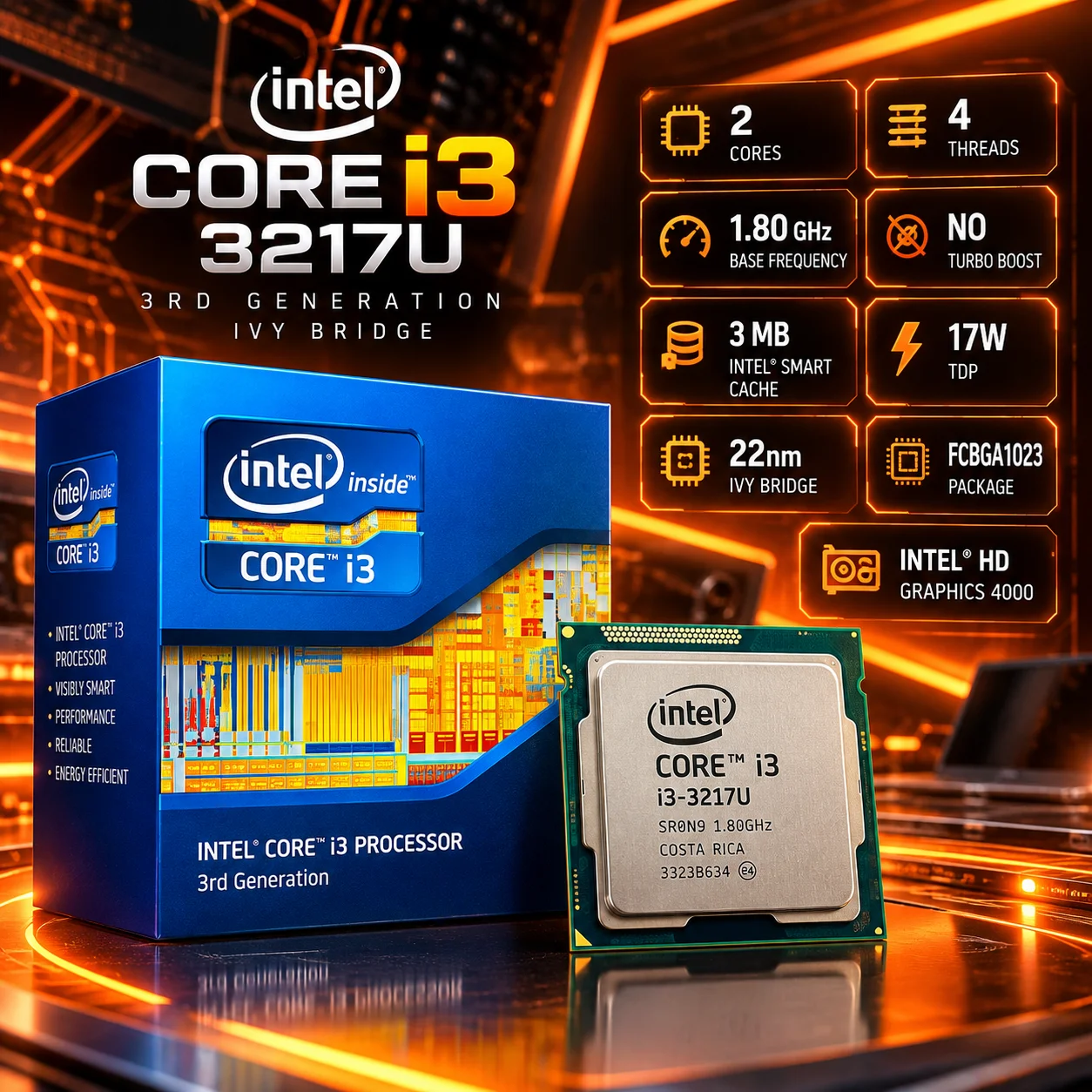
Intel Core i3-3217U Mobile Processor 3M Cache, 1.80 GHz
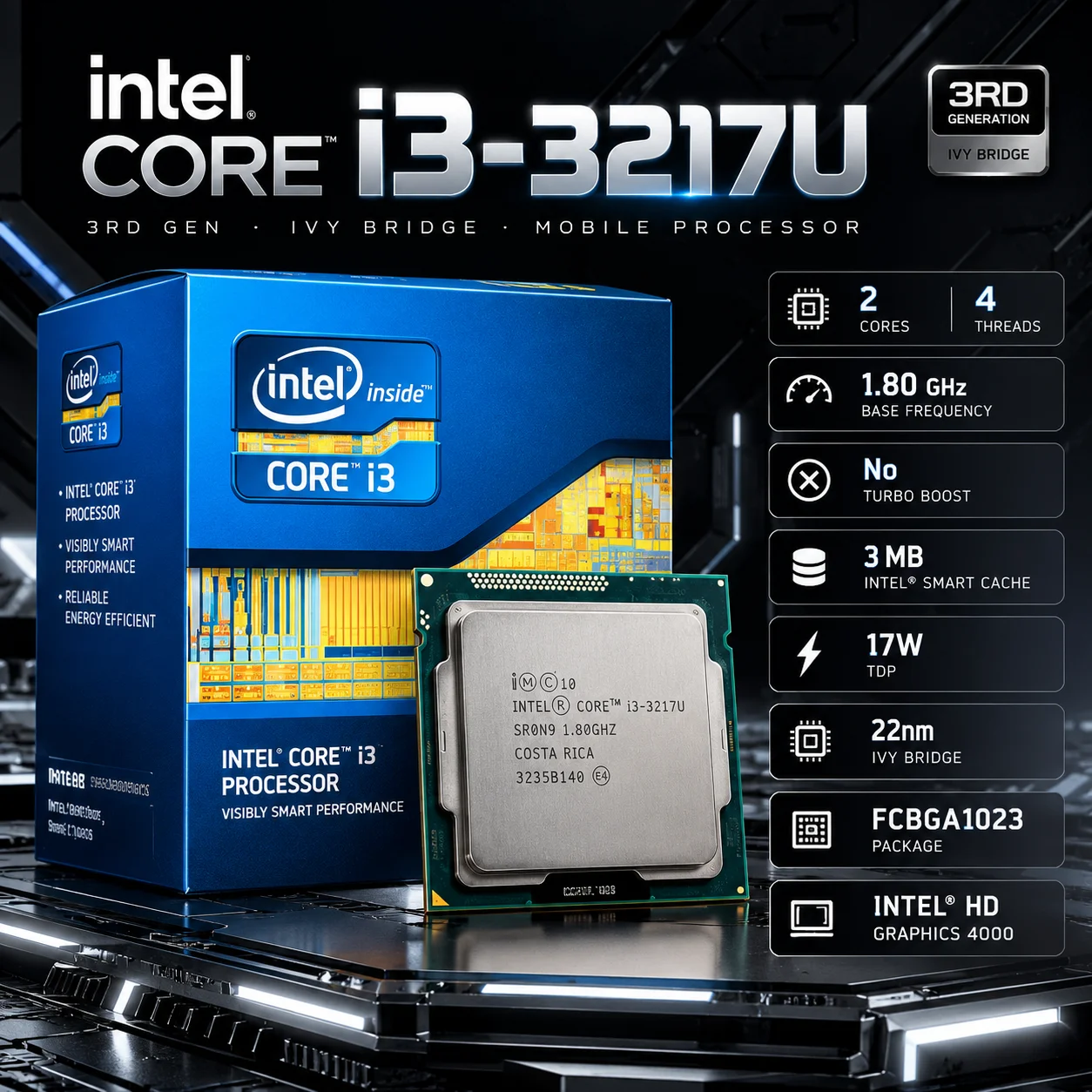
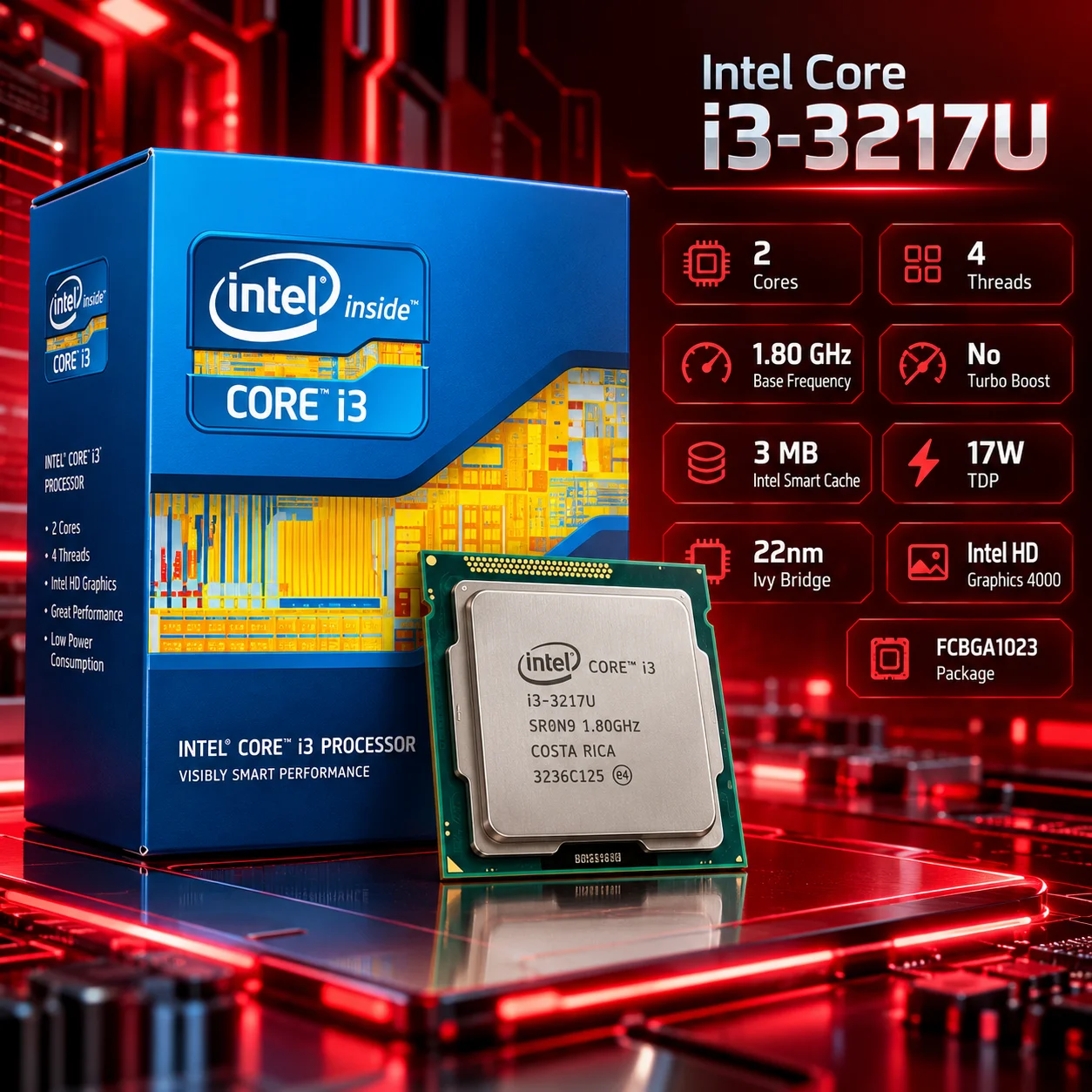
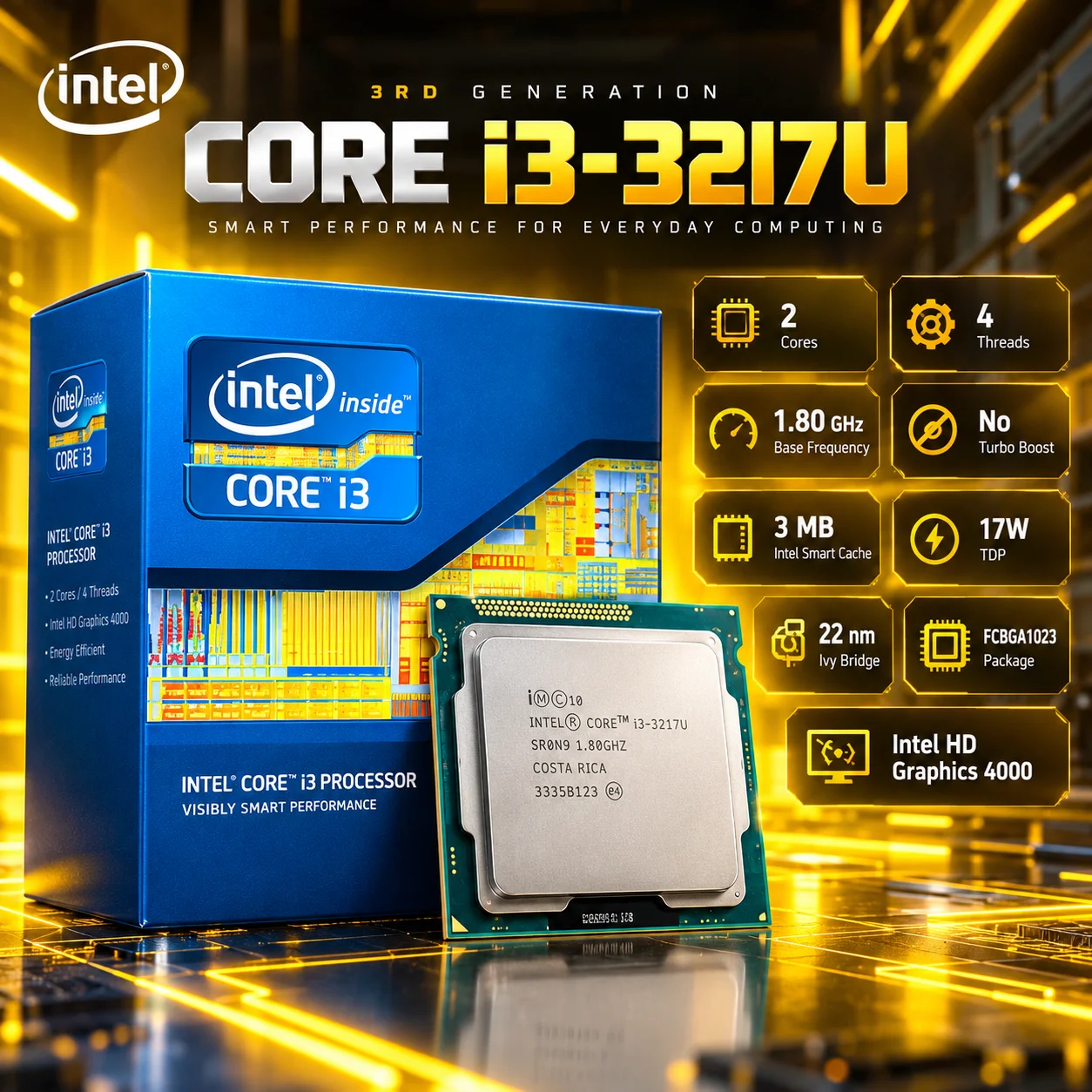
- 2 Cores and 4 Threads with Intel Hyper-Threading
- 1.80 GHz Base Frequency with 3 MB L3 Smart Cache
- Intel HD Graphics 4000 integrated graphics solution
- 17W Low TDP designed for efficient mobile systems
*Approximate regional retail guide prices. Pixahunt is an informational catalog.
CPU Benchmark Scores & Performance Analysis
TESTEDCinebench R23, Geekbench 6, PassMark CPU Mark scores & real-world gaming/office suitability tests.
Technical Specifications
Comprehensive hardware architecture and specifications
General
| Series | Core i3 |
| Model | i3-3217U |
| Cpu Cooler | Not Included |
| Code-Name | Ivy Bridge |
| Generation | 3rd Gen |
| Sockets Supported | FCBGA1023 |
Performance
| Base Frequency | 1.80 GHz |
| Turbo Frequency Max. | N/A |
| Core | 2 |
| Threads | 4 |
| CPU Cache | 3 MB L3 Cache |
| L1 Cache | 64 KB (per core) |
| L2 Cache | 256 KB (per core) |
| L3 Cache | 3 MB |
| TDP | 17 W |
| Lithography | 22 nm |
| Multiplier | 18.0x |
| Multiplier Unlocked | No |
| Processor Type | Core i3 |
Memory Support
| Memory Max. | 32 GB |
| Memory Type | DDR3/L/-RS 1333/1600 |
| Memory Speed | 1333/1600 MT/s |
| Memory Channel | 2 |
| Max Memory Bandwidth | 25.6 GB/s |
| ECC Memory Supported | No |
Graphics
| Built-in GPU | Yes |
| Processor Graphics | Intel HD Graphics 4000 |
| Graphics Base Frequency | 350 MHz |
| Graphics Dynamic Frequency | 1.05 GHz |
| Graphics Core Count | N/A |
| Max Video Memory | Shared Memory |
| Max Resolution | eDP/DP/HDMI/SDVO/CRT |
Technical Info
| DirectX Support | 11 |
| OpenGL Support | 4.0 |
| Approx. Power Consumption | 17 W |
| Compatible Products / Chipsets | Intel Mobile Chipset |
| PCI Express Version | 2.0 |
| PCI Express Lanes | 16 |
| Thermal Solution (MPK / Box) | Not Included |
| Max. Operating Temperature (Tjmax) | 105°C |
Warranty
| Manufacturing Warranty | 01 Year Limited |
Additional Info
| Specialty | Intel Hyper-Threading Technology, Intel Virtualization Technology (VT-x), AVX Instructions |
| Others | Discontinued Product (End of Life) |
| Country Of Origin | USA |
| Made in/ Assemble | China / Malaysia |
Editorial Overview & Review
In-depth insights, architecture summary, and performance evaluation
Introduction & Overview: The Ultrabook Pioneer
Back when the term "Ultrabook" was first reshaping the mobile computing landscape, Intel needed silicon that could balance genuine everyday responsiveness with meager power draws. Enter the Intel Core i3-3217U, a 3rd Generation "Ivy Bridge" processor designed explicitly for ultra-thin laptops, compact form-factor systems, and early convertible devices.
Positioned as an entry-to-mid-range mobile solution, the i3-3217U targeted mainstream consumers, students, and mobile professionals who required a reliable daily driver for web browsing, office suites, and media consumption without sacrificing battery life or dealing with bulky cooling assemblies. Though long since discontinued and relegated to the secondary market, this 22nm processor represents an important stepping stone in the evolution of ultra-low-voltage (ULV) mobile computing.
Architecture, Performance & Key Technologies: Engineering for Efficiency
At the heart of the Core i3-3217U is Intel’s proven 22nm Ivy Bridge microarchitecture, which introduced the industry to 3D Tri-Gate transistors for significantly improved power efficiency. Operating at a fixed base frequency of 1.80 GHz—with no Turbo Boost frequency available—the chip relies on its dual-core, four-thread setup via Intel Hyper-Threading Technology to handle light concurrent workloads.
- Power Consumption: Boasting a remarkably low Thermal Design Power (TDP) of just 17 W, it operates cool and enables slim chassis designs with minimal active cooling requirements.
- Cache & Memory: The processor features a shared 3 MB L3 cache alongside dedicated L1 (64 KB per core) and L2 (256 KB per core) caches. It supports up to 32 GB of dual-channel DDR3/L/-RS memory running at speeds up to 1600 MT/s, delivering a healthy maximum memory bandwidth of 25.6 GB/s.
- Integrated Graphics: Equipped with Intel HD Graphics 4000, featuring a base frequency of 350 MHz and a dynamic burst frequency up to 1.05 GHz. It brings DirectX 11 and OpenGL 4.0 support to the table, handling hardware video acceleration and legacy graphics APIs with ease.
- Instruction Sets & Virtualization: Modern additions for its era included AVX instruction support for vector-heavy calculations and Intel Virtualization Technology (VT-x) for basic hardware virtualization tasks.
Real-World Use Cases: Daily Productivity and Beyond
When evaluated in the context of its intended era and class, the i3-3217U excels at standard day-to-day tasks. If your daily routine involves heavy web browsing with multiple tabs open, drafting documents in Microsoft Office, streaming 1080p video, and managing emails, this processor moves through tasks fluidly. The inclusion of Hyper-Threading ensures that background updates don't grind your foreground applications to a halt.
However, its limitations become apparent when pushed into heavy content creation or modern gaming. While the HD 4000 graphics engine can easily manage casual titles, older eSports games (like *League of Legends* on modest settings), and multimedia playback, it lacks the horsepower for modern 3D rendering, video editing of 4K footage, or contemporary AAA gaming. Similarly, its fixed 1.80 GHz clock speed without turbo capabilities means bursty, single-threaded tasks will take longer to complete compared to higher-end Core i5 or i7 ULV stablemates.
Strengths & Potential Considerations
As with any legacy hardware, looking at the pros and cons requires a pragmatic perspective tailored to budget-conscious buyers or hobbyists.
- Pros:
- Extremely low 17W power draw translates to great energy efficiency and cool operating temperatures.
- Quad-thread processing (Hyper-Threading) offers smoother multitasking than basic Celeron or Pentium mobile chips of the same generation.
- Capable integrated graphics (HD 4000) for media decoding and casual use.
- Support for up to 32 GB of DDR3 memory provides surprising upgrade headroom for older laptops.
- Cons:
- End-of-life (EOL) product with no modern driver updates or active manufacturer support.
- Lacks Intel Turbo Boost Technology, capping performance during demanding workloads.
- PCI Express is limited to version 2.0, bottlenecking ultra-fast modern NVMe solid-state drives.
- Inadequate for contemporary gaming, heavy video production, or intensive modern software suites.
Final Buying Verdict: Who Is It For Today?
The Intel Core i3-3217U is no longer a part of the modern retail conversation, but it frequently populates the used market in budget-friendly, second-hand Ultrabooks and enterprise thin-and-lights. If you are shopping on an ultra-tight budget and need a secondary machine strictly for word processing, classroom note-taking, or media streaming—and you find a laptop powered by this chip for next to nothing—it remains a capable, highly efficient text-and-browser machine.
However, for anyone seeking a primary workstation for modern productivity apps, school work requiring specialized software, or light gaming, your investment is better directed toward newer generations of silicon that offer vastly superior IPC (instructions per cycle), hardware security mitigations, and modern instruction sets.
OUR RATING CONSENSUS
The overall rating is based on review by our experts & industry benchmark suites
Quick Snapshot
- Overall Rating
- 4.5 / 10
- Brand
- Intel
- Category
- Processor
- Catalog Model
- i3-3217U
- Status
- Published
- Release Date
- Oct 10, 2026
Pixahunt Tech Community
Connect with hardware enthusiasts, compare benchmarks, and explore real user setups.
Explore Full Newsfeed →Related Gadgets
- 3.20 GHz Dual-Core Clock Speed for Reliable Everyday Computing
- Intel Hyper-Threading Technology Enabling 4 Parallel Threads
- Built-in Intel HD Graphics for Integrated Display Support
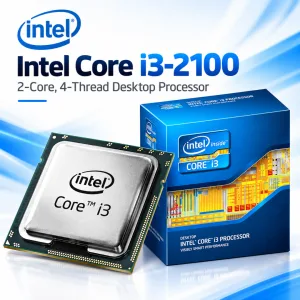
- 2 cores and 4 threads with Intel Hyper-Threading Technology
- 3.10 GHz base processor frequency
- 3 MB Intel Smart Cache
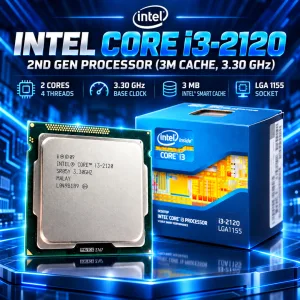
- 2 Cores and 4 Threads with Intel Hyper-Threading Technology
- 3.30 GHz Base Clock Frequency with 3 MB Intel Smart Cache
- Includes Intel HD Graphics 2000 integrated graphics
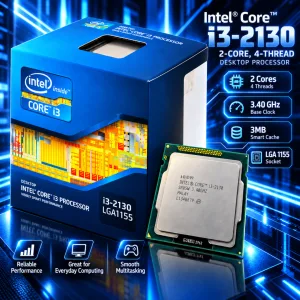
- 2 cores and 4 threads with Intel Hyper-Threading Technology
- 3.40 GHz processor base frequency with 3 MB Intel Smart Cache
- Integrated Intel HD Graphics 2000