

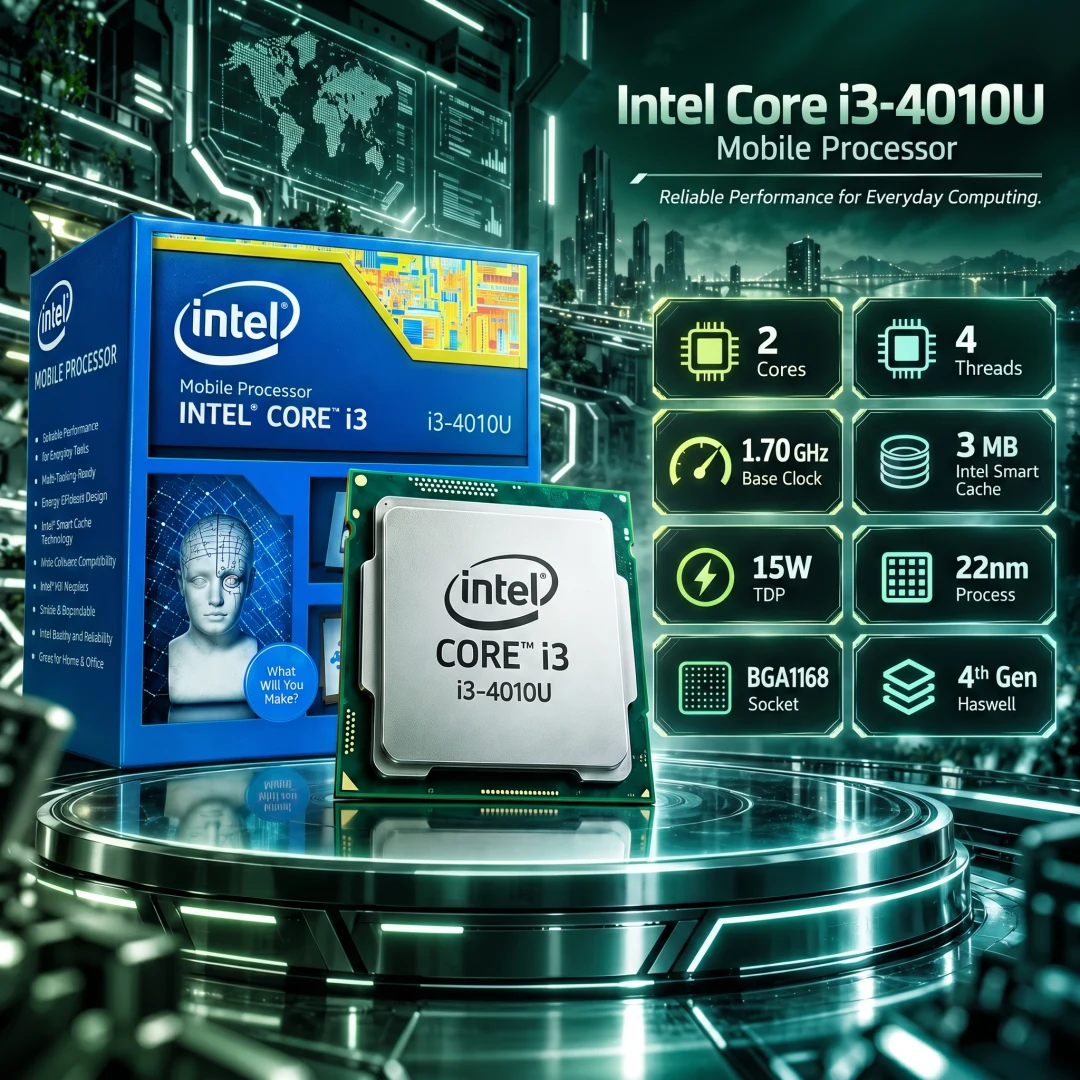
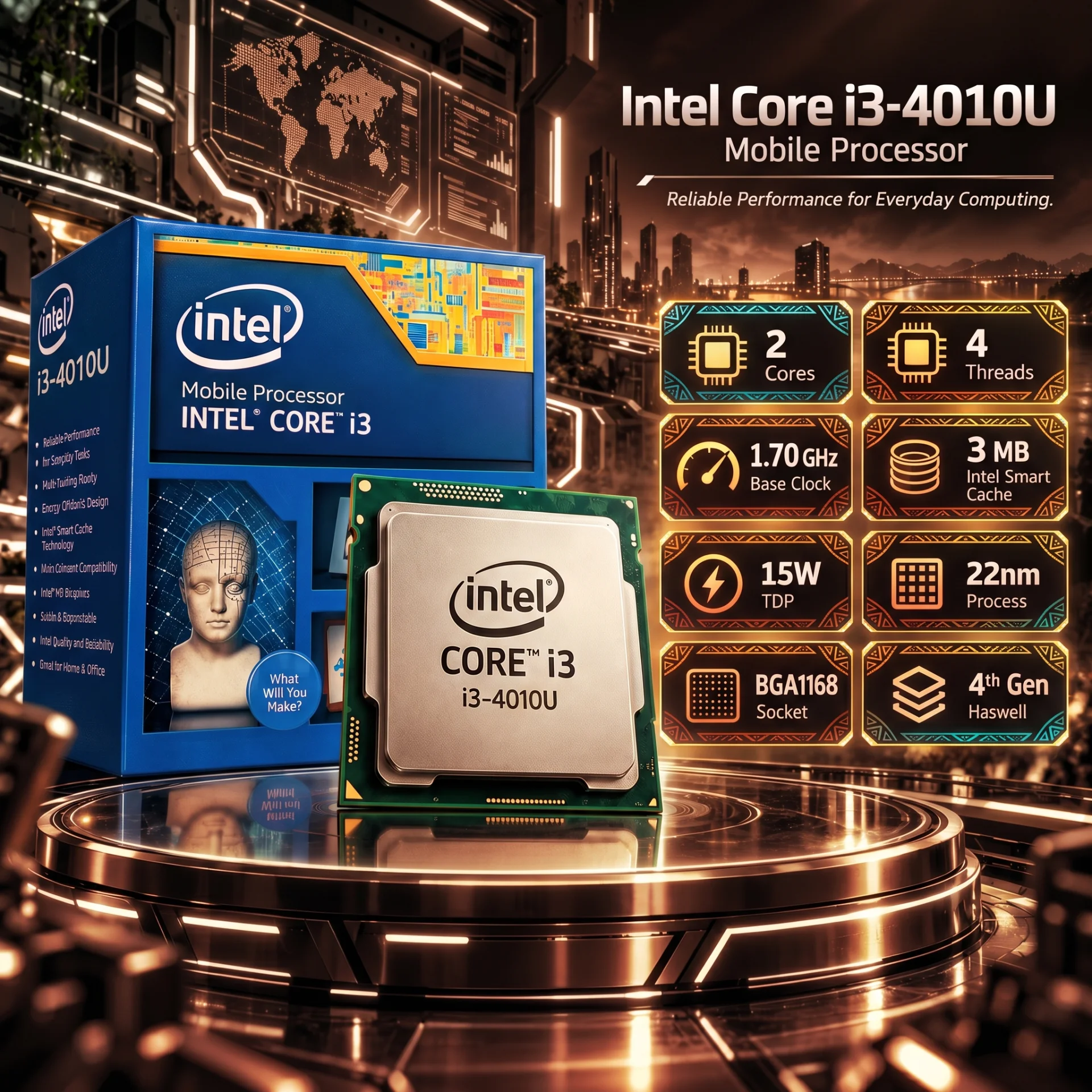
Intel Core i3-4010U 2-Core, 4-Thread Mobile Processor
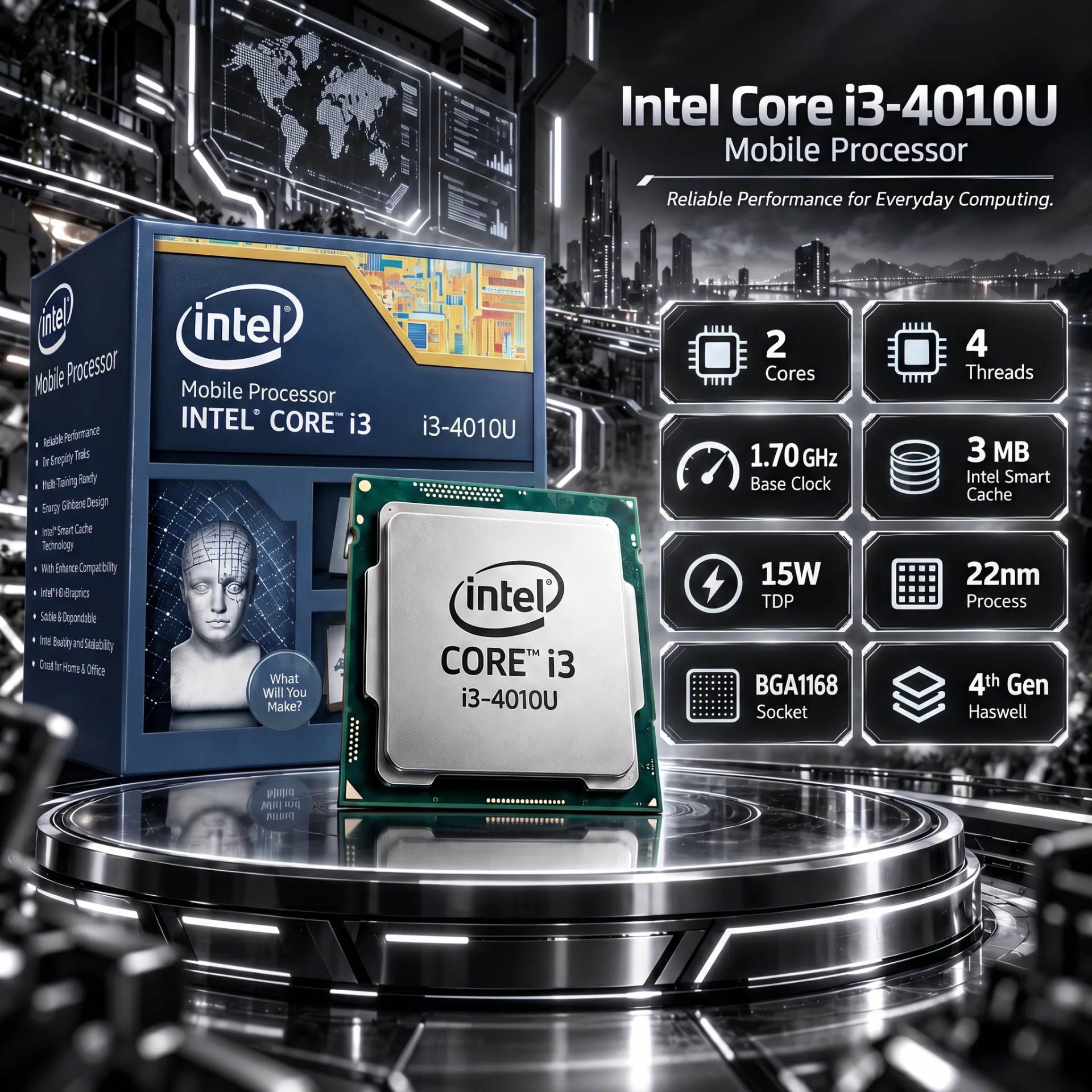
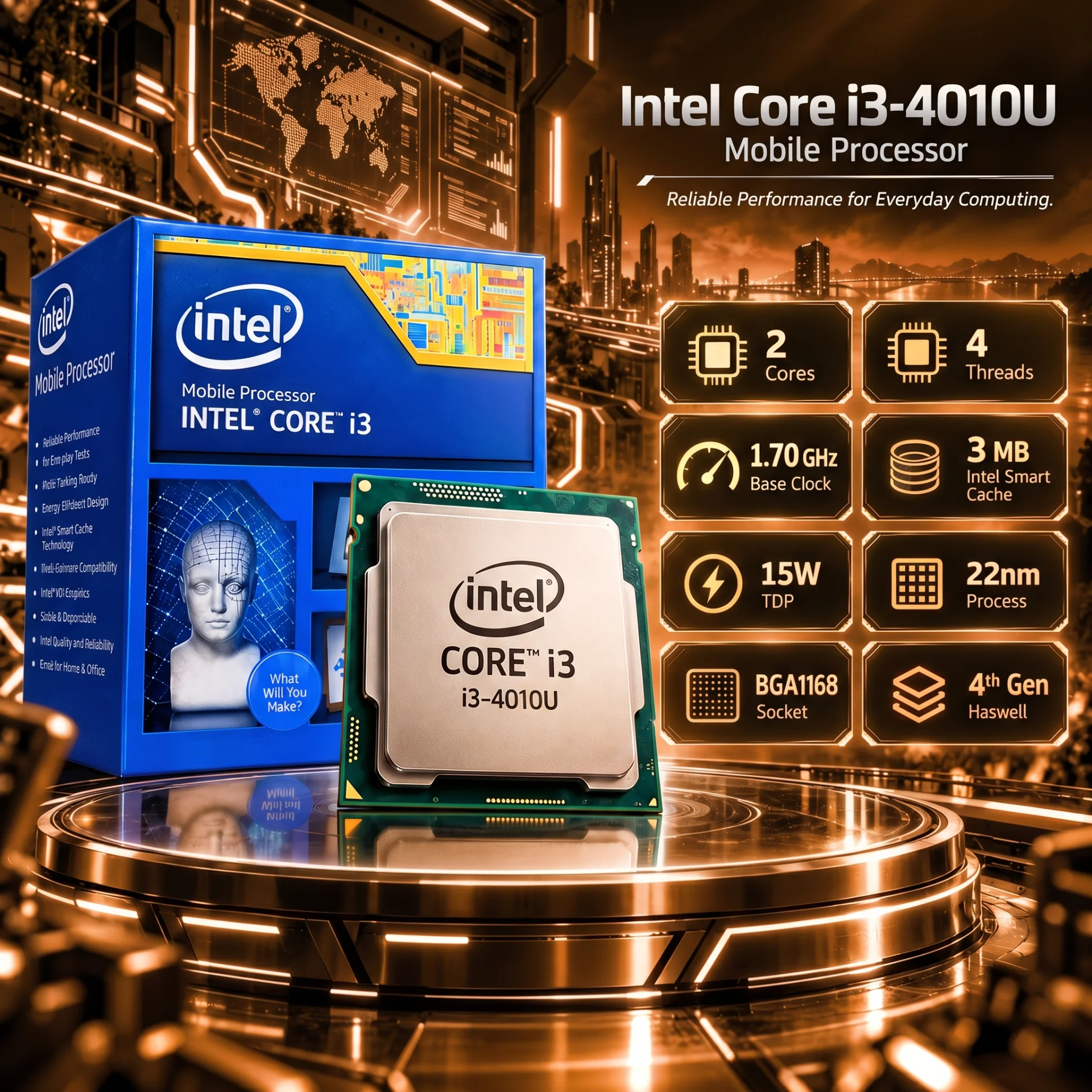
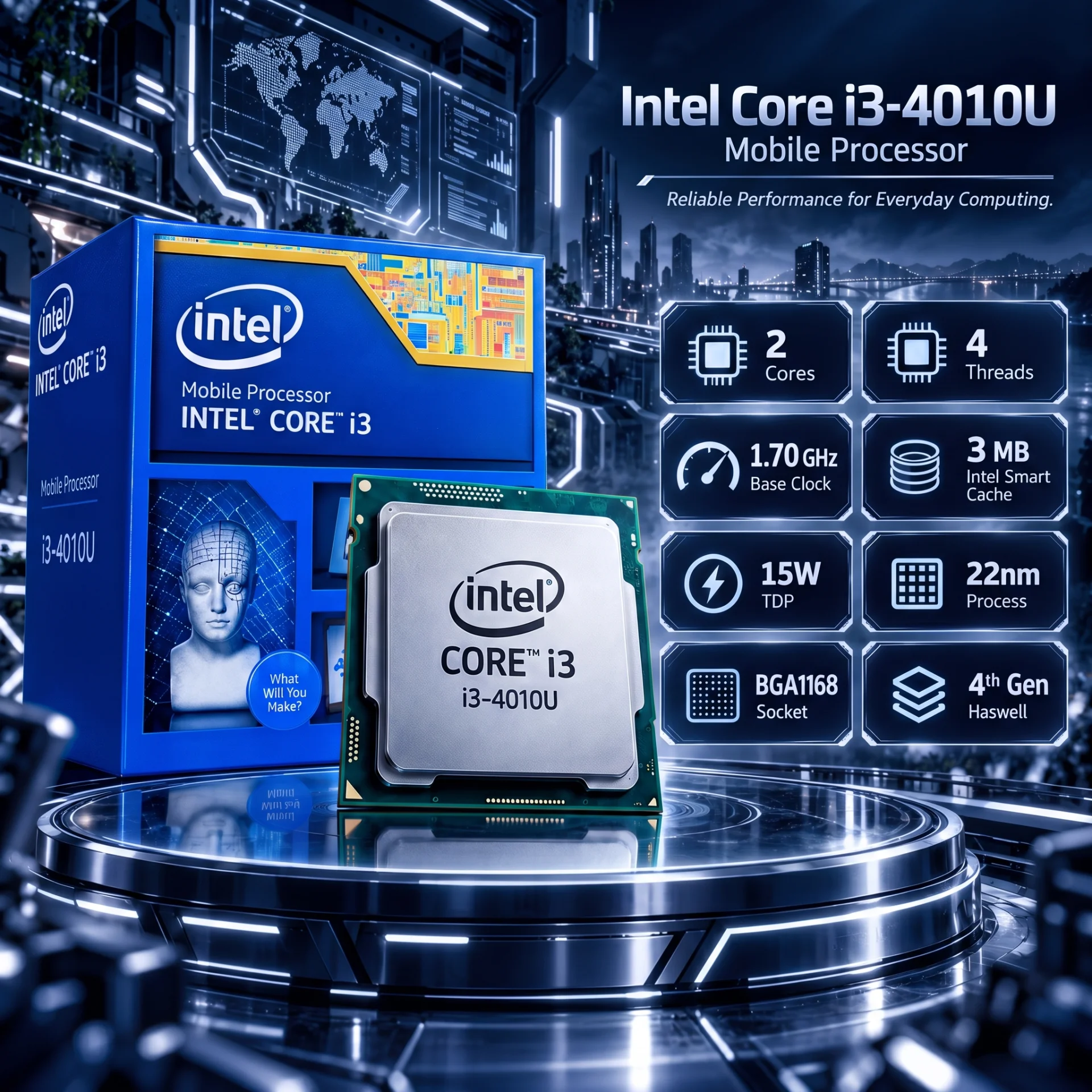
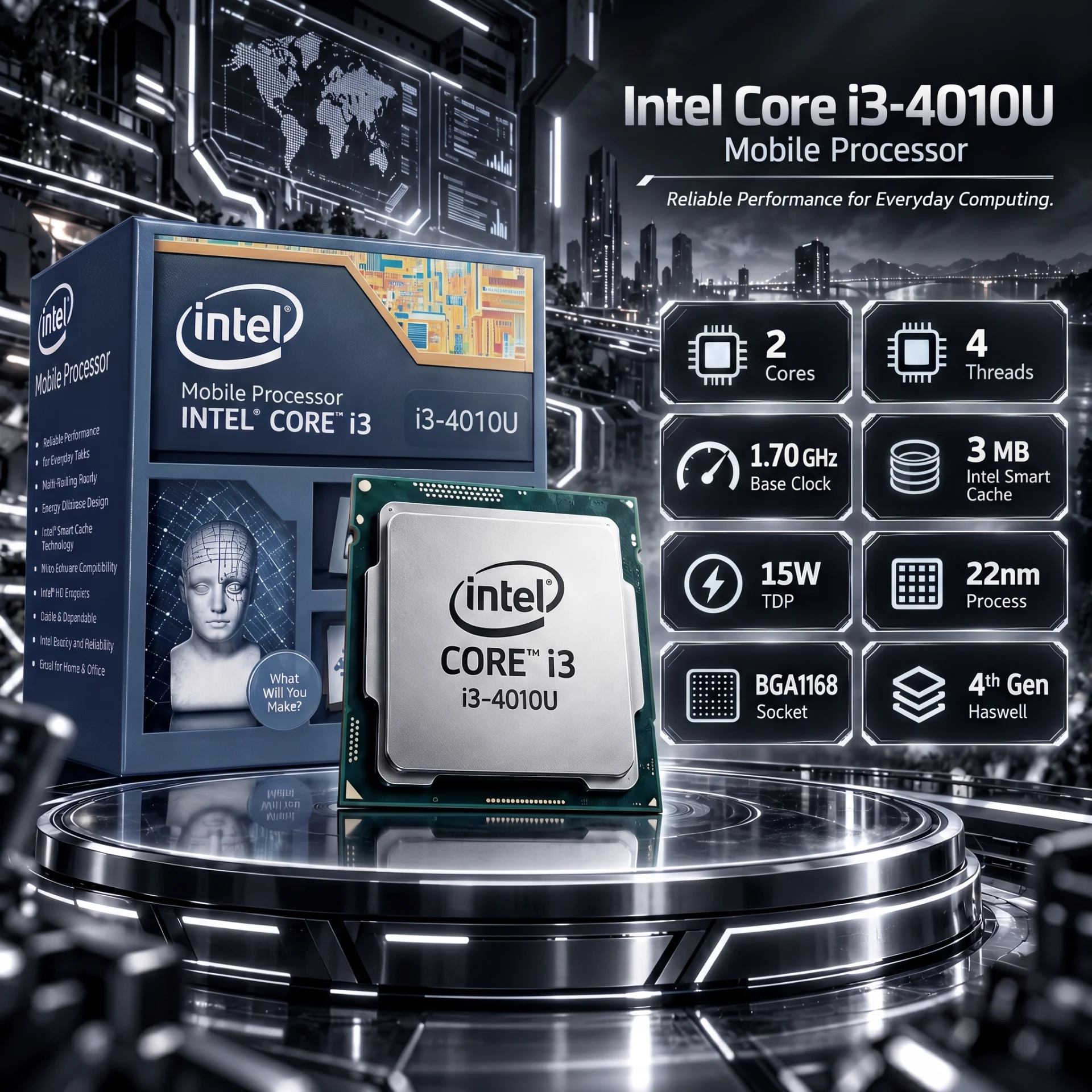
- 2 cores and 4 threads with Intel Hyper-Threading Technology
- 1.70 GHz base processor frequency with 3 MB Intel Smart Cache
- Integrated Intel HD Graphics 4400 supporting up to 3 displays
- Power-efficient 15W Thermal Design Power (TDP)
*Approximate regional retail guide prices. Pixahunt is an informational catalog.
CPU Benchmark Scores & Performance Analysis
TESTEDCinebench R23, Geekbench 6, PassMark CPU Mark scores & real-world gaming/office suitability tests.
Technical Specifications
Comprehensive hardware architecture and specifications
General
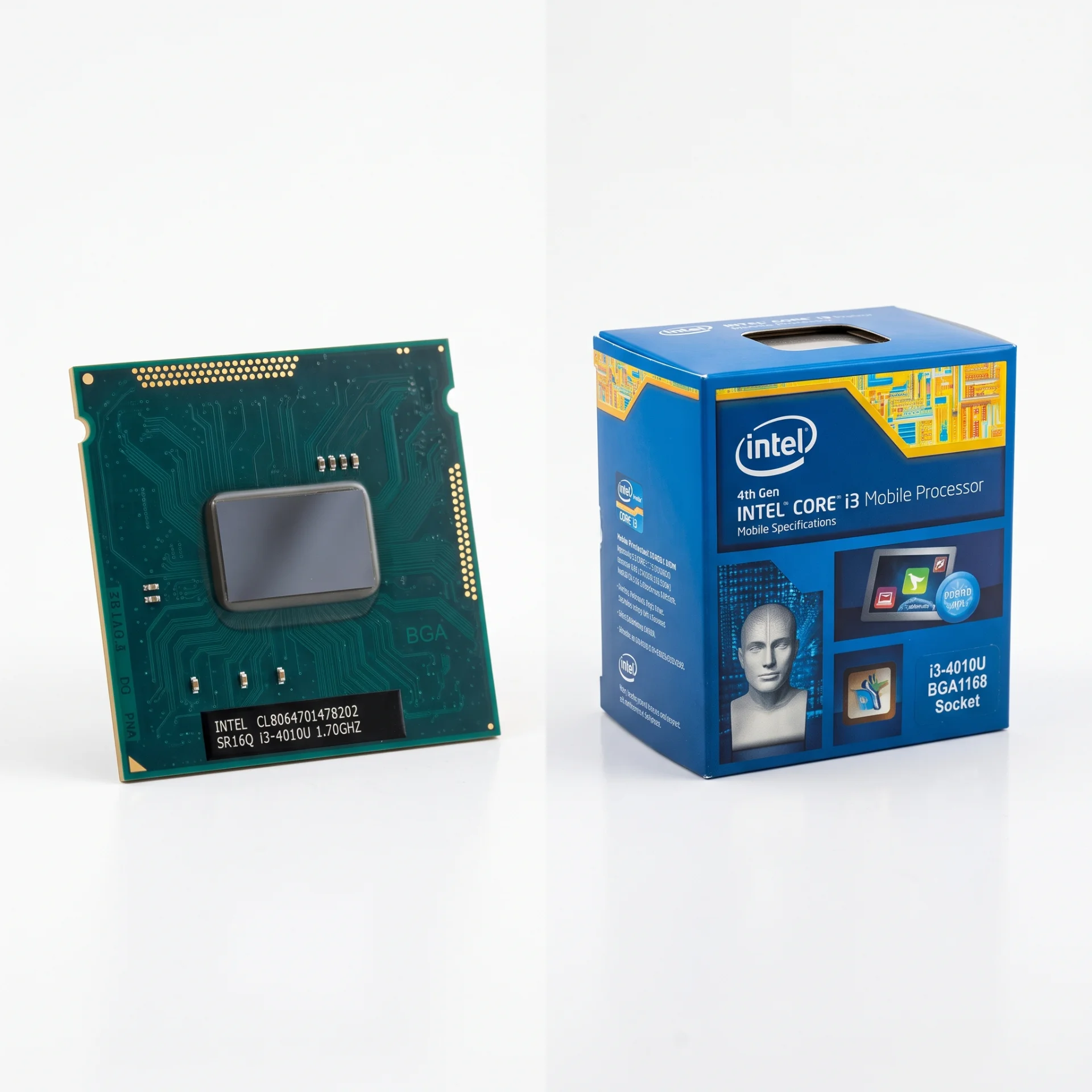
| Series | Core i3 |
| Model | i3-4010U |
| Cpu Cooler | Not Included |
| Code-Name | Haswell |
| Generation | 4th Gen |
| Sockets Supported | FCBGA1168 |
Performance
| Processor Type. | Core i3 |
| Base Frequency | 1.70 GHz |
| Turbo Frequency Max. | N/A |
| Core | 2 |
| Threads | 4 |
| CPU Cache | 3 MB Intel Smart Cache |
| L1 Cache | 128 KB |
| L2 Cache | 512 KB |
| L3 Cache | 3 MB |
| TDP | 15 W |
| Lithography | 22 nm |
| Multiplier | 17.0x |
| Multiplier Unlocked | No |
Memory Support
| Memory Max. | 16 GB |
| Memory Type | DDR3L 1333/1600, LPDDR3 1333/1600 |
| Memory Speed | Up to 1600 MT/s |
| Memory Channel | 2 |
| Max Memory Bandwidth | 25.6 GB/s |
| ECC Memory Supported | No |
Graphics
| Built-in GPU | Yes |
| Processor Graphics | Intel HD Graphics 4400 |
| Graphics Base Frequency | 200 MHz |
| Graphics Dynamic Frequency | 1.00 GHz |
| Graphics Core Count | N/A |
| Max Video Memory | 2 GB |
| Max Resolution | HDMI: 3200x2000 @60Hz, DP: 3200x2000 @60Hz |
Technical Info
| DirectX Support | 11.2/12 |
| OpenGL Support | 4.3 |
| Approx. Power Consumption | 15 W |
| Compatible Products / Chipsets | Mobile Intel 8 Series Express Chipset family |
| PCI Express Version | 2.0 |
| PCI Express Lanes | 12 |
| Thermal Solution (MPK / Box) | N/A |
| Max. Operating Temperature (Tjmax) | 100°C |
Warranty
| Manufacturing Warranty | Discontinued Product / N/A |
Additional Info
| Specialty | Intel Hyper-Threading, Intel Virtualization Technology (VT-x, VT-d), Intel AES-NI |
| Others | Embedded Options Available, Mobile Processor |
| Country Of Origin | USA |
| Made in/ Assemble | China / Malaysia |
Editorial Overview & Review
In-depth insights, architecture summary, and performance evaluation
Introduction & Overview
When Intel introduced its 4th Generation "Haswell" microarchitecture, the mobile computing landscape underwent a dramatic shift toward power efficiency and longer battery life. Resting squarely in the middle of this era's mobile lineup is the Intel Core i3-4010U, an ultra-low-voltage (ULV) dual-core processor engineered specifically for thin-and-light laptops, ultrabooks, and compact mini-PCs.
Positioned as an accessible entry-level chip within the Core series, the i3-4010U was designed to bring the architectural benefits of Haswell to budget-conscious mainstream consumers. Aimed at students, office workers, and everyday users who prioritize portable form factors and thermal efficiency over raw computing power, this chip aimed to deliver reliable daily execution without draining battery life or generating excessive heat.
Architecture, Performance & Key Technologies
The Core i3-4010U is built on Intel’s 22 nm lithography using 3D Tri-Gate transistors, bringing remarkable energy refinements compared to previous-generation processors. Operating on a fixed base clock of 1.70 GHz, the processor does not feature Intel Turbo Boost Technology—a standard omission for the Core i3 family of this generation. However, it compensates with Intel Hyper-Threading Technology, allowing its 2 physical cores to process 4 concurrent threads, ensuring smoother multitasking than traditional dual-core chips.
The processor architecture integrates several crucial subsystems onto a single die package:
- Cache Hierarchy: Equipped with a 3 MB Intel Smart Cache (alongside 128 KB L1 and 512 KB L2 cache) to reduce latency and speed up frequently accessed data.
- Thermal Efficiency: A conservative 15 W Thermal Design Power (TDP) encompasses the CPU cores, memory controller, and integrated GPU, enabling slim chassis designs with modest cooling solutions.
- Integrated Graphics: Features Intel HD Graphics 4400, featuring a base clock of 200 MHz and a dynamic boost frequency up to 1.00 GHz. It supports DirectX 11.2/12, OpenGL 4.3, and external displays up to 3200x2000 @ 60Hz via DisplayPort or HDMI.
- Memory Controller: Supports up to 16 GB of low-voltage DDR3L or LPDDR3 memory in dual-channel configuration operating at up to 1600 MT/s, delivering a maximum memory bandwidth of 25.6 GB/s.
- Hardware Instruction Sets: Includes hardware-accelerated Intel AES-NI for fast, secure encryption, alongside Intel Virtualization Technology (VT-x and VT-d) for efficient hardware abstraction.
Real-World Use Cases
Understanding where the Core i3-4010U shines—and where it hits its boundaries—comes down to real-world software demands:
- Daily Productivity & Web Browsing: The i3-4010U handles word processing, spreadsheet management, online document collaboration, and routine web browsing with ease. When paired with an SSD and adequate RAM (8 GB or more), system responsiveness remains crisp for general computing.
- Media Playback & Home Theater: Thanks to integrated hardware video decoding, the HD Graphics 4400 effortlessly handles 1080p HD media streaming and local video playback. It functions exceptionally well inside home-theater PCs (HTPCs) or light media hub setups.
- Multitasking: Thanks to Hyper-Threading, running a web browser alongside a music streaming app and background office utility works reliably. However, heavy tab usage and background updates will push the 1.70 GHz non-turbo clock to its limit.
- Gaming & Content Creation: The i3-4010U is not tailored for heavy content creation or modern 3D gaming. While it can run legacy 2D indie titles, retro emulators, and casual games (such as World of Warcraft or Counter-Strike: Source on lower resolutions and settings), modern AAA gaming and 4K video rendering are beyond its dynamic capability.
Strengths & Potential Considerations
Strengths:
- Exceptional Energy Efficiency: The 15 W TDP design maximizes battery performance and enables whisper-quiet thermal designs.
- Hyper-Threading Support: Provides 4 logical execution threads to help soften the impact of multithreaded workloads on a dual-core chip.
- Robust Feature Set: Hardware-level AES-NI encryption and VT-x/VT-d virtualization capabilities are great inclusions for an entry-level processor.
- Capable Display Engine: Intel HD Graphics 4400 smoothly handles high-resolution desktop displays up to 3200x2000.
Potential Considerations:
- No Turbo Boost: Locked at a maximum of 1.70 GHz, limiting burst performance under sudden heavy compute loads.
- BGA Socket Limitations: Uses the FCBGA1168 socket (soldered directly to the motherboard), meaning CPU upgrades are impossible.
- Aging Hardware Architecture: Lacks modern hardware video codecs (such as AV1 or VP9 hardware decoding) and relies on older PCIe 2.0 standards.
- Discontinued Status: As an older-generation component, official direct support and manufacturing warranties are discontinued.
Final Buying Verdict
The Intel Core i3-4010U remains a solid testament to Haswell's leap forward in power management. In its prime, it delivered an ideal balance of low thermal output, reliable day-to-day speed, and long battery runtime for affordable ultra-portables.
In today's ecosystem, this processor is best viewed through the lens of ultra-budget refurbished hardware, secondary machines, or repurposed low-power home servers. If you are looking at a deeply discounted refurbished laptop or a compact mini-PC for basic office work, web browsing, home automation, or media playback, an i3-4010U system—especially when retrofitted with a solid-state drive—offers surprising utility and high energy efficiency for minimal monetary investment.
OUR RATING CONSENSUS
The overall rating is based on review by our experts & industry benchmark suites
Quick Snapshot
- Overall Rating
- 4.5 / 10
- Brand
- Intel
- Category
- Processor
- Catalog Model
- i3-4010U
- Status
- Published
- Release Date
- Oct 10, 2026
Pixahunt Tech Community
Connect with hardware enthusiasts, compare benchmarks, and explore real user setups.
Explore Full Newsfeed →Related Gadgets
- 3.20 GHz Dual-Core Clock Speed for Reliable Everyday Computing
- Intel Hyper-Threading Technology Enabling 4 Parallel Threads
- Built-in Intel HD Graphics for Integrated Display Support
- 2 cores and 4 threads with Intel Hyper-Threading Technology
- 3.10 GHz base processor frequency
- 3 MB Intel Smart Cache
- 2 Cores and 4 Threads with Intel Hyper-Threading Technology
- 3.30 GHz Base Clock Frequency with 3 MB Intel Smart Cache
- Includes Intel HD Graphics 2000 integrated graphics
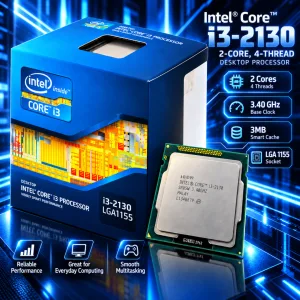
- 2 cores and 4 threads with Intel Hyper-Threading Technology
- 3.40 GHz processor base frequency with 3 MB Intel Smart Cache
- Integrated Intel HD Graphics 2000