

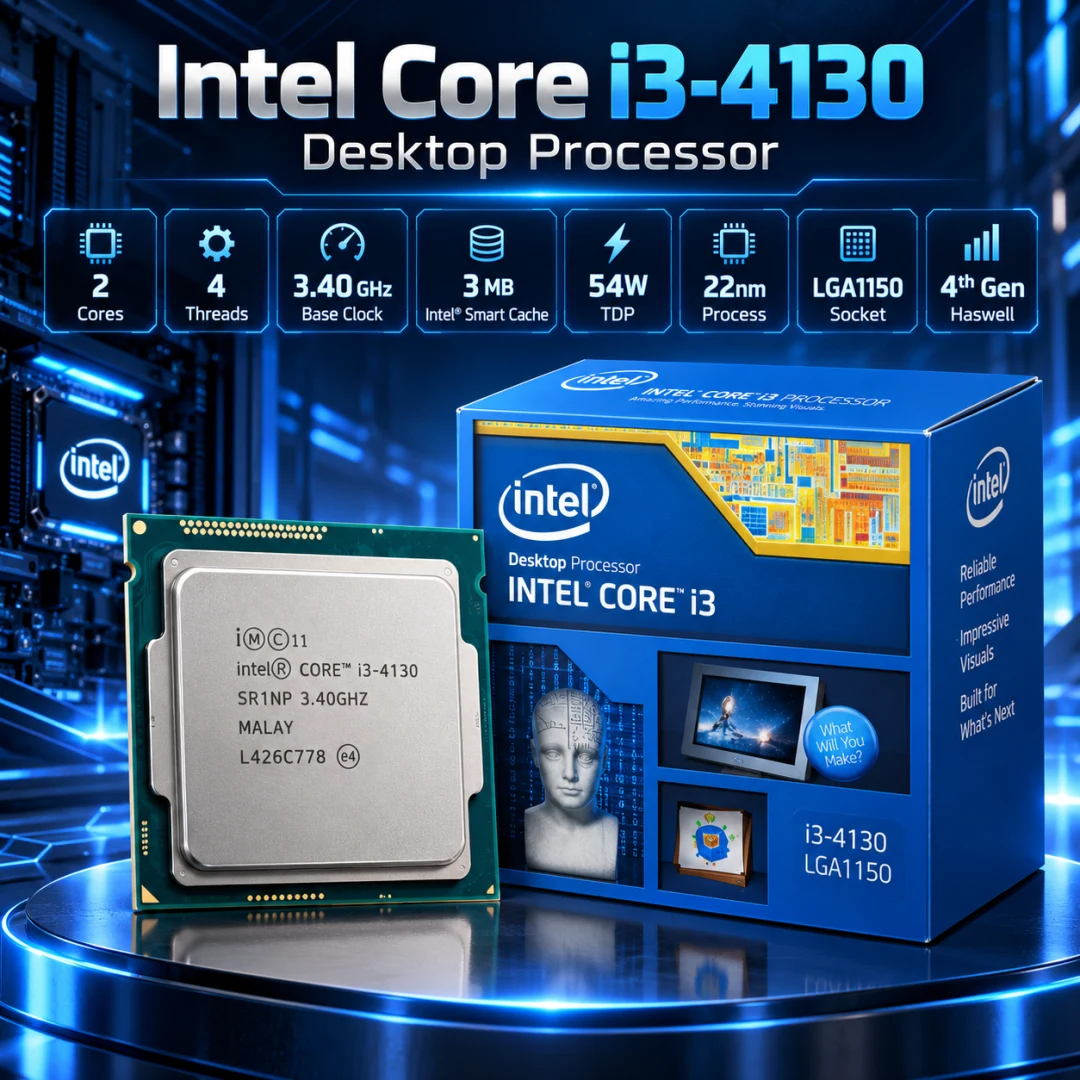
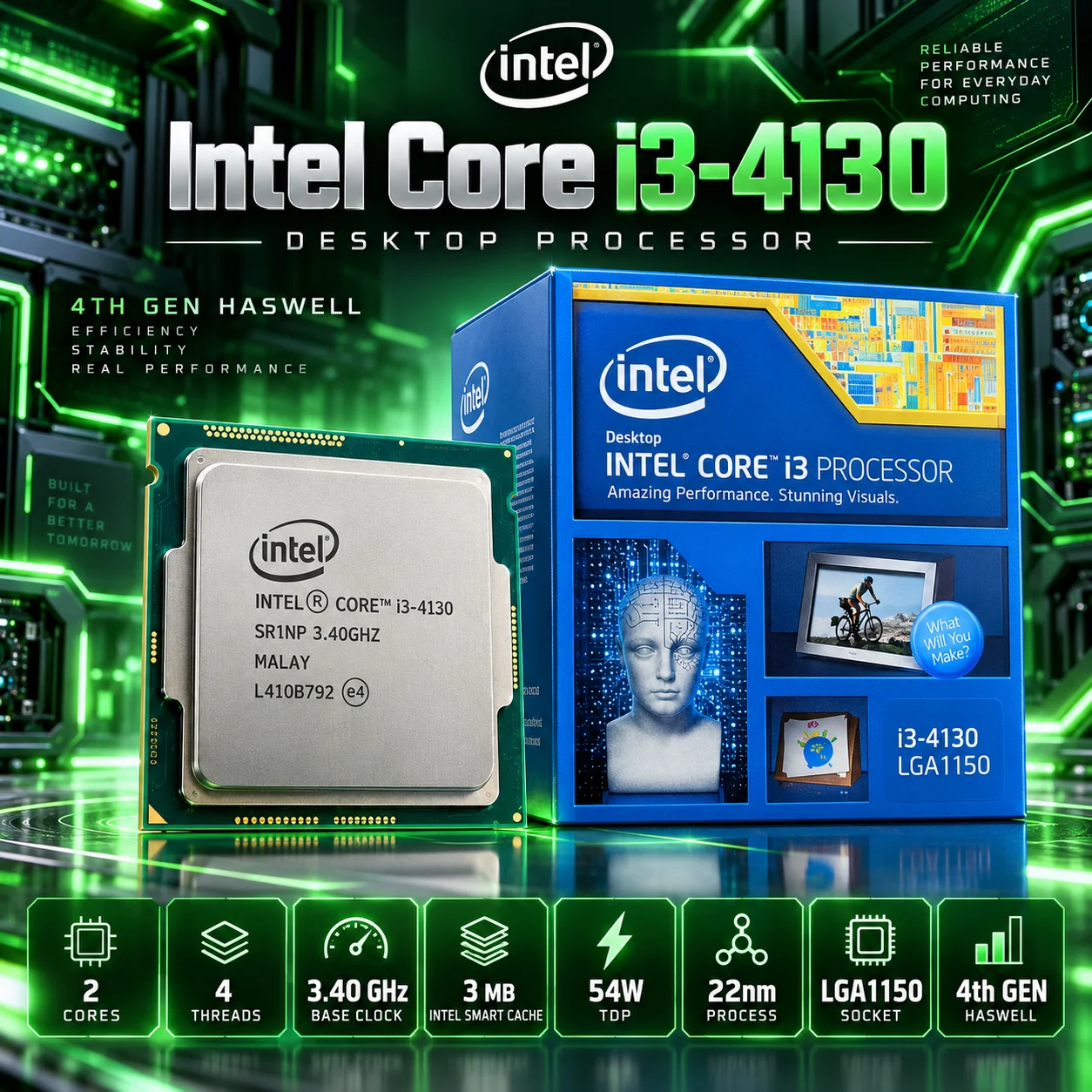
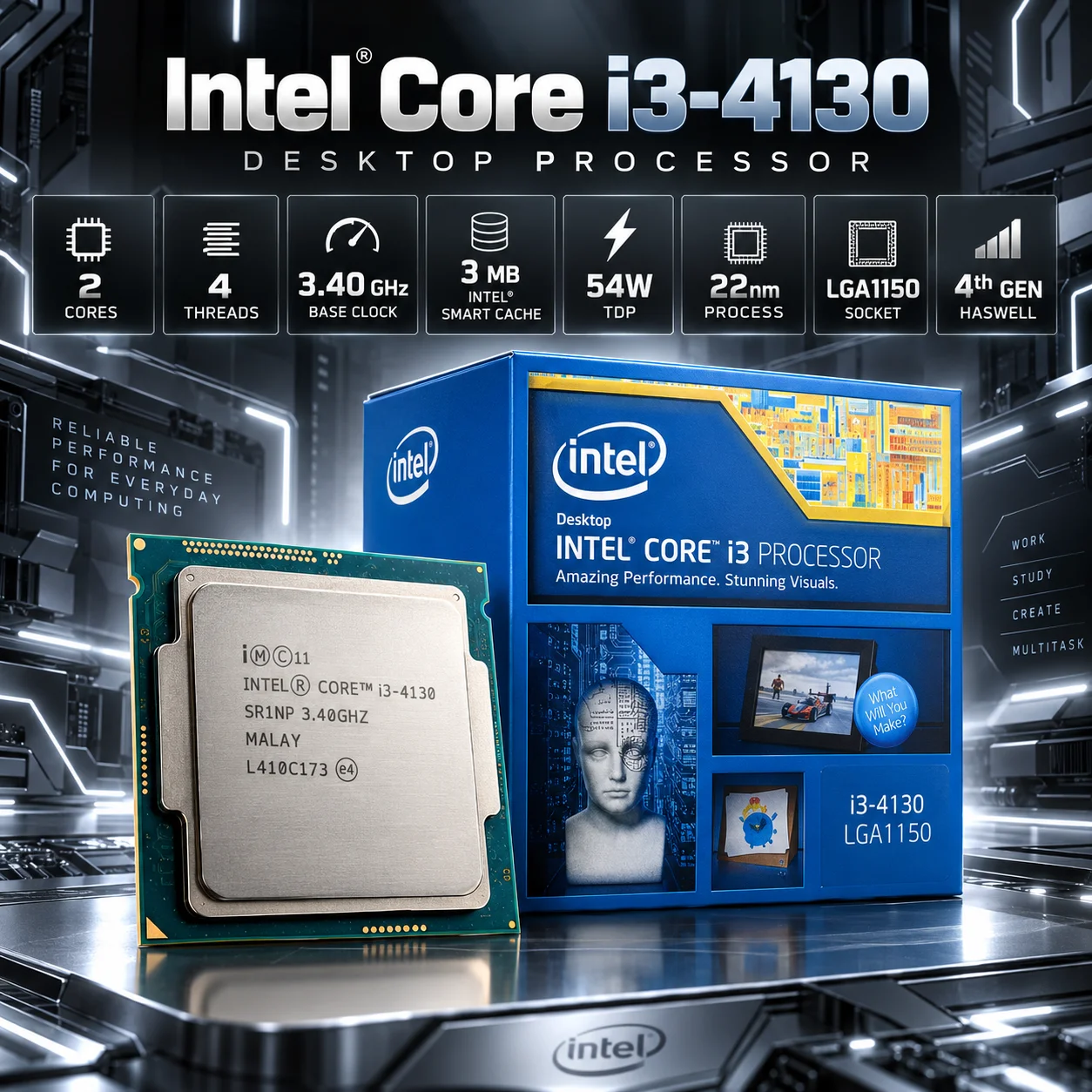
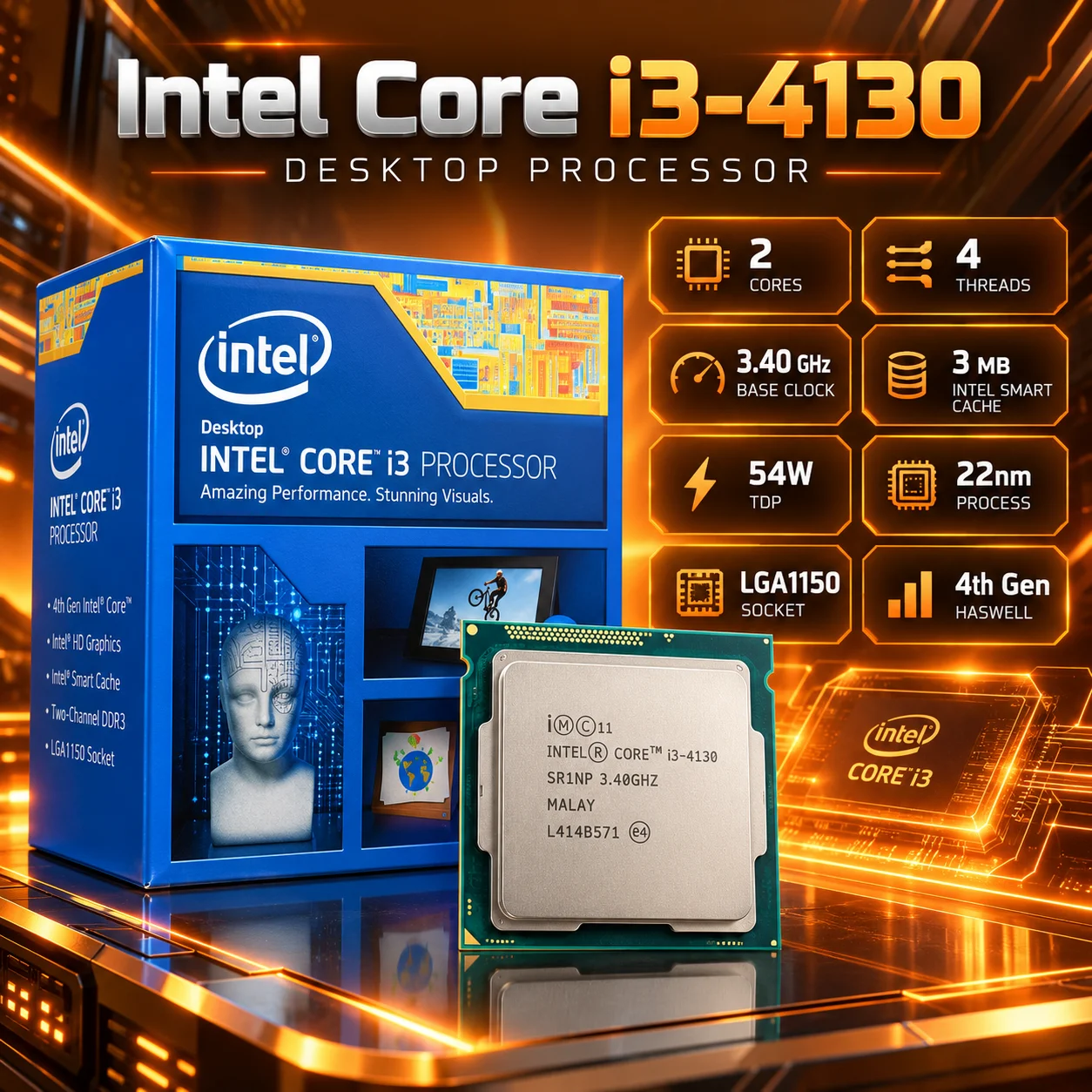
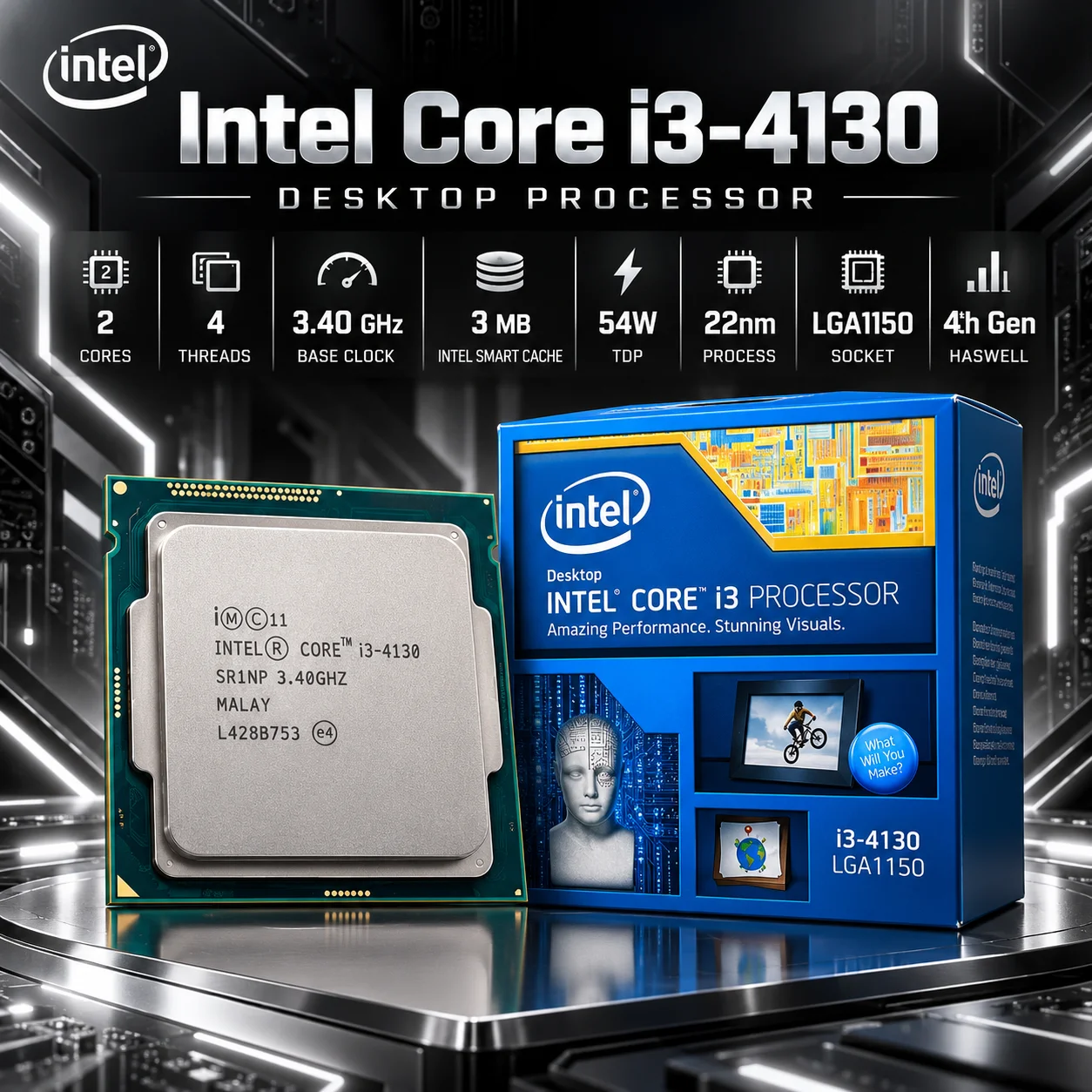
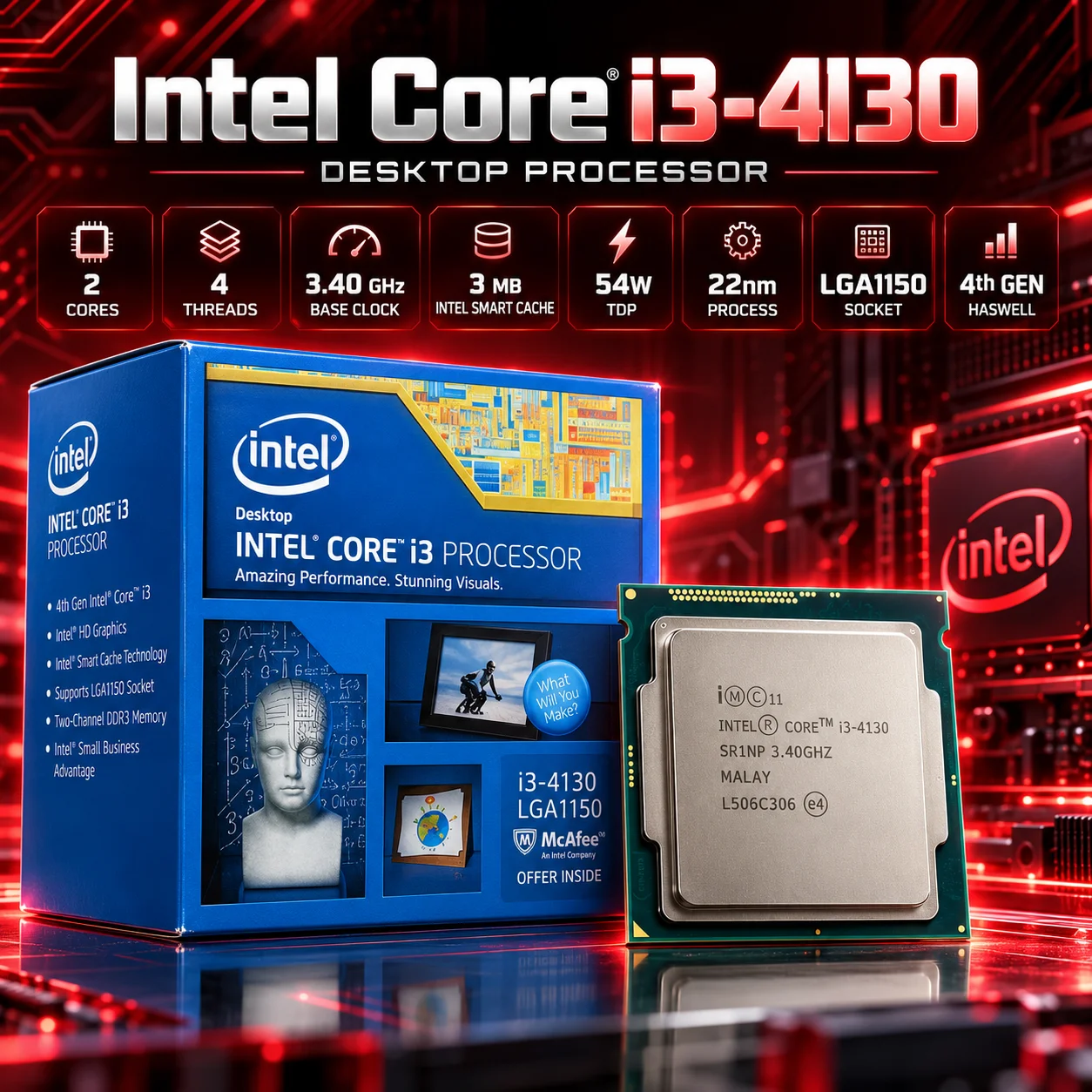
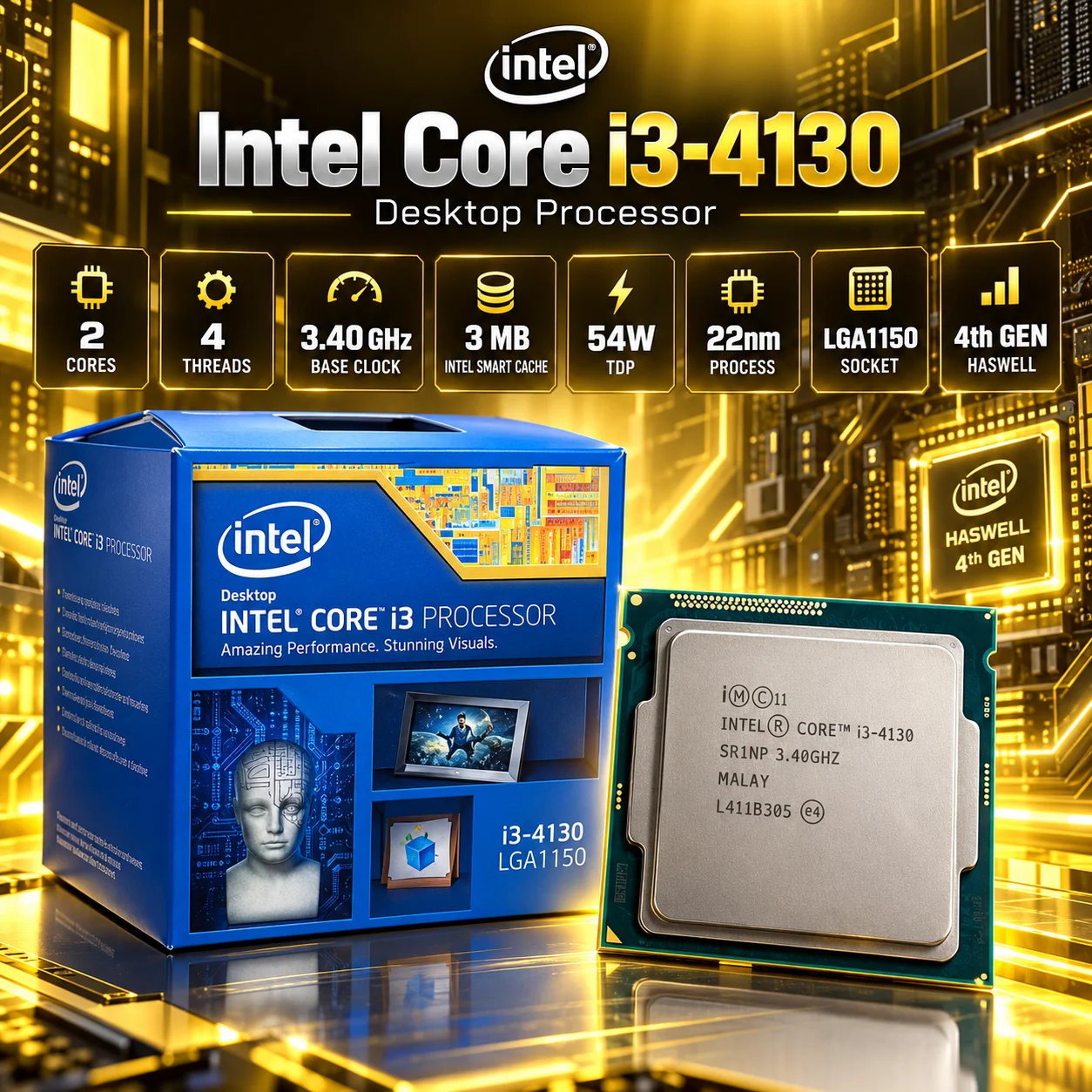
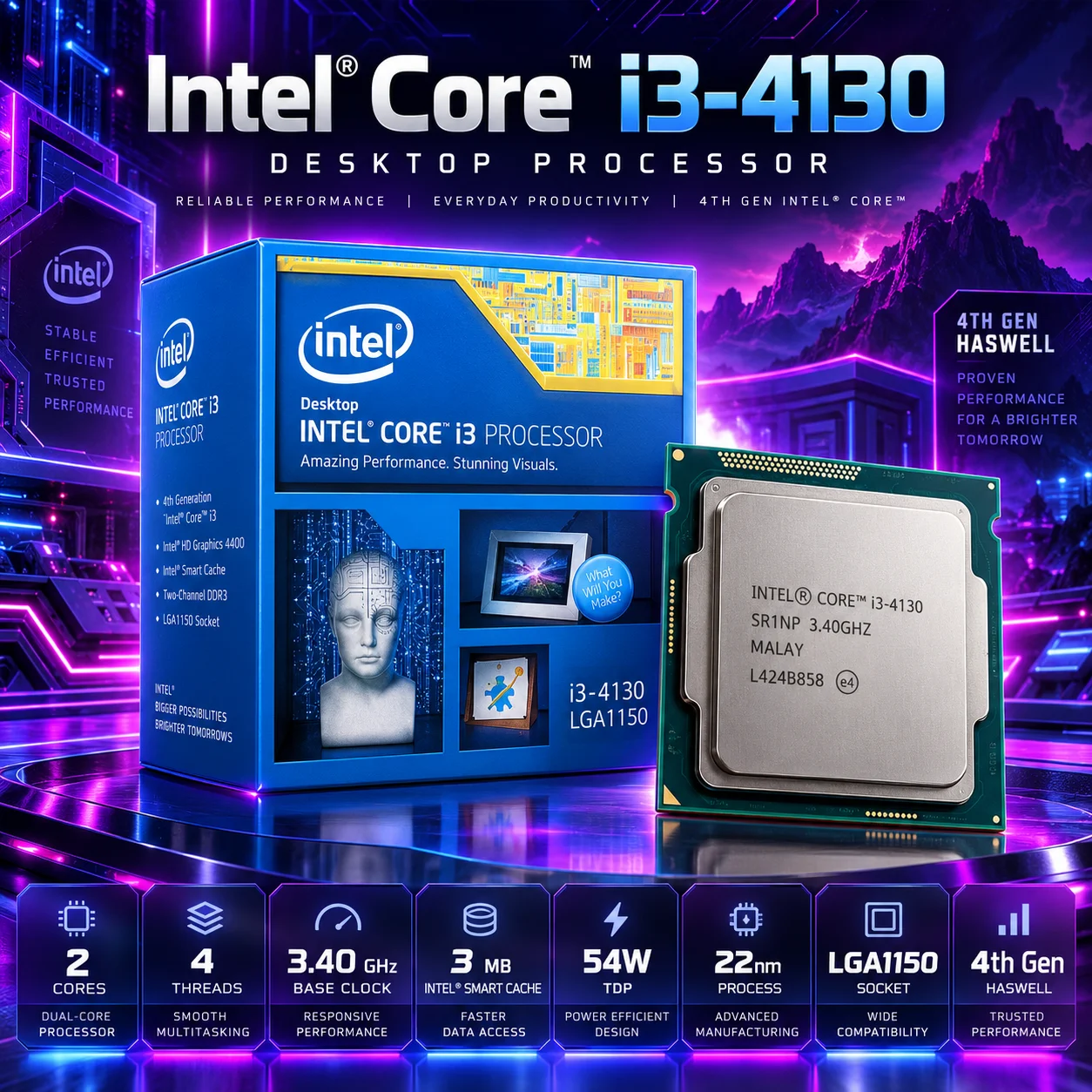
Intel Core i3-4130 4th Gen Haswell Dual-Core 3.40 GHz Desktop Processor
- 2 Cores & 4 Threads with Intel Hyper-Threading Technology
- 3.40 GHz Base Clock Frequency
- Integrated Intel HD Graphics 4400
- 22nm Haswell Architecture with 54W TDP
*Approximate regional retail guide prices. Pixahunt is an informational catalog.
CPU Benchmark Scores & Performance Analysis
TESTEDCinebench R23, Geekbench 6, PassMark CPU Mark scores & real-world gaming/office suitability tests.
Technical Specifications
Comprehensive hardware architecture and specifications
General
| Series | Core i3 |
| Model | Intel Core i3-4130 |
| Cpu Cooler | Included (Intel Stock Cooler) |
| Code-Name | Haswell |
| Generation | 4th Gen |
| Sockets Supported | LGA 1150 |
Performance
| Base Frequency | 3.40 GHz |
| Turbo Frequency Max. | N/A |
| Core | 2 |
| Threads | 4 |
| CPU Cache | 3 MB Intel Smart Cache |
| L1 Cache | 128 KB (64 KB per core) |
| L2 Cache | 512 KB (256 KB per core) |
| L3 Cache | 3 MB |
| TDP | 54W |
| Lithography | 22 nm |
| Multiplier | 34.0x |
| Multiplier Unlocked | No |
| Processor Type | Core i3 |
Memory Support
| Memory Max. | 32 GB |
| Memory Type | DDR3 / DDR3L |
| Memory Speed | DDR3-1333/1600, DDR3L-1333/1600 @ 1.5V |
| Memory Channel | 2 |
| Max Memory Bandwidth | 25.6 GB/s |
| ECC Memory Supported | Yes |
Graphics
| Built-in GPU | Yes |
| Processor Graphics | Intel HD Graphics 4400 |
| Graphics Base Frequency | 350 MHz |
| Graphics Dynamic Frequency | 1.15 GHz |
| Graphics Core Count | N/A |
| Max Video Memory | 2 GB |
| Max Resolution | HDMI: 4096x2304@24Hz, DP: 3840x2160@60Hz, VGA: 1920x1200@60Hz |
Technical Info
| DirectX Support | 11.1 / 12 |
| OpenGL Support | 4.3 |
| Approx. Power Consumption | 54W |
| Compatible Products / Chipsets | Intel H81, B85, Q85, Q87, H87, Z87, H97, Z97 |
| PCI Express Version | PCIe 3.0 |
| PCI Express Lanes | 16 Lanes |
| Thermal Solution (MPK / Box) | PCG 2013C |
| Max. Operating Temperature (Tjmax) | 72°C |
Warranty
| Manufacturing Warranty | 3 Years (Discontinued / End of Servicing) |
Additional Info
| Specialty | Intel Hyper-Threading Technology, Intel Virtualization Technology (VT-x), Intel AVX2 Instruction Set, Intel Quick Sync Video |
| Others | Instruction Set Extensions: Intel SSE4.1, Intel SSE4.2, Intel AVX2; 64-bit Architecture |
| Country Of Origin | USA |
| Made in/ Assemble | Costa Rica / Vietnam / Malaysia |
Editorial Overview & Review
In-depth insights, architecture summary, and performance evaluation
Introduction & Overview
Welcome back to the workbench, tech enthusiasts. Today, we are taking a nostalgic yet analytical look back at a true stalwart of budget computing: the Intel Core i3-4130. Launched during the era of Intel's 4th Generation "Haswell" architecture, this dual-core processor was engineered precisely for cost-conscious builders, entry-level office workstations, and home users who needed reliable everyday performance without breaking the bank. While the tech landscape has rapidly evolved, examining the i3-4130 gives us a fascinating window into how foundational desktop computing needs were met during a period of massive architectural shifts.
Architecture, Performance & Key Technologies
Built on a refined 22-nanometer manufacturing process, the Core i3-4130 operates at a fixed clock speed of 3.4 GHz. Because it belongs to the Core i3 tier, it lacks Intel’s Turbo Boost technology, meaning it relies on its robust base frequency to handle workloads. However, it features Intel Hyper-Threading Technology, allowing its 2 physical cores to process 4 concurrent threads. This capability was a massive boon for multitasking in its class, ensuring that background applications wouldn't choke foreground tasks.
On the graphics front, the processor is equipped with Intel HD Graphics 4400, supporting DirectX 11.1, OpenGL 4.3, and standard high-definition video playback outputs like HDMI and DisplayPort. While modern system specs have heavily pivoted toward complex multi-gigabit modems, advanced neural engines, and sophisticated multi-camera arrays found in modern mobile platforms, the i3-4130 was strictly a desktop powerhouse focused on raw, reliable CPU and integrated graphical output for standard displays. It also brought notable instruction-set extensions like AVX 2.0, giving it surprising competency in vector-heavy computations for its time.
Real-World Use Cases
How does a dual-core chip from the Haswell generation hold up in practical scenarios? Let's break down its performance across various environments:
- Daily Productivity & Office Work: This is where the i3-4130 truly shines. Handling multi-tab web browsing, heavy Microsoft Office suites, email clients, and document editing is a breeze. It remains a legendary choice for budget-friendly business desktops.
- Media Consumption & Light Creation: Thanks to its integrated graphics and Quick Sync Video technology, streaming 1080p and even 4K video content is handled smoothly. Light photo cropping and basic file compression are well within its wheelhouse.
- Gaming & Multitasking: While modern AAA titles will quickly overwhelm its dual-core setup, paired with a modest entry-level dedicated graphics card, the i3-4130 can comfortably handle classic eSports titles like League of Legends, Counter-Strike: Global Offensive, and Dota 2 at 1080p medium settings. Heavy video rendering or modern multi-threaded AAA gaming, however, will push it past its limits.
Strengths & Potential Considerations
Every piece of hardware has its distinct set of advantages and limitations, especially when evaluated through a modern lens:
- Pros:
- Extremely reliable and durable silicon longevity.
- Low thermal design power (TDP of 54W), keeping power bills and cooling requirements minimal.
- Hyper-Threading provides an effective boost to multi-threaded office applications.
- Cost-effective entry point for legacy LGA 1150 motherboard ecosystems.
- Cons:
- Limited to just 2 physical cores, making it obsolete for modern heavy multi-threaded workloads.
- No native overclocking support (non-K series).
- Integrated graphics are vastly outclassed by modern APUs and dedicated GPUs.
- Lacks support for modern operating system requirements (such as official Windows 11 compatibility without workarounds).
Final Buying Verdict
The Intel Core i3-4130 is a masterclass in historical budget engineering. For those looking to repurpose old hardware into a basic home server, a retro eSports gaming rig for younger kids, or a dependable word-processing machine for a garage workshop, it still holds a charmingly functional place in the tech world. However, for primary daily drivers, modern content creation, or cutting-edge gaming, you will want to look toward contemporary multi-core alternatives. Ultimately, the i3-4130 earns our respect as a rugged, dependable workhorse that defined a generation of affordable desktop computing.
OUR RATING CONSENSUS
The overall rating is based on review by our experts & industry benchmark suites
Quick Snapshot
- Overall Rating
- 4.8 / 10
- Brand
- Intel
- Category
- Processor
- Catalog Model
- i3-4130
- Status
- Published
- Release Date
- Oct 10, 2026
Pixahunt Tech Community
Connect with hardware enthusiasts, compare benchmarks, and explore real user setups.
Explore Full Newsfeed →Related Gadgets
- 3.20 GHz Dual-Core Clock Speed for Reliable Everyday Computing
- Intel Hyper-Threading Technology Enabling 4 Parallel Threads
- Built-in Intel HD Graphics for Integrated Display Support
- 2 cores and 4 threads with Intel Hyper-Threading Technology
- 3.10 GHz base processor frequency
- 3 MB Intel Smart Cache
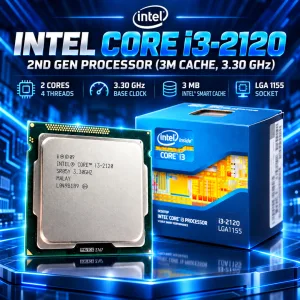
- 2 Cores and 4 Threads with Intel Hyper-Threading Technology
- 3.30 GHz Base Clock Frequency with 3 MB Intel Smart Cache
- Includes Intel HD Graphics 2000 integrated graphics
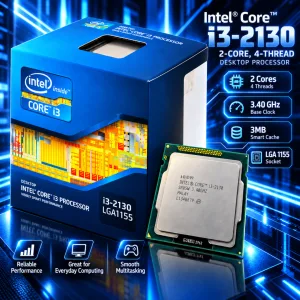
- 2 cores and 4 threads with Intel Hyper-Threading Technology
- 3.40 GHz processor base frequency with 3 MB Intel Smart Cache
- Integrated Intel HD Graphics 2000