

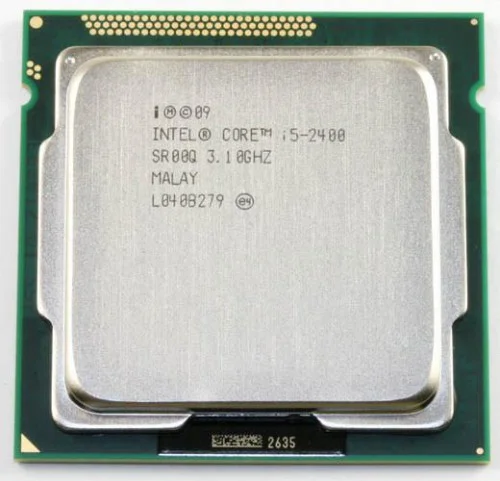
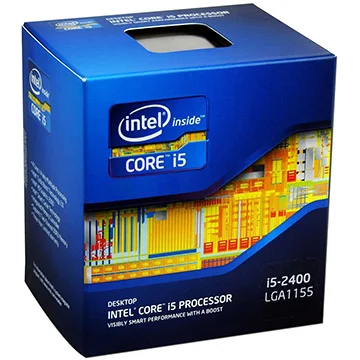
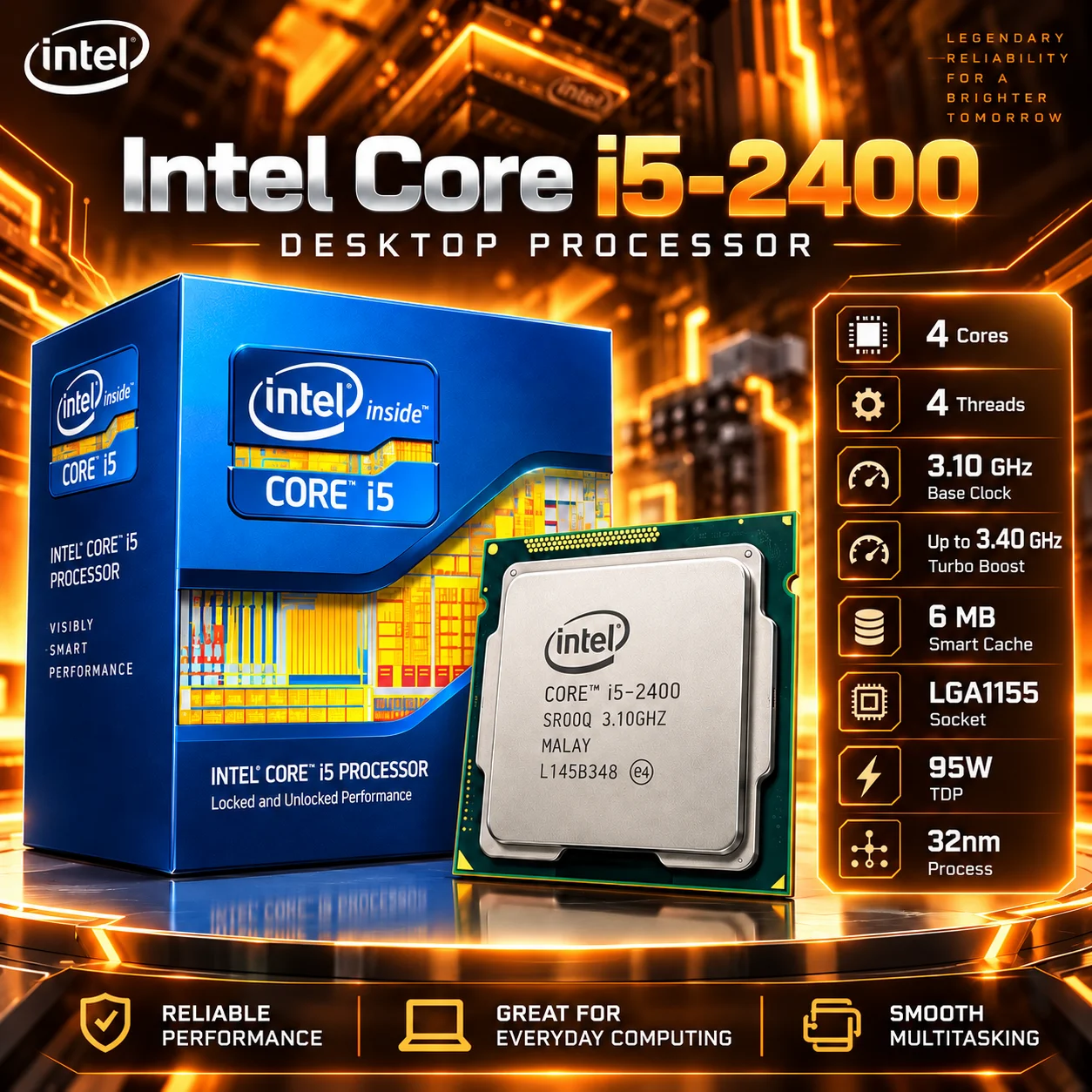
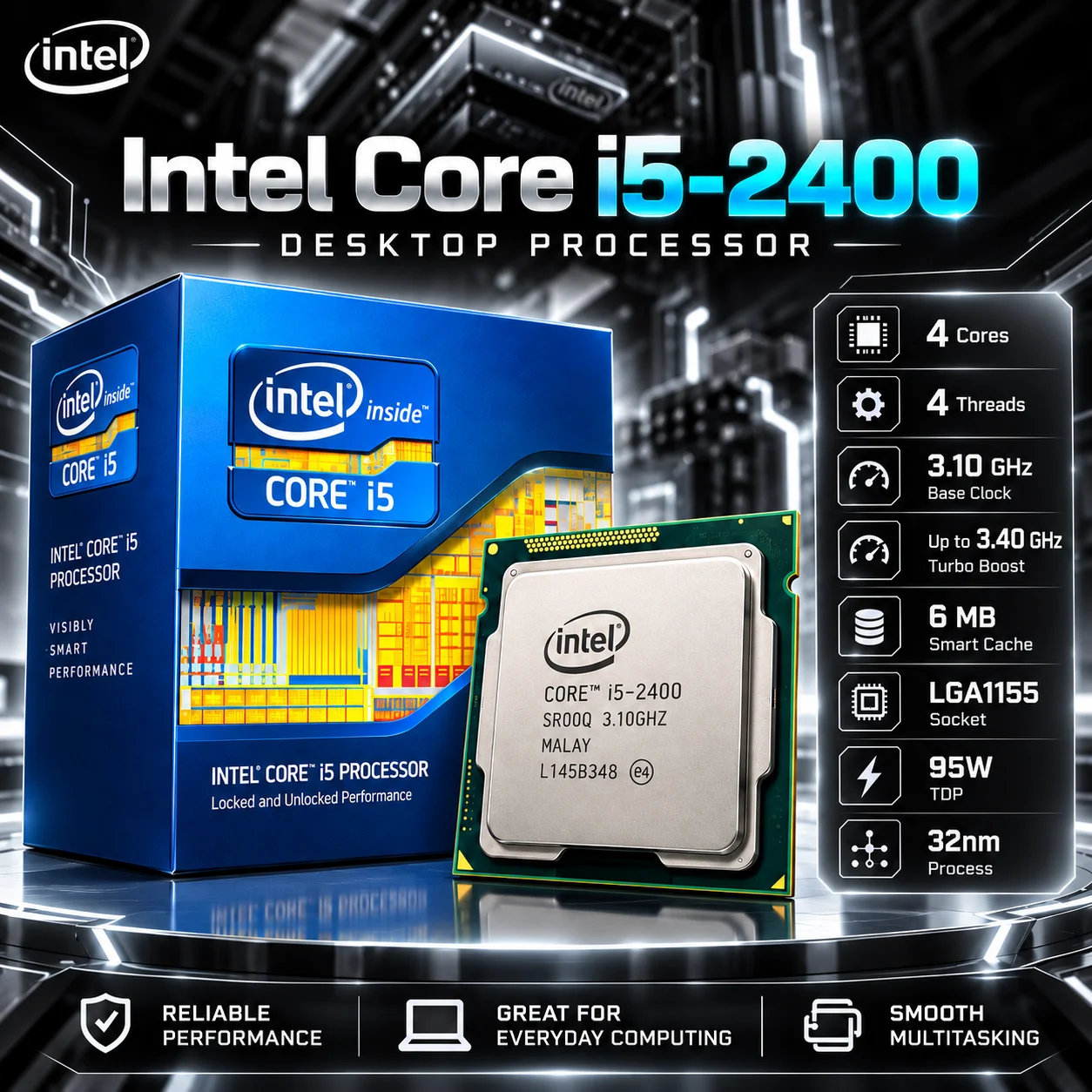
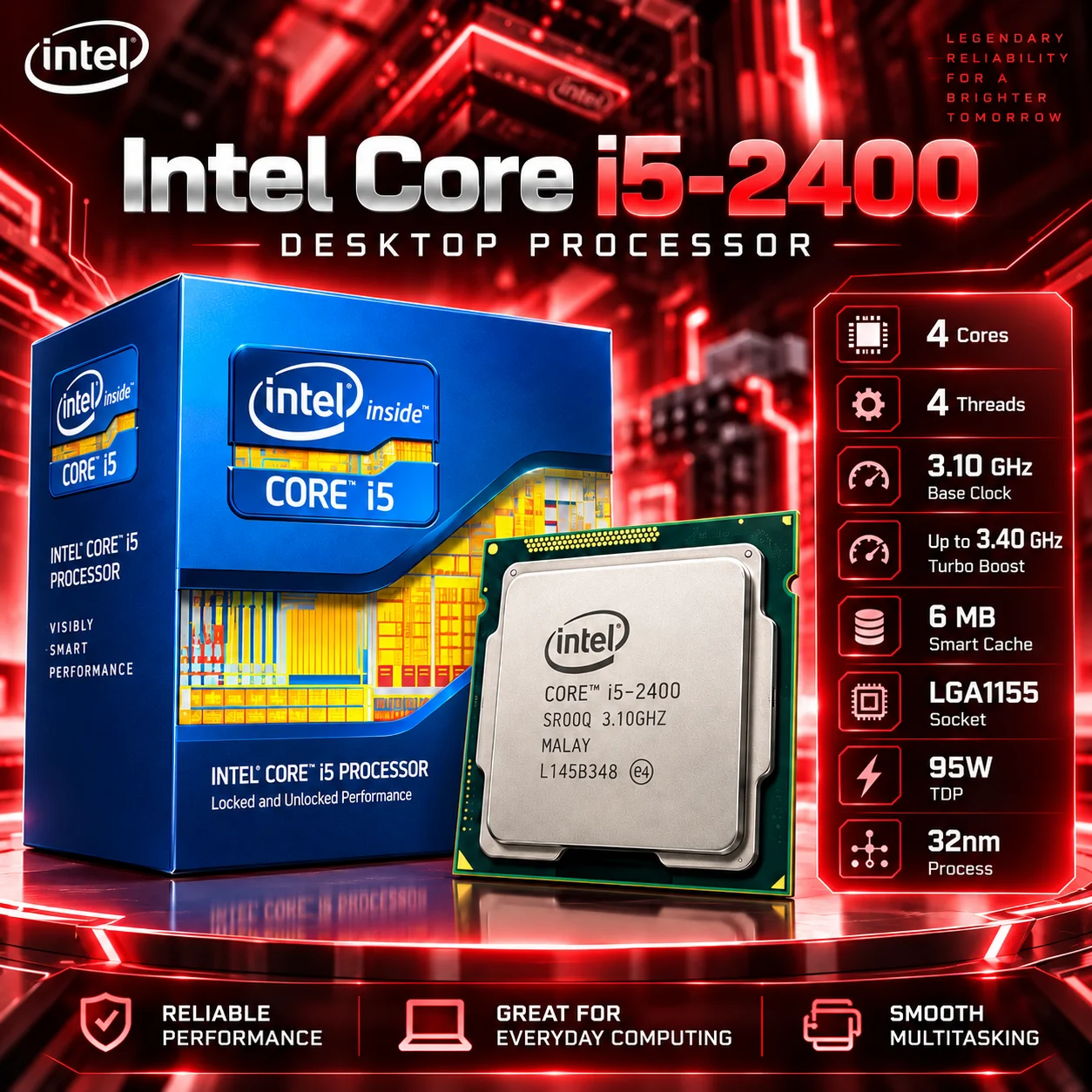
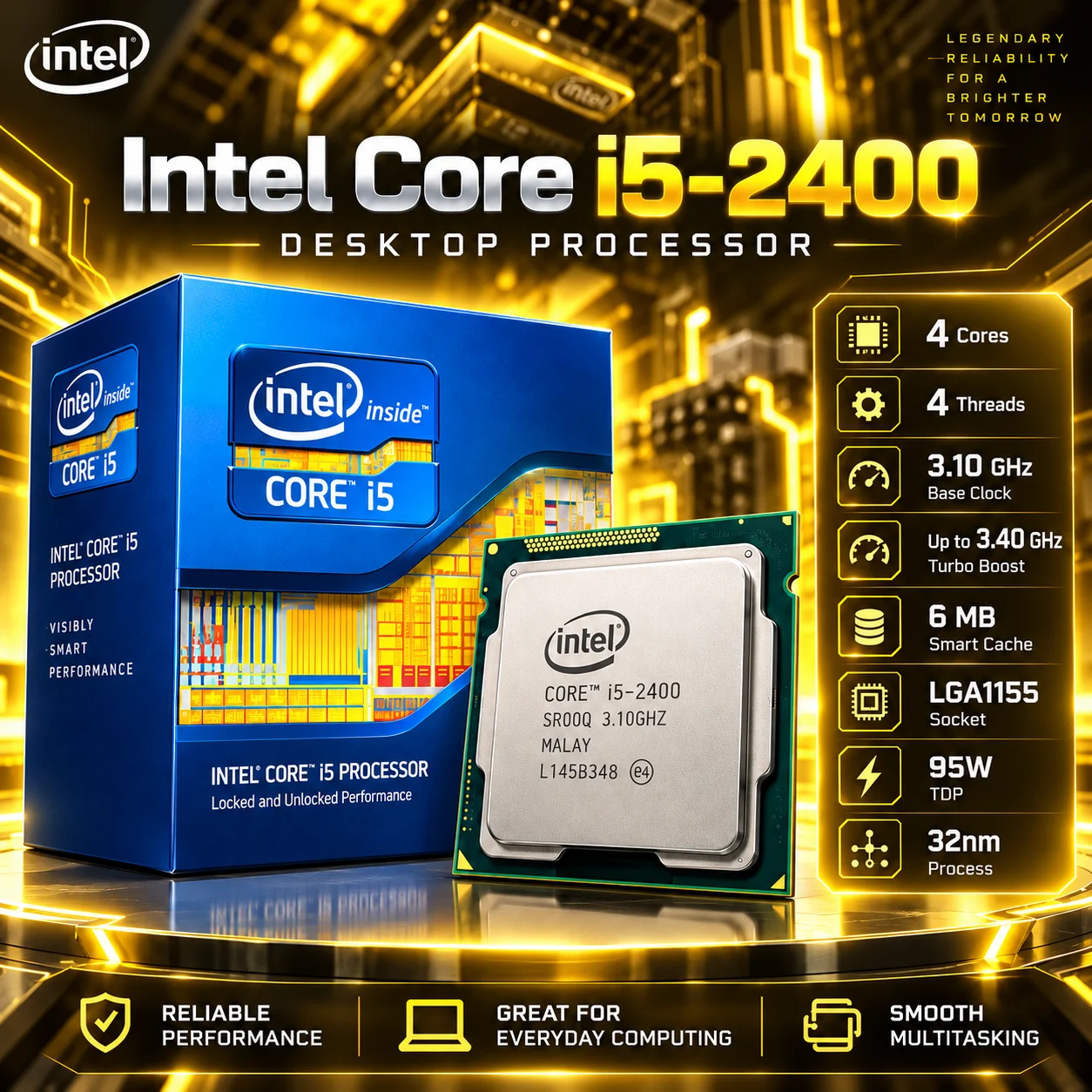
Intel Core i5-2400 Processor (6M Cache, up to 3.40 GHz)
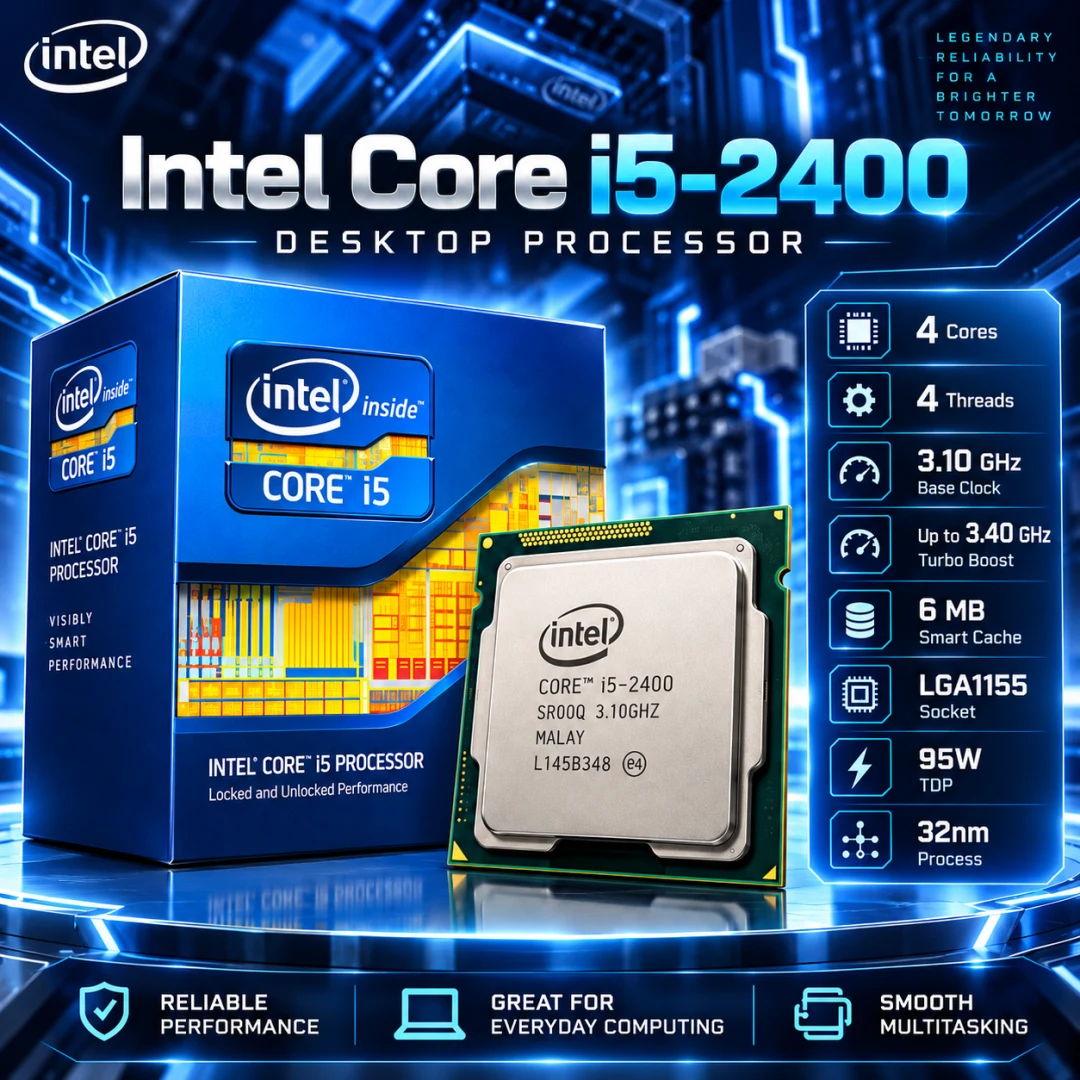
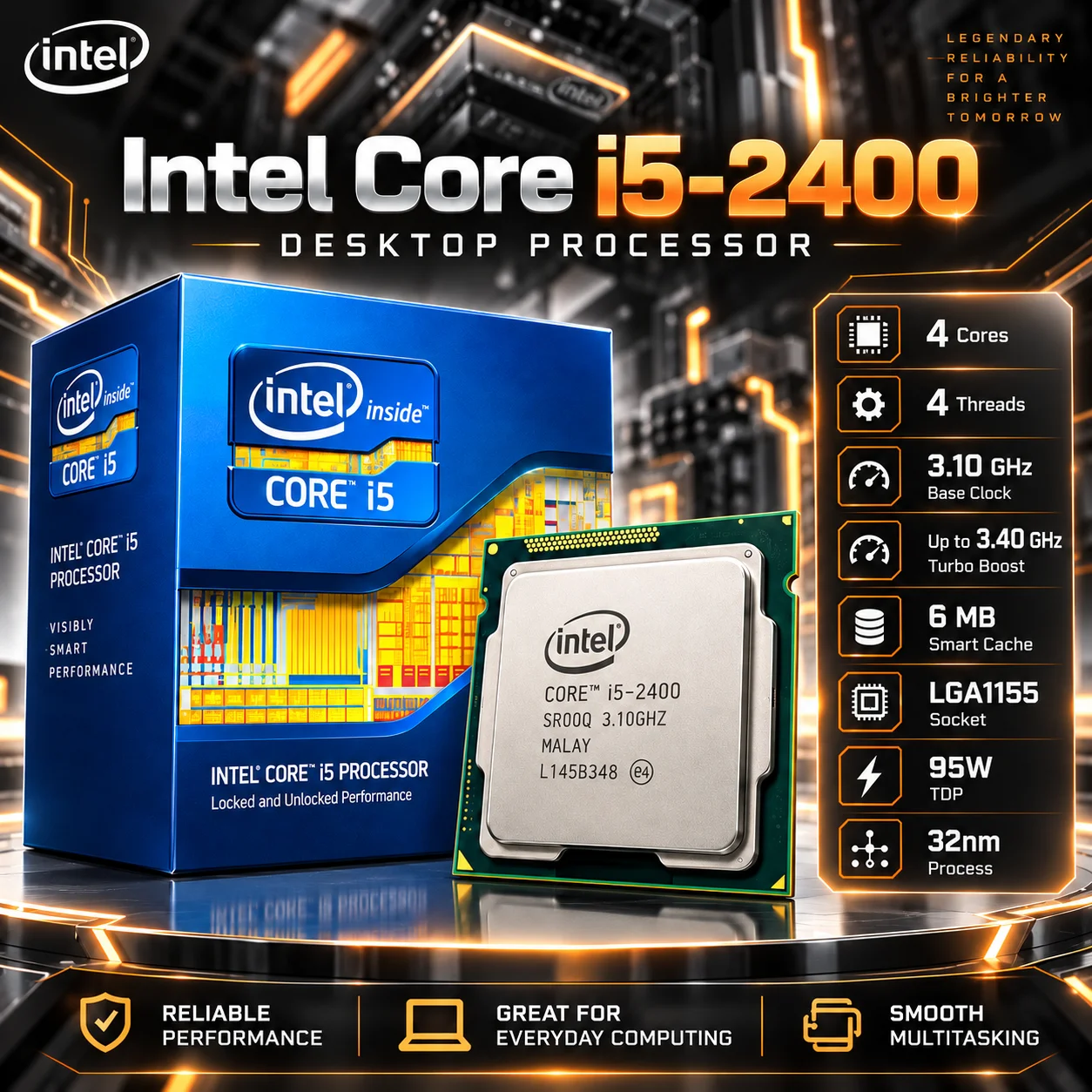
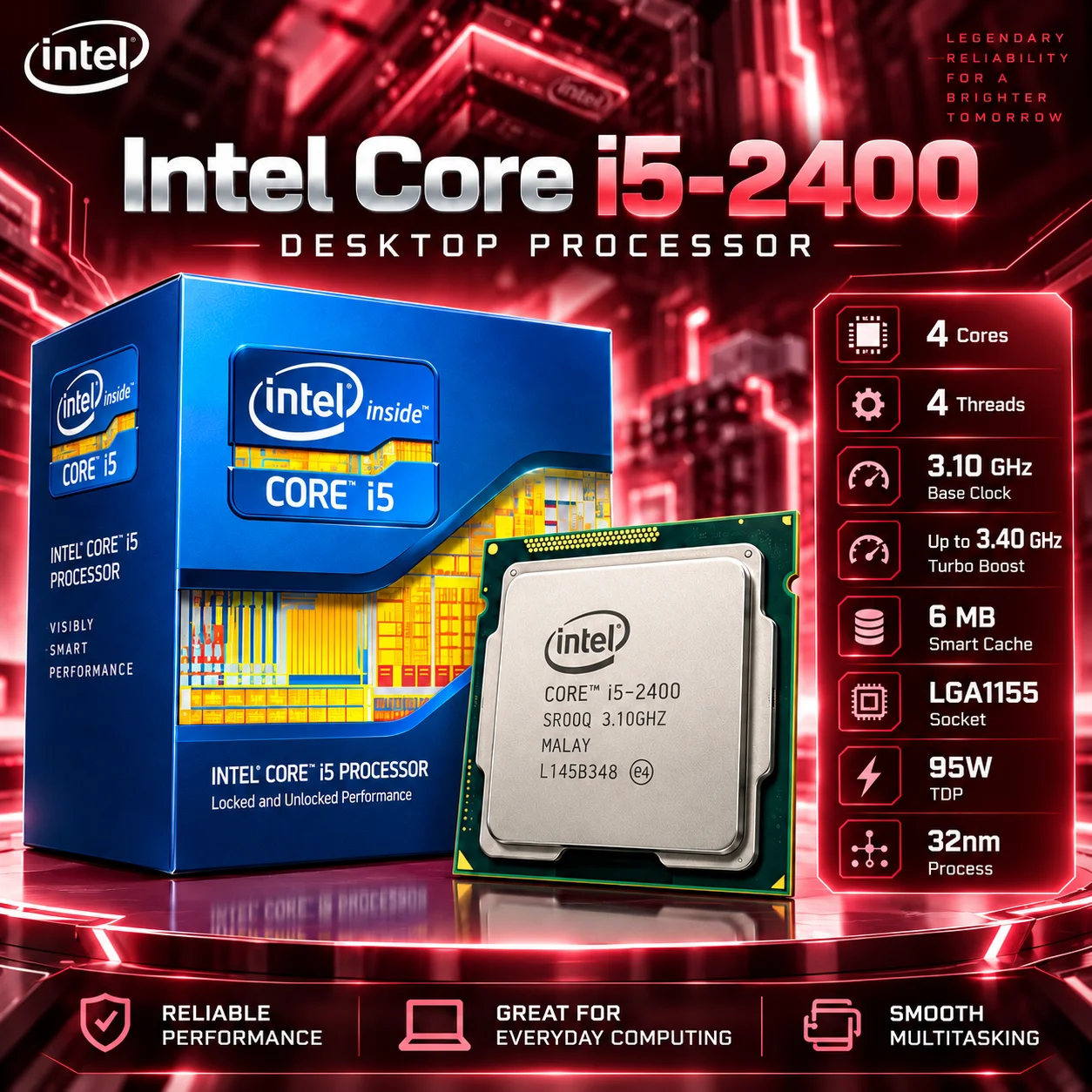
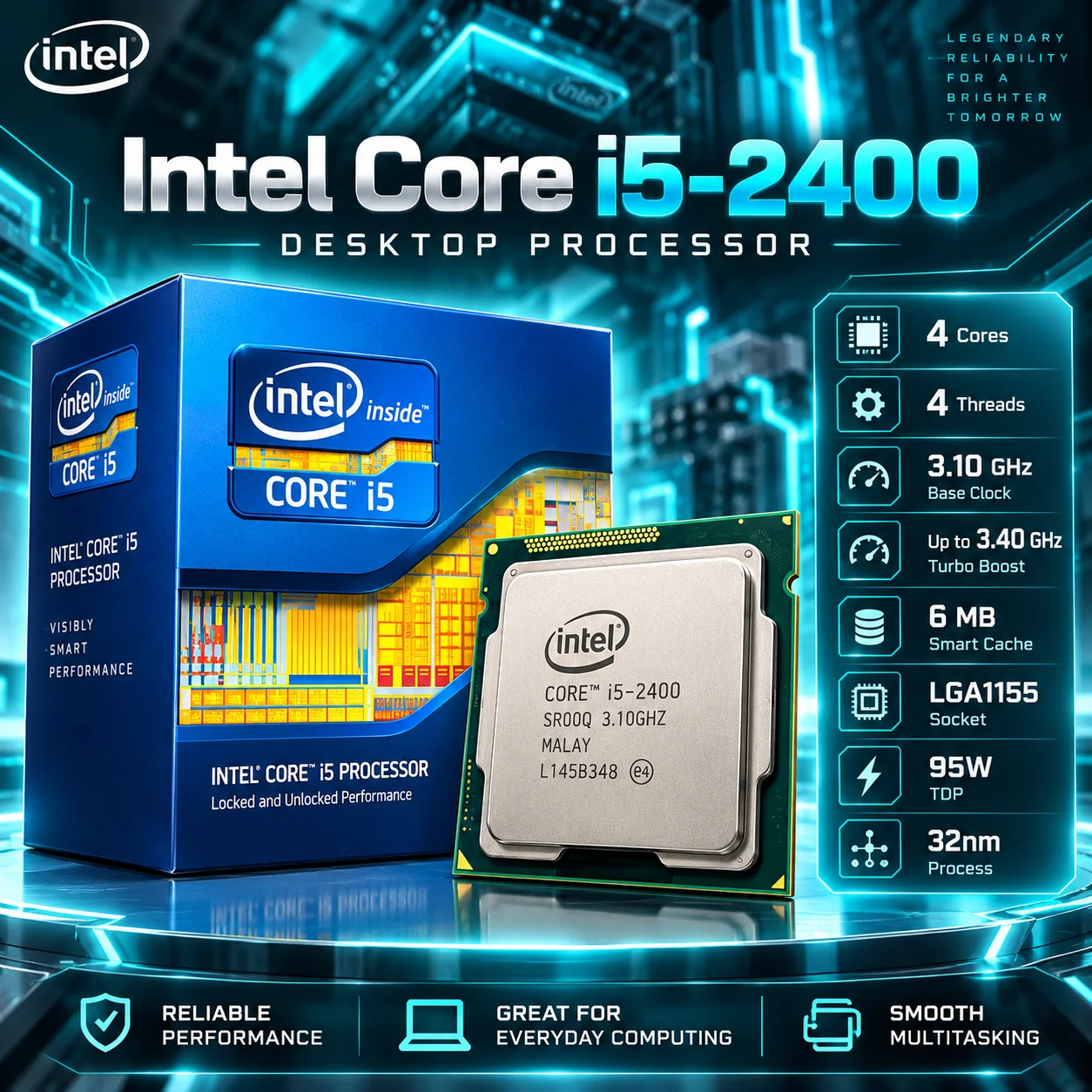
- 4 cores and 4 threads
- 3.10 GHz base frequency with up to 3.40 GHz max turbo frequency
- 6 MB Intel Smart Cache
- Intel HD Graphics 2000 integrated graphics
*Approximate regional retail guide prices. Pixahunt is an informational catalog.
CPU Benchmark Scores & Performance Analysis
TESTEDCinebench R23, Geekbench 6, PassMark CPU Mark scores & real-world gaming/office suitability tests.
Technical Specifications
Comprehensive hardware architecture and specifications
General
| Series | Core i5 |
| Model | i5-2400 |
| Cpu Cooler | Not Included |
| Code-Name | Sandy Bridge |
| Generation | 2nd Gen |
| Sockets Supported | LGA1155 |
Performance
| Base Frequency | 3.10 GHz |
| Turbo Frequency Max. | 3.40 GHz |
| Core | 4 |
| Threads | 4 |
| CPU Cache | 6 MB Intel Smart Cache |
| L1 Cache | 64 KB (per core) |
| L2 Cache | 256 KB (per core) |
| L3 Cache | 6 MB |
| TDP | 95 W |
| Lithography | 32 nm |
| Multiplier | 31.0x |
| Multiplier Unlocked | No |
| Processor Type | Core i5 |
Memory Support
| Memory Max. | 32 GB |
| Memory Type | DDR3 |
| Memory Speed | 1066/1333 MT/s |
| Memory Channel | 2 |
| Max Memory Bandwidth | 21 GB/s |
| ECC Memory Supported | No |
Graphics
| Built-in GPU | Yes |
| Processor Graphics | Intel HD Graphics 2000 |
| Graphics Base Frequency | 850 MHz |
| Graphics Dynamic Frequency | 1.10 GHz |
| Graphics Core Count | N/A |
| Max Video Memory | N/A |
| Max Resolution | N/A |
Technical Info
| DirectX Support | N/A |
| OpenGL Support | N/A |
| Approx. Power Consumption | 95W |
| Compatible Products / Chipsets | Intel 6 Series |
| PCI Express Version | 2.0 |
| PCI Express Lanes | 16 |
| Thermal Solution (MPK / Box) | N/A |
| Max. Operating Temperature (Tjmax) | 72.6°C |
Warranty
| ManufacturingWarranty | N/A |
Additional Info
| Specialty | Intel Turbo Boost Technology 2.0, Intel Virtualization Technology |
| Others | Discontinued Product |
| Country Of Origin | N/A |
| Made in/ Assemble | N/A |
Editorial Overview & Review
In-depth insights, architecture summary, and performance evaluation
Introduction & Overview: The Legend of Sandy Bridge
When Intel released its 2nd Generation Core processors—famously code-named Sandy Bridge—back in early 2011, the tech landscape shifted dramatically. At the heart of this mainstream revolution was the Intel Core i5-2400, a quad-core desktop processor designed for mid-range systems, pre-built office rigs, and budget-conscious custom PC builders.
Positioned comfortably between the entry-level Core i3 line and the enthusiast-grade Core i7 chips, the i5-2400 targeted everyday professionals, gamers on a budget, and home users demanding reliable, multi-threaded performance without breaking the bank. Though officially a discontinued product in Intel’s vast historical archive, this silicon legend still holds a special place in DIY PC culture for its sheer resilience and longevity.
Architecture, Performance & Key Technologies
Built on a mature 32nm lithography process, the Core i5-2400 utilizes the LGA1155 socket and pairs naturally with Intel 6-series chipsets. Under the hood, it features 4 physical cores and 4 threads, shunning Hyper-Threading in favor of pure, unadulterated quad-core execution.
- Clock Speeds: The processor operates at a solid 3.10 GHz base frequency, scaling dynamically up to a 3.40 GHz Turbo Frequency Max via Intel Turbo Boost Technology 2.0.
- Cache Architecture: It boasts 6 MB of Intel Smart Cache (shared L3), backed by 256 KB of L2 cache and 64 KB of L1 cache per core.
- Power & Efficiency: With a 95W TDP (Thermal Design Power) and a maximum operating temperature (Tjmax) of 72.6°C, it balances desktop power delivery requirements efficiently for its era.
- Memory Subsystem: The integrated memory controller supports dual-channel DDR3 memory speeds up to 1333 MT/s, delivering a maximum bandwidth of 21 GB/s across up to 32 GB of RAM.
- Graphics: It includes on-board Intel HD Graphics 2000, operating with a base frequency of 850 MHz and a dynamic frequency up to 1.10 GHz, providing basic display outputs and hardware video acceleration out of the box.
It is worth noting that with a Multiplier Unlocked status of "No" and a fixed 31.0x multiplier, overclocking enthusiasts won't find much headroom here—this chip was engineered for rock-solid stability at stock speeds.
Real-World Use Cases
How does a veteran processor hold up? Historically, the Intel Core i5-2400 has been a staple of budget productivity and entry-level gaming setups.
For daily productivity and office tasks, this processor remains more than capable. Web browsing with dozens of tabs, heavy spreadsheet management, document editing, and video conferencing are handled smoothly, especially when paired with an SSD and at least 8GB of DDR3 RAM.
In the realm of gaming, the i5-2400 earned its reputation as a legendary budget pairing for second-hand graphics cards like the GTX 750 Ti, GTX 1050 Ti, or RX 570. While modern AAA titles will heavily bottleneck on its four non-hyper-threaded cores, eSports titles (like CS:GO, League of Legends, and Valorant) alongside older classics remain entirely playable at respectable frame rates.
For content creation, its lack of modern instruction sets and high core/thread counts means heavy 4K video editing or complex 3D rendering will test your patience, though basic photo editing and 1080p video cuts are manageable for hobbyists.
Strengths & Potential Considerations
To evaluate the i5-2400 objectively, we have to weigh its historical architecture against the modern computing environment:
- Strengths (Pros):
- Incredible longevity and historical reliability.
- True quad-core performance that easily handles basic computing and light eSports gaming.
- Extremely affordable on the used and secondary hardware markets.
- Includes functional integrated graphics (Intel HD 2000) for troubleshooting or basic display setups.
- Supports Intel Virtualization Technology for basic lab environments and virtual machines.
- Potential Considerations (Cons):
- Officially discontinued and lacking modern security mitigations/instruction sets.
- Locked multiplier limits any performance gains via overclocking.
- Lacks ECC memory support and PCIe 3.0 (restricted to PCIe 2.0 lanes).
- Struggles heavily with modern, multi-threaded AAA gaming and heavy workstation workloads.
- DDR3 memory standard is heavily outdated compared to modern DDR4/DDR5 platforms.
Final Buying Verdict
The Intel Core i5-2400 is a monument to durable hardware engineering. While it is entirely obsolete for high-end gaming, professional content creation, or modern enterprise workloads, it remains a fantastic choice for ultra-budget retro builds, office restoration projects, or an inexpensive home media server.
If you are looking to build a modern gaming rig or a future-proof workstation, look toward current-generation hardware. However, if you find a complete system or chip on the used market for pocket change, the i5-2400 still has enough life left in it to serve as a reliable, highly capable daily driver for basic computing needs.
OUR RATING CONSENSUS
The overall rating is based on review by our experts & industry benchmark suites
Quick Snapshot
- Overall Rating
- 5.1 / 10
- Brand
- Intel
- Category
- Processor
- Catalog Model
- i5-2400
- Status
- Published
- Release Date
- Oct 10, 2026
Pixahunt Tech Community
Connect with hardware enthusiasts, compare benchmarks, and explore real user setups.
Explore Full Newsfeed →Related Gadgets
- 3.20 GHz Dual-Core Clock Speed for Reliable Everyday Computing
- Intel Hyper-Threading Technology Enabling 4 Parallel Threads
- Built-in Intel HD Graphics for Integrated Display Support
- 2 cores and 4 threads with Intel Hyper-Threading Technology
- 3.10 GHz base processor frequency
- 3 MB Intel Smart Cache
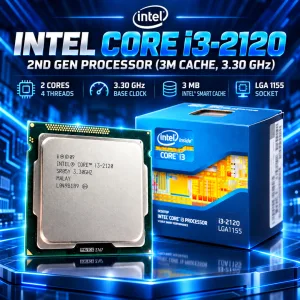
- 2 Cores and 4 Threads with Intel Hyper-Threading Technology
- 3.30 GHz Base Clock Frequency with 3 MB Intel Smart Cache
- Includes Intel HD Graphics 2000 integrated graphics
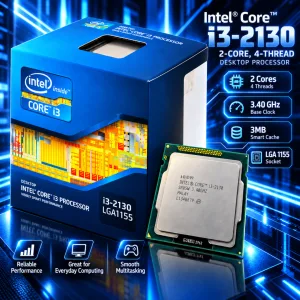
- 2 cores and 4 threads with Intel Hyper-Threading Technology
- 3.40 GHz processor base frequency with 3 MB Intel Smart Cache
- Integrated Intel HD Graphics 2000