

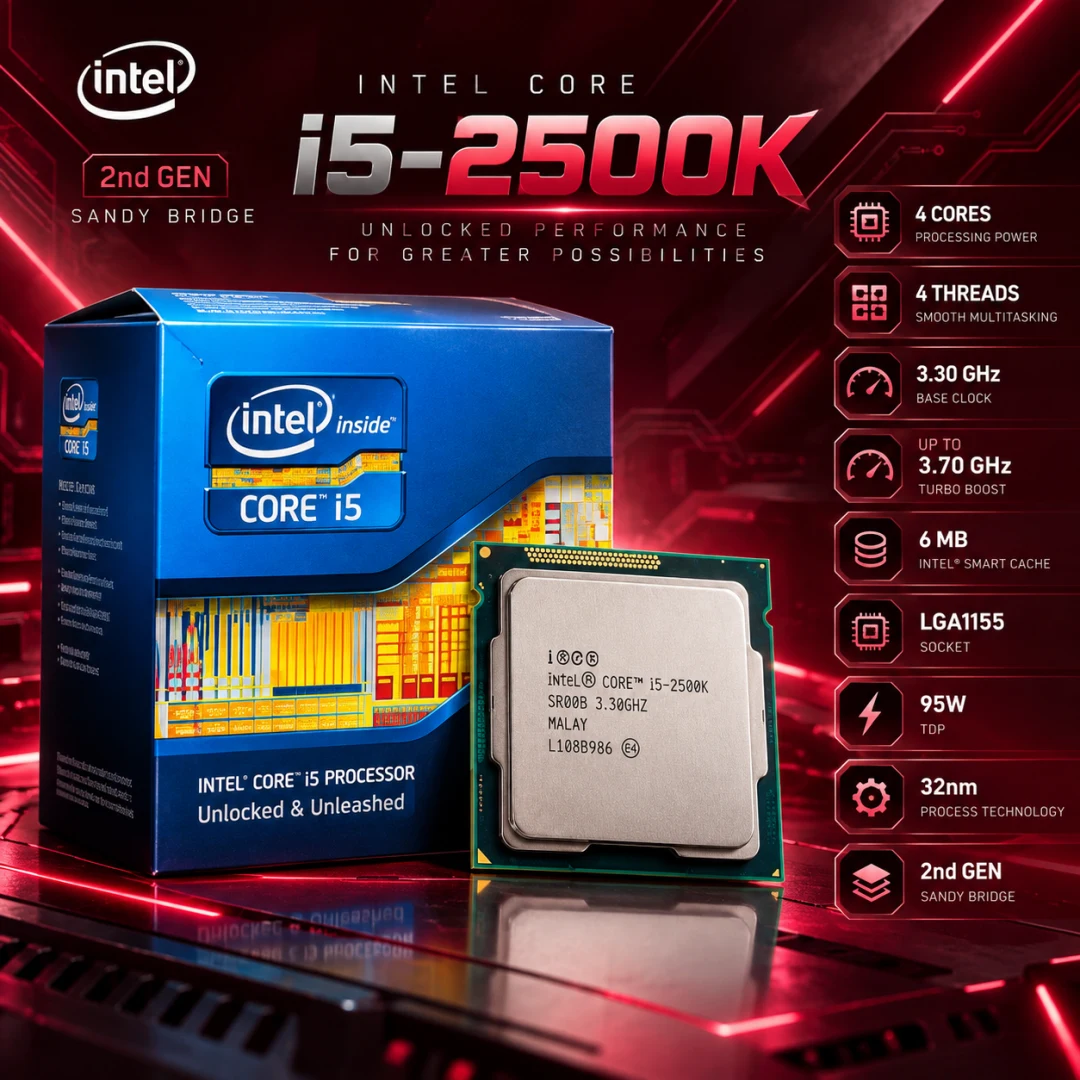
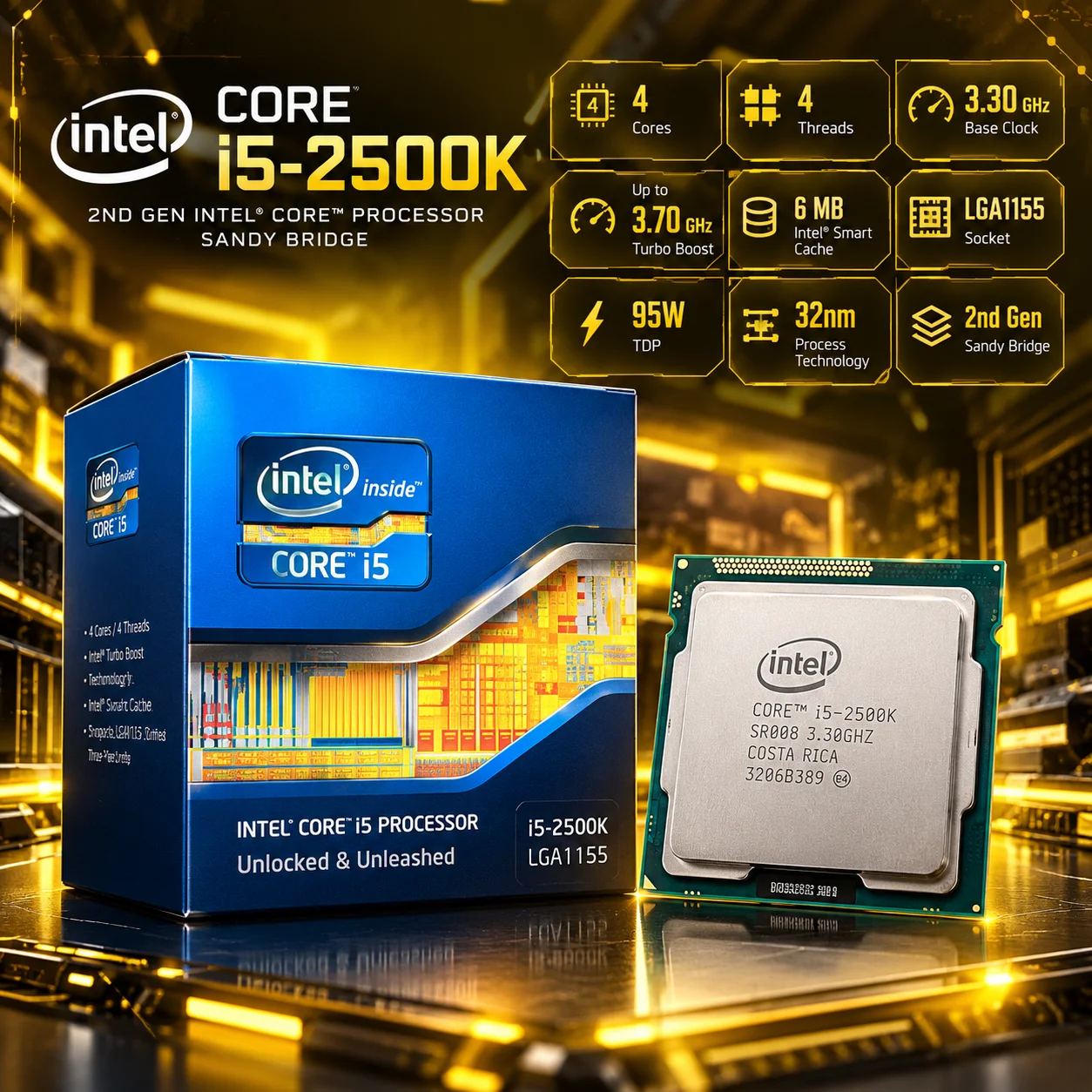
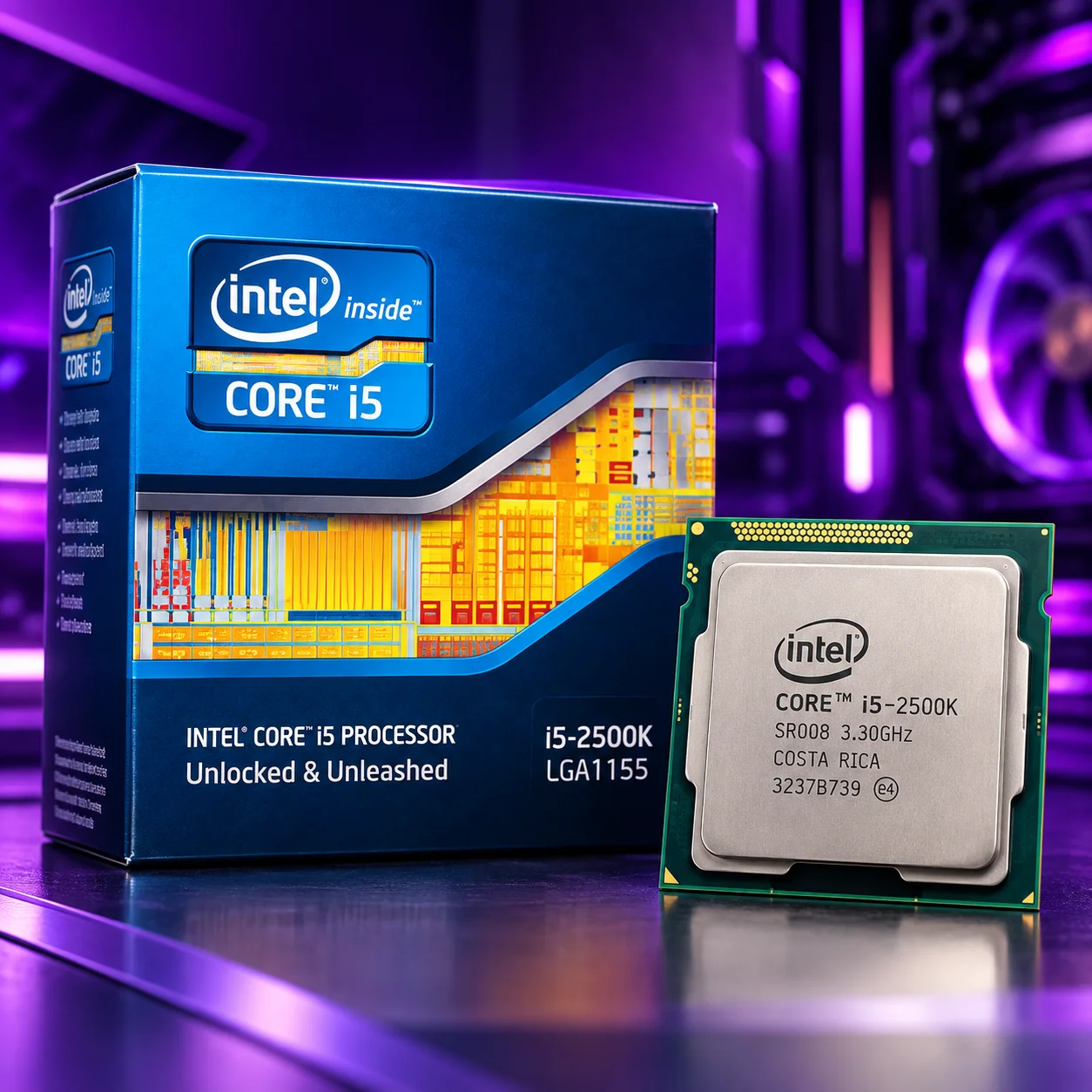
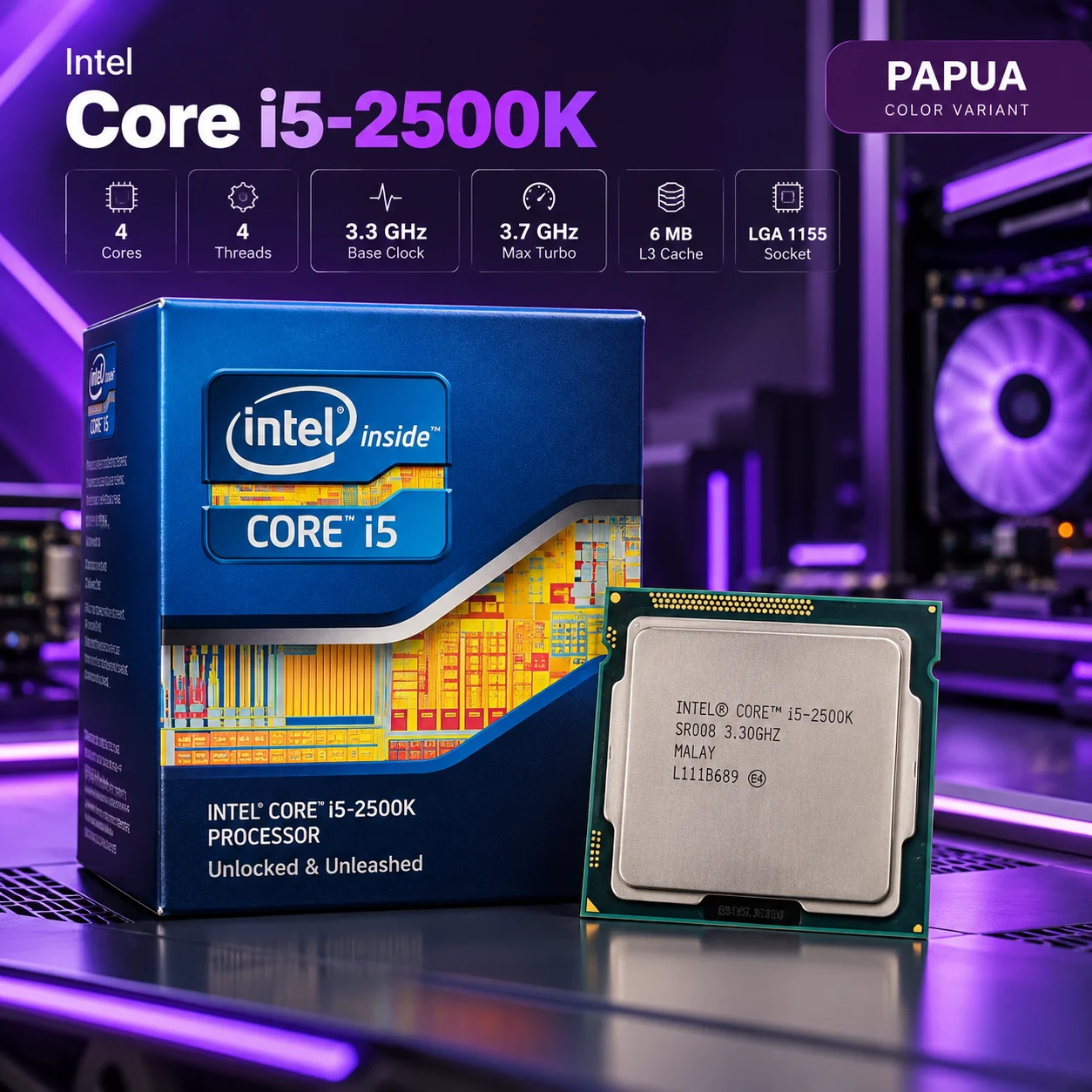
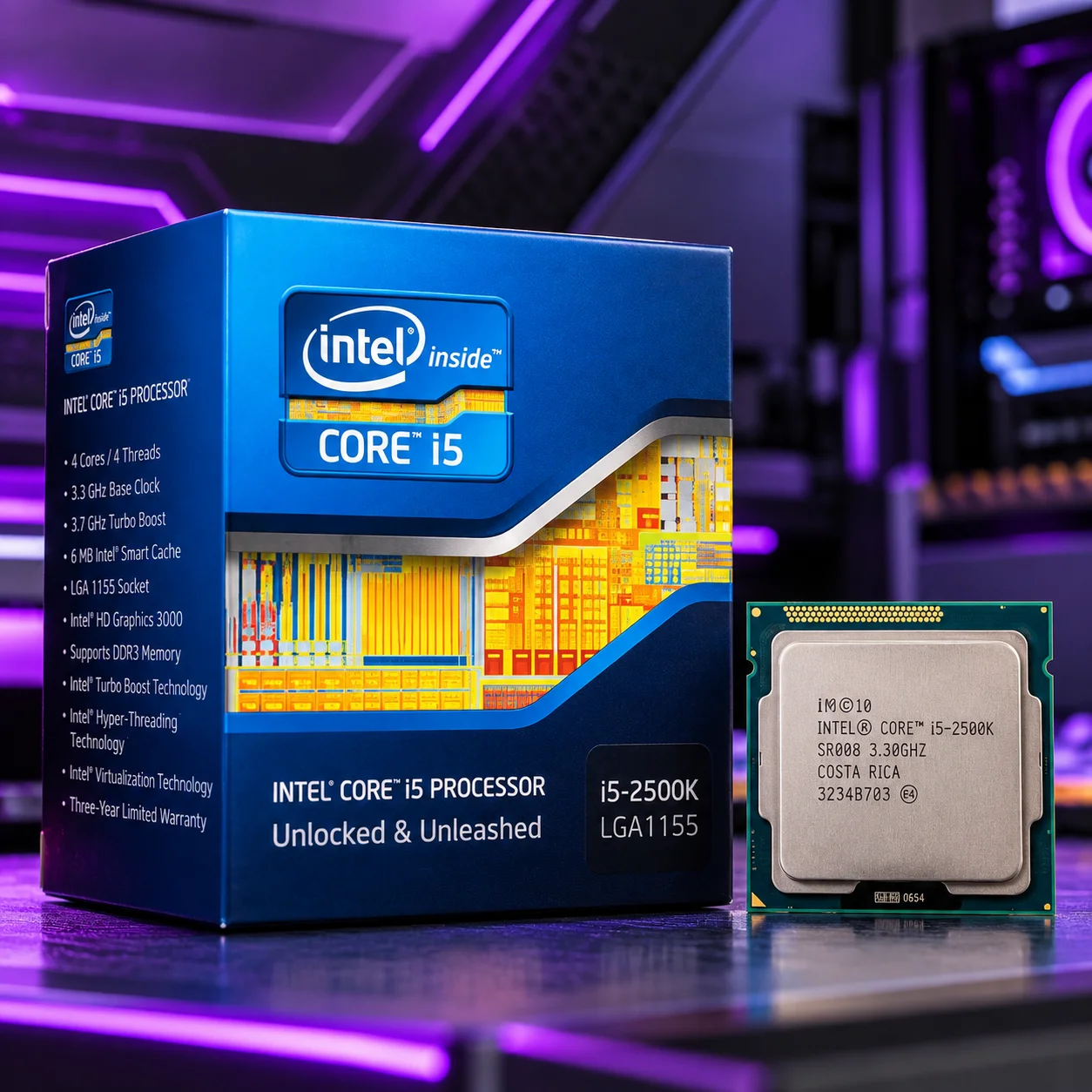
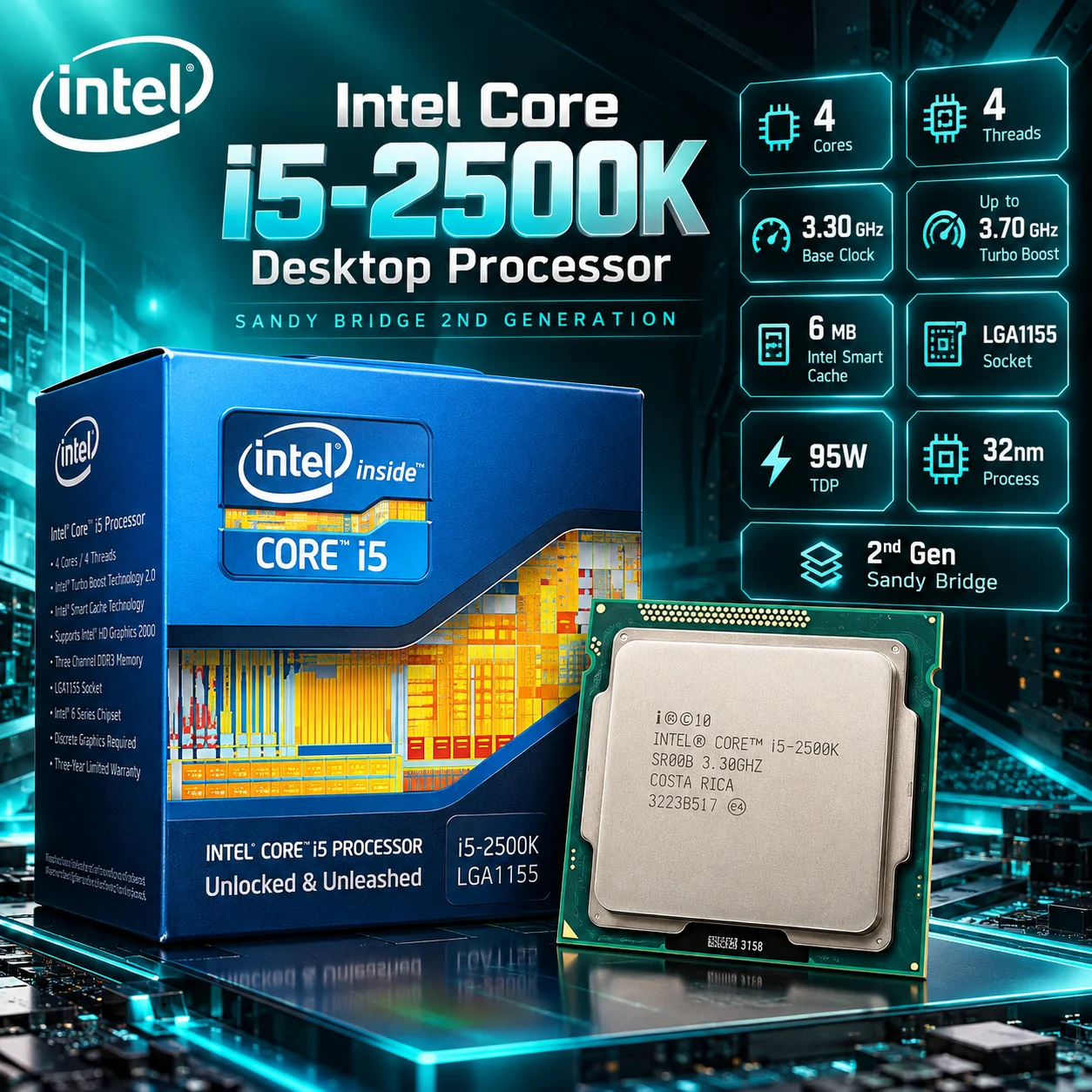
Intel Core i5-2500K Processor (6M Cache, up to 3.70 GHz)
- 4 Cores and 4 Threads
- 3.30 GHz base frequency with up to 3.70 GHz max turbo frequency
- Unlocked multiplier for easy overclocking
- Intel HD Graphics 3000 integrated graphics
*Approximate regional retail guide prices. Pixahunt is an informational catalog.
CPU Benchmark Scores & Performance Analysis
TESTEDCinebench R23, Geekbench 6, PassMark CPU Mark scores & real-world gaming/office suitability tests.
Technical Specifications
Comprehensive hardware architecture and specifications
General
| Series | Core i5 |
| Model | i5-2500K |
| Cpu Cooler | Not Included |
| Code-Name | Sandy Bridge |
| Generation | 2nd Gen |
| Sockets Supported | LGA1155 |
Performance
| Base Frequency | 3.30 GHz |
| Turbo Frequency Max. | 3.70 GHz |
| Core | 4 |
| Threads | 4 |
| CPU Cache | 6 MB Intel Smart Cache |
| L1 Cache | 256 KB |
| L2 Cache | 1 MB |
| L3 Cache | 6 MB |
| TDP | 95W |
| Lithography | 32 nm |
| Multiplier | 33.0x |
| Multiplier Unlocked | Yes |
| Processor Type | Core i5 |
Memory Support
| Memory Max. | 32 GB |
| Memory Type | DDR3 1066/1333 |
| Memory Speed | 1333 MT/s |
| Memory Channel | 2 |
| Max Memory Bandwidth | 21 GB/s |
| ECC Memory Supported | No |
Graphics
| Built-in GPU | Yes |
| Processor Graphics | Intel HD Graphics 3000 |
| Graphics Base Frequency | 850 MHz |
| Graphics Dynamic Frequency | 1.10 GHz |
| Graphics Core Count | N/A |
| Max Video Memory | N/A |
| Max Resolution | N/A |
Technical Info
| DirectX Support | 10.1 |
| OpenGL Support | 3.1 |
| Approx. Power Consumption | 95W |
| Compatible Products / Chipsets | Intel 6 Series (H61, H67, P67, Z68), Intel 7 Series (Z75, Z77) |
| PCI Express Version | 2.0 |
| PCI Express Lanes | 16 |
| Thermal Solution (MPK / Box) | Not Included |
| Max. Operating Temperature (Tjmax) | 72.6°C |
Warranty
| ManufacturingWarranty | Discontinued Product (No active warranty) |
Additional Info
| Specialty | Intel Quick Sync Video, Intel Turbo Boost Technology 2.0, Unlocked for Overclocking |
| Others | OS Support: Windows, Linux |
| Country Of Origin | USA |
| Made in/ Assemble | Costa Rica / Malaysia |
Editorial Overview & Review
In-depth insights, architecture summary, and performance evaluation
Introduction & Overview: The Legend of Sandy Bridge
In the vast timeline of consumer computing, few processors achieve legendary status. Intel’s Core i5-2500K, belonging to the 2nd Generation "Sandy Bridge" family on the LGA1155 socket, is arguably one of the most beloved and impactful CPUs ever released. Positioned squarely in the mid-range performance tier upon its debut, it was designed with one clear target audience in mind: savvy gamers, enthusiasts, and performance-conscious builders who wanted high-end capabilities without paying the extortionate "Extreme Edition" tax.
What cemented the i5-2500K in hardware hall-of-fame history was not just its stock capability, but its democratisation of overclocking. Featuring an unlocked multiplier packaged with a rock-solid architecture, it became the undisputed king of value, turning budget rigs into high-performance powerhouses with a simple tweak in the BIOS.
Architecture, Performance & Key Technologies
Built on a mature 32nm lithography process, the i5-2500K operates on a 4-core, 4-thread layout (eschewing hyper-threading, which was reserved for the pricier i7 tier). Out of the box, it features a base frequency of 3.30 GHz that dynamically scales up to 3.70 GHz via Intel Turbo Boost Technology 2.0. Backed by 6 MB of Intel Smart Cache and a 95W TDP, it struck an exceptional balance between thermal output and raw compute strength.
- The Overclocking Champion: Thanks to the unlocked multiplier, paired with compatible chipsets like the P67, Z68, and Z77, enthusiasts routinely pushed this chip past the 4.5 GHz mark on modest air cooling, extracting monumental generational performance gains.
- Graphics & Media Acceleration: It includes Intel HD Graphics 3000 (operating up to 1.10 GHz dynamically), along with Intel Quick Sync Video—a hardware-accelerated video transcoding feature that was years ahead of its time and revolutionized local video editing workflows.
- Memory Subsystem: Supporting dual-channel DDR3 memory up to 1333 MT/s (with reliable headroom for faster enthusiast kits) and 16 PCIe 2.0 lanes, it provided ample bandwidth for the GPU and storage configurations of its era.
Real-World Use Cases: How It Holds Up
When evaluated in its historical context, the i5-2500K was an absolute monster for daily productivity, demanding office multitasking, and gaming. Its strong IPC (Instructions Per Cycle) meant that quad-core computing felt snappy, responsive, and entirely unhindered by everyday applications.
In gaming, paired with a discrete graphics card, it served as the baseline recommendation for mid-to-high-tier builds for years. It easily crushed multi-threaded titles of its generation and kept pace with newer architectures well past its expected lifecycle due to its massive headroom when overclocked. For content creators, features like Quick Sync made rendering and video conversion shockingly fast, lightening the load for creators working on 1080p pipelines.
Strengths & Potential Considerations
Every piece of hardware has its high points and limitations, especially when looking back at a classic product:
- Pros:
- Legendary overclocking capability with massive frequency headroom.
- Incredible longevity, offering usable performance long past its launch window.
- Intel Quick Sync hardware acceleration for seamless video transcoding.
- Robust platform stability across 6-series and 7-series chipsets.
- Cons:
- Limited to 4 cores and 4 threads, lacking modern multi-threading density for heavy modern productivity workloads.
- Stuck on older PCIe 2.0 and DDR3 memory standards.
- Official manufacturer warranty has expired as it is a discontinued product.
Final Buying Verdict
The Intel Core i5-2500K is a masterclass in processor engineering—a chip that delivered performance way above its weight class and refused to become obsolete. Today, as a brand-new retail purchase, its time has naturally passed, superseded by modern multi-core architectures boasting DDR5 and PCIe 4.0/5.0 support.
However, as a cornerstone of computing history, a budget secondhand build, or a nostalgic project piece, the i5-2500K remains an awe-inspiring slice of silicon. It taught a whole generation of builders the joy of overclocking and set a golden standard for price-to-performance that manufacturers still strive to match today.
OUR RATING CONSENSUS
The overall rating is based on review by our experts & industry benchmark suites
Quick Snapshot
- Overall Rating
- 4.5 / 10
- Brand
- Intel
- Category
- Processor
- Catalog Model
- i5-2500K
- Status
- Published
Pixahunt Tech Community
Connect with hardware enthusiasts, compare benchmarks, and explore real user setups.
Explore Full Newsfeed →Related Gadgets
- 3.20 GHz Dual-Core Clock Speed for Reliable Everyday Computing
- Intel Hyper-Threading Technology Enabling 4 Parallel Threads
- Built-in Intel HD Graphics for Integrated Display Support
- 2 cores and 4 threads with Intel Hyper-Threading Technology
- 3.10 GHz base processor frequency
- 3 MB Intel Smart Cache
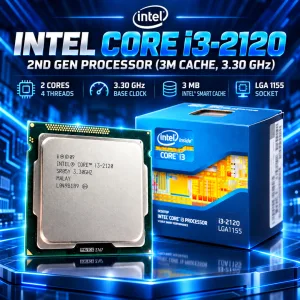
- 2 Cores and 4 Threads with Intel Hyper-Threading Technology
- 3.30 GHz Base Clock Frequency with 3 MB Intel Smart Cache
- Includes Intel HD Graphics 2000 integrated graphics
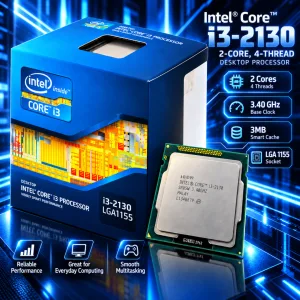
- 2 cores and 4 threads with Intel Hyper-Threading Technology
- 3.40 GHz processor base frequency with 3 MB Intel Smart Cache
- Integrated Intel HD Graphics 2000