

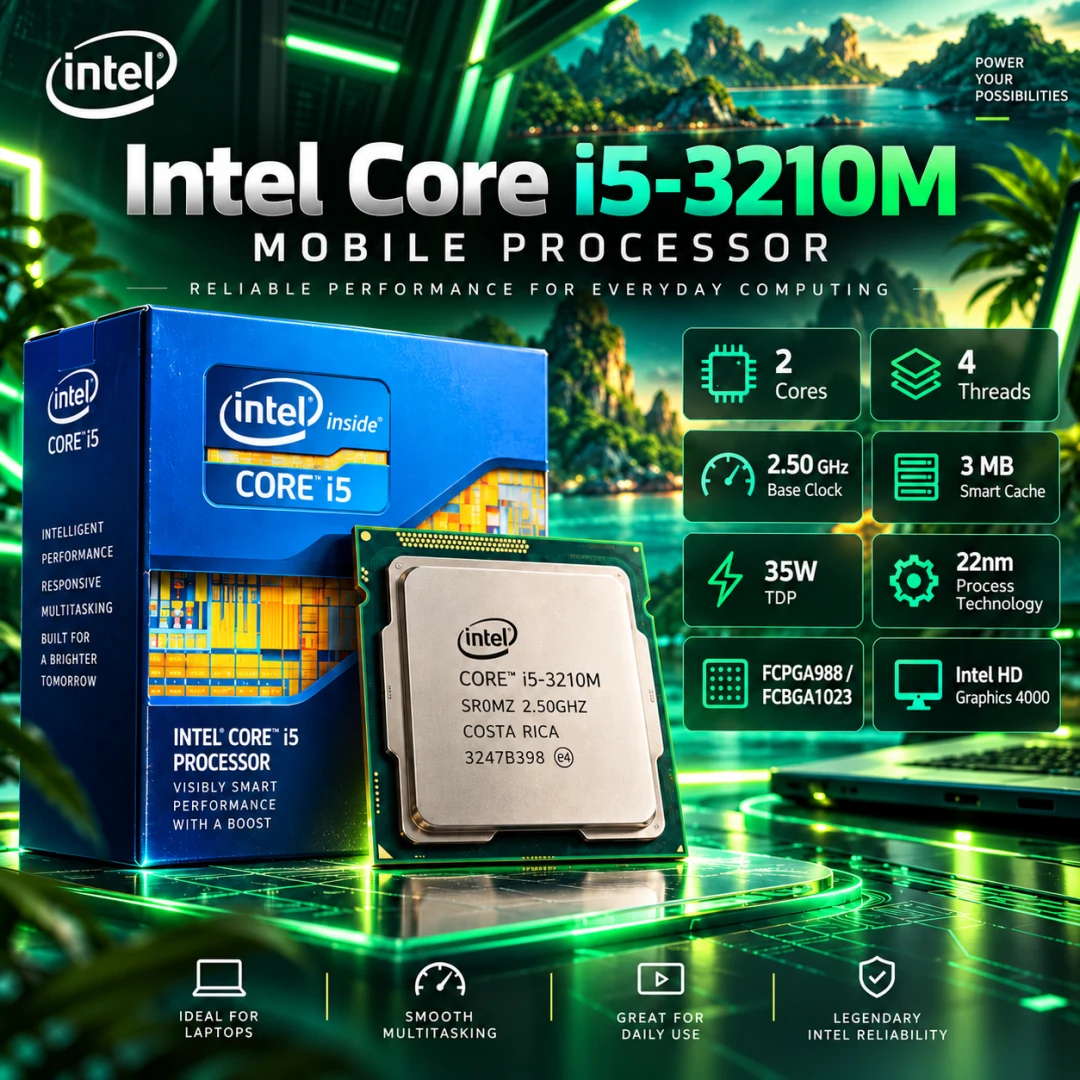
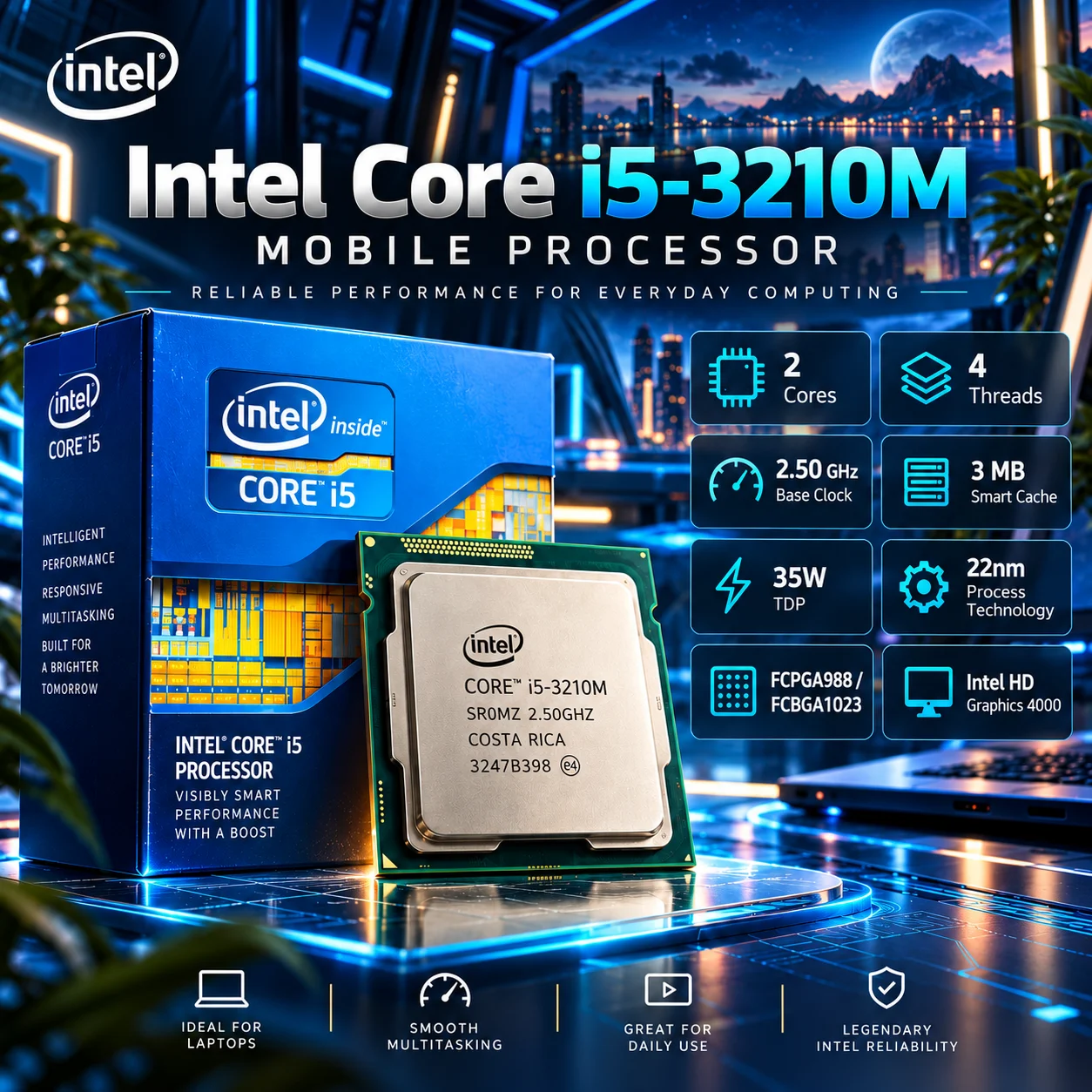
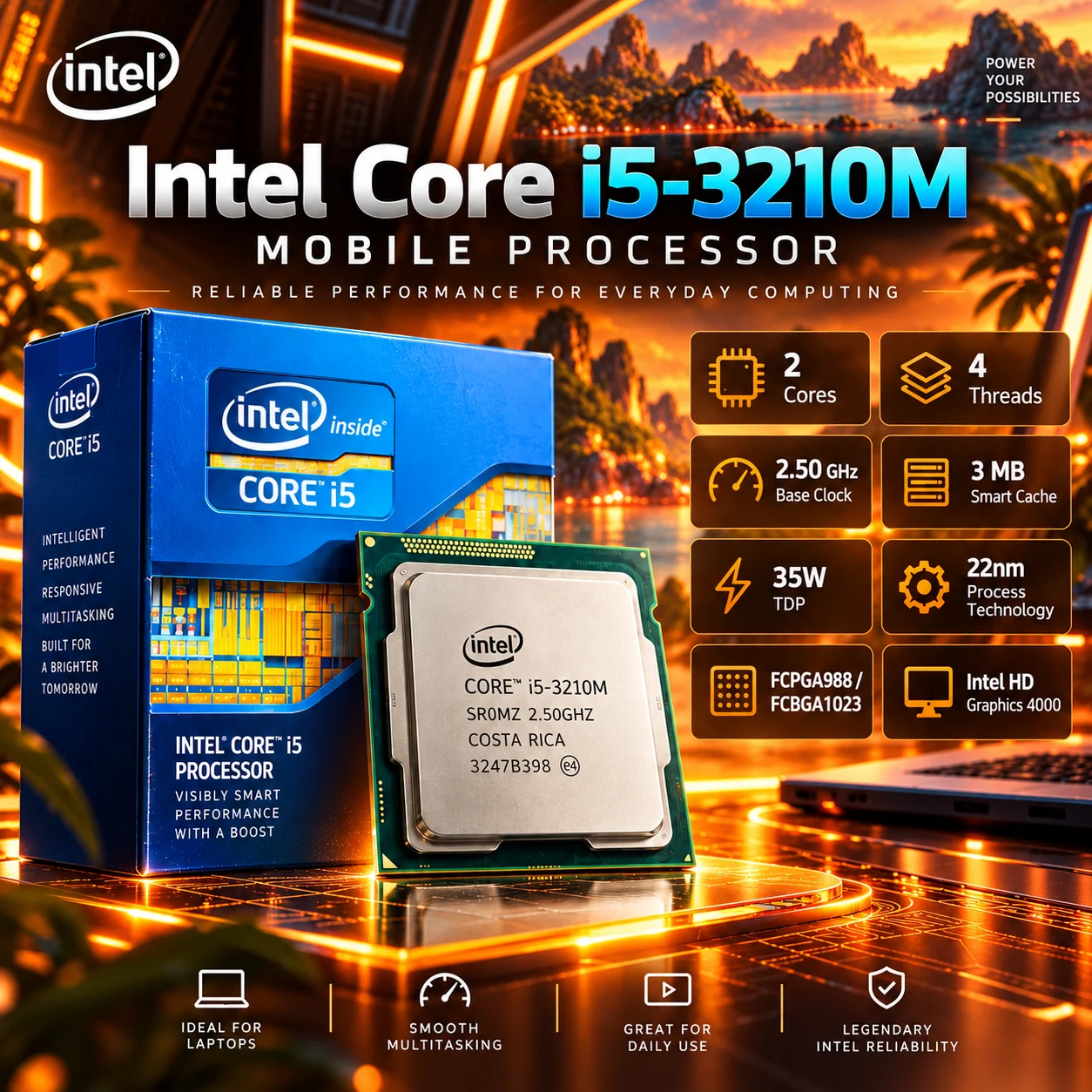
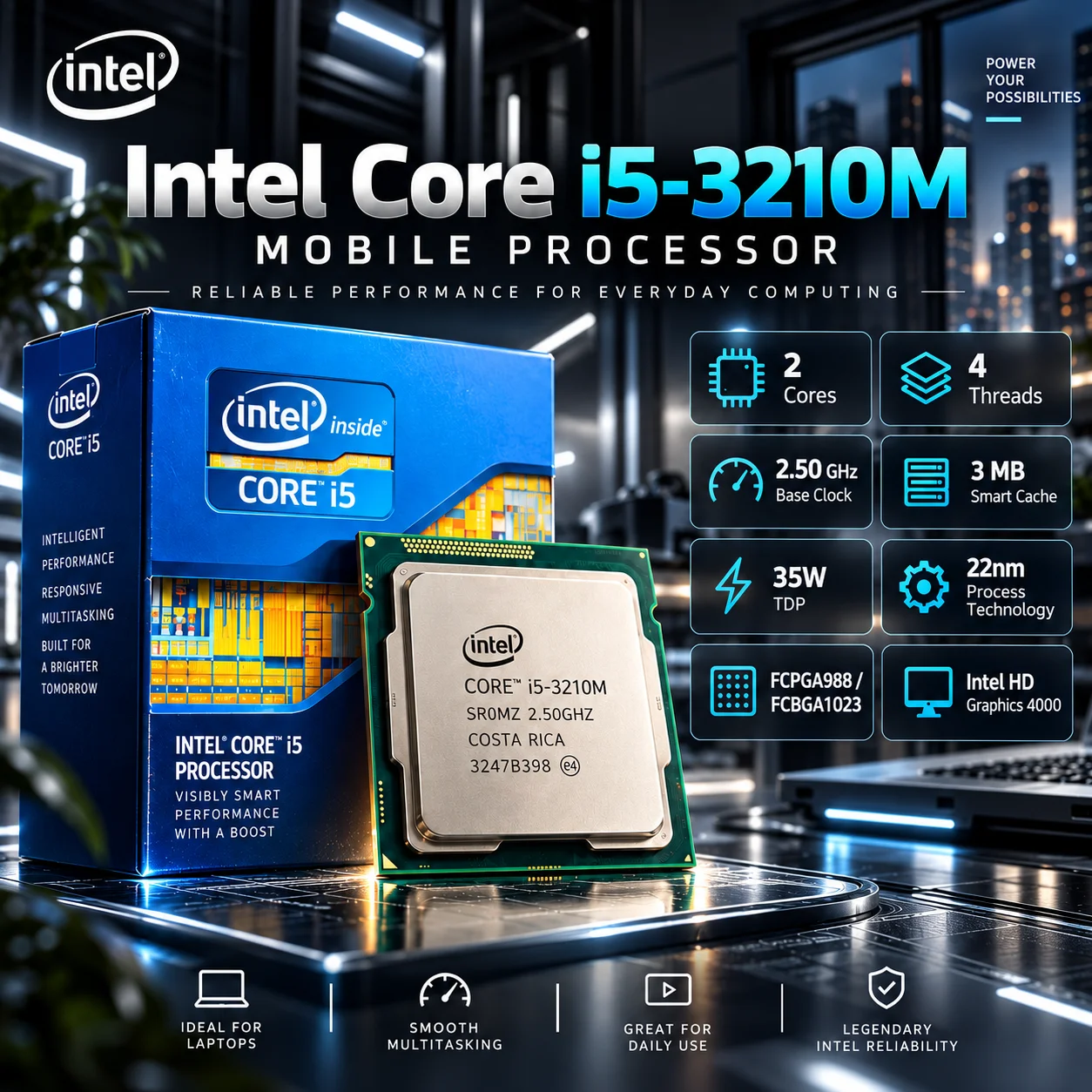
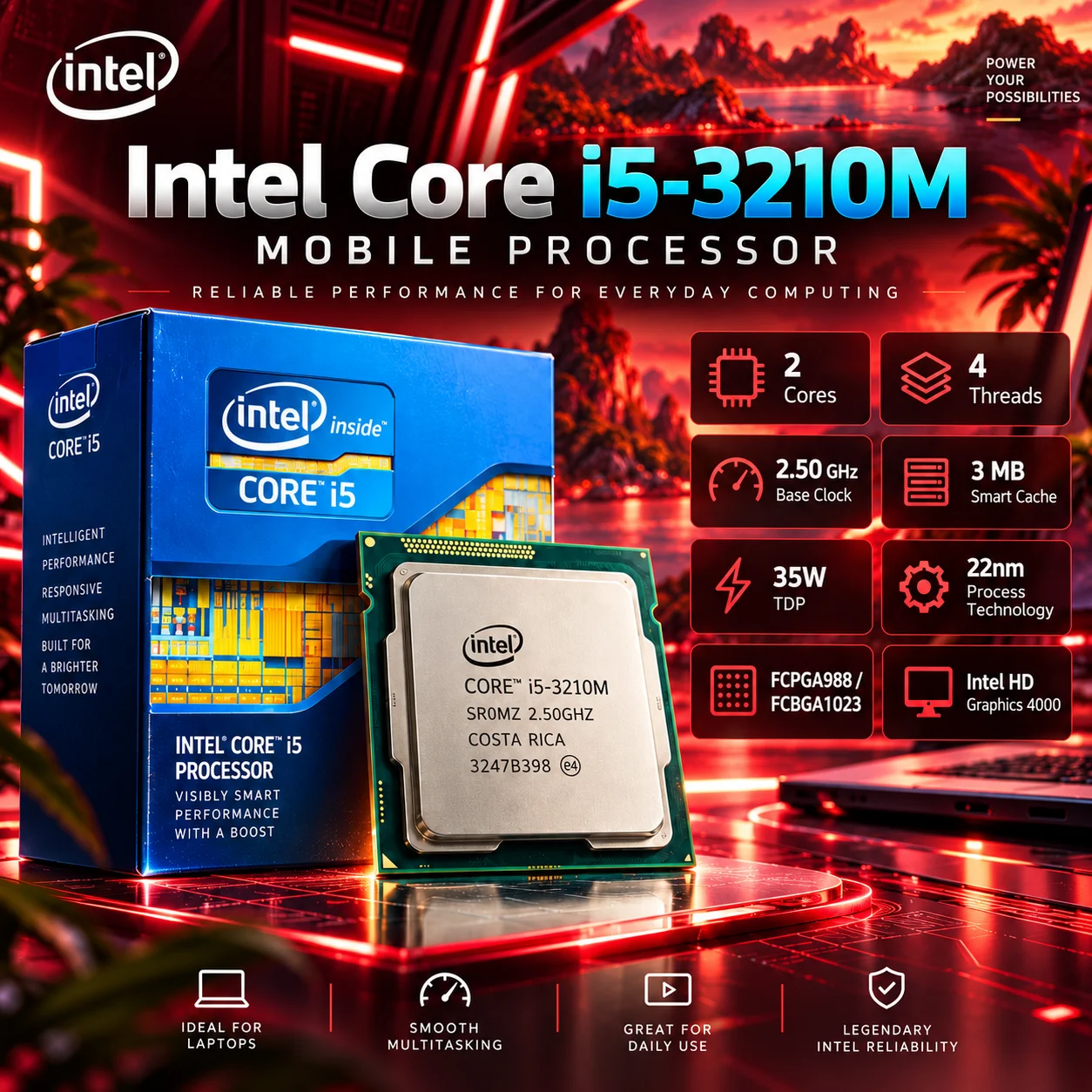
Intel Core i5-3210M 2.50 GHz Dual-Core Mobile Processor
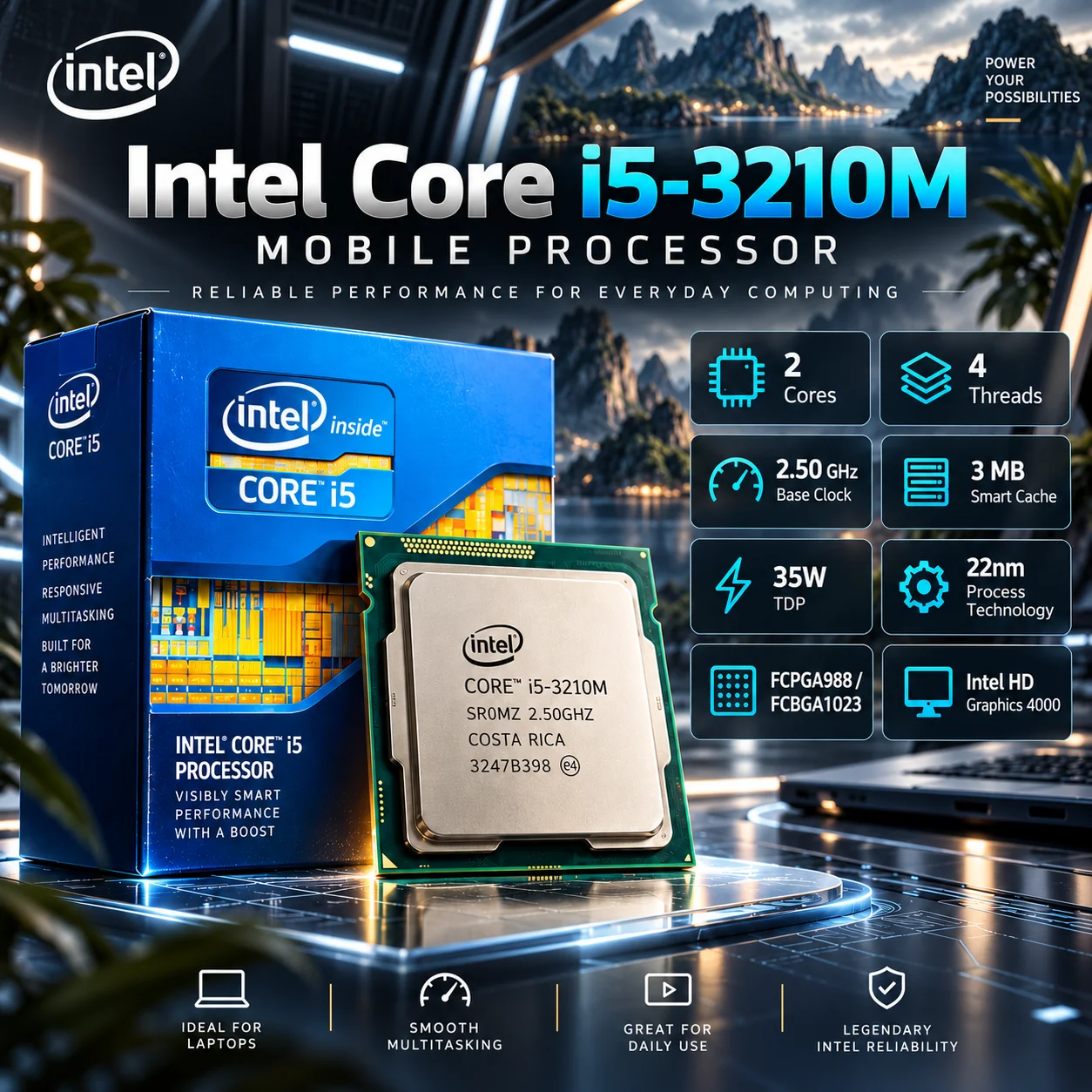
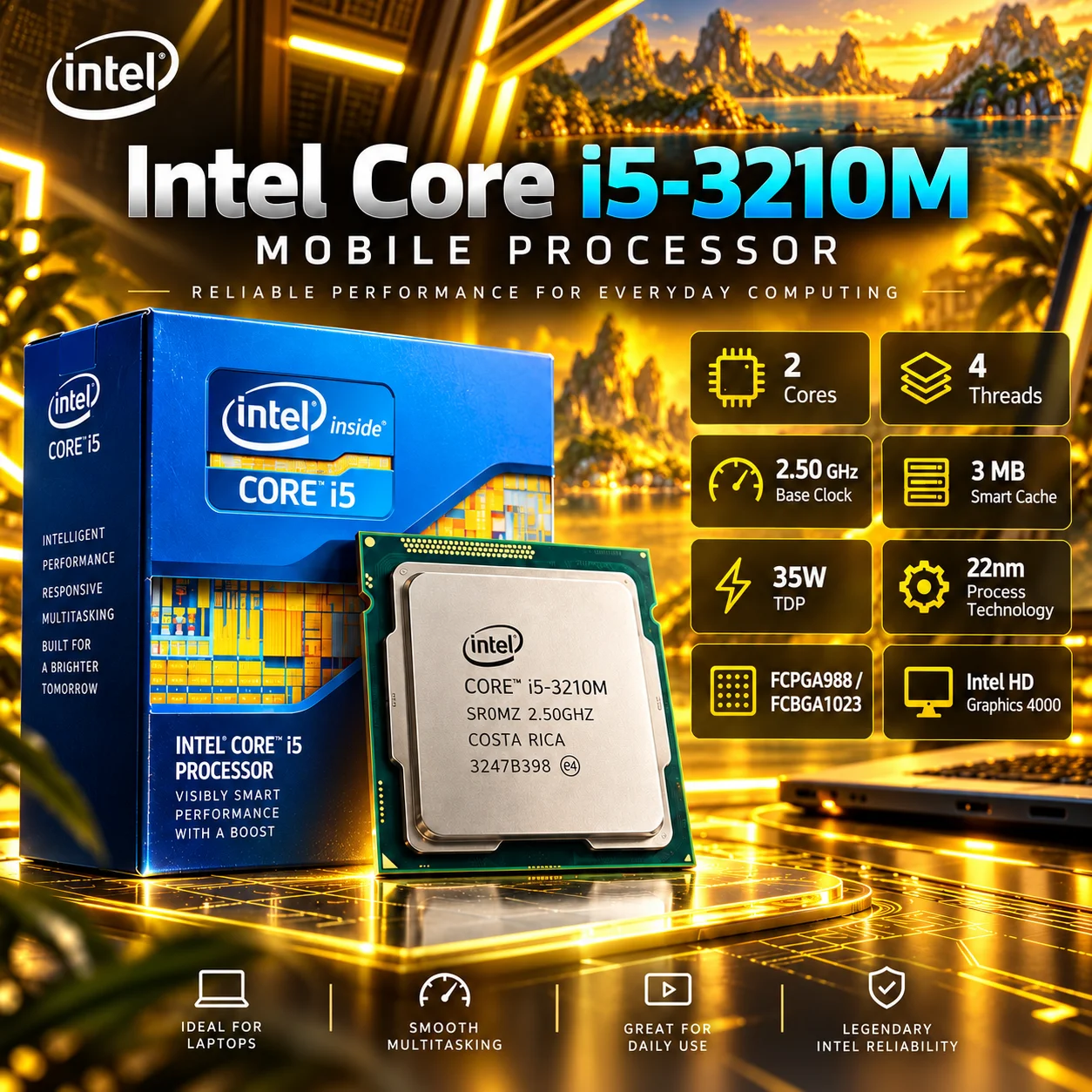
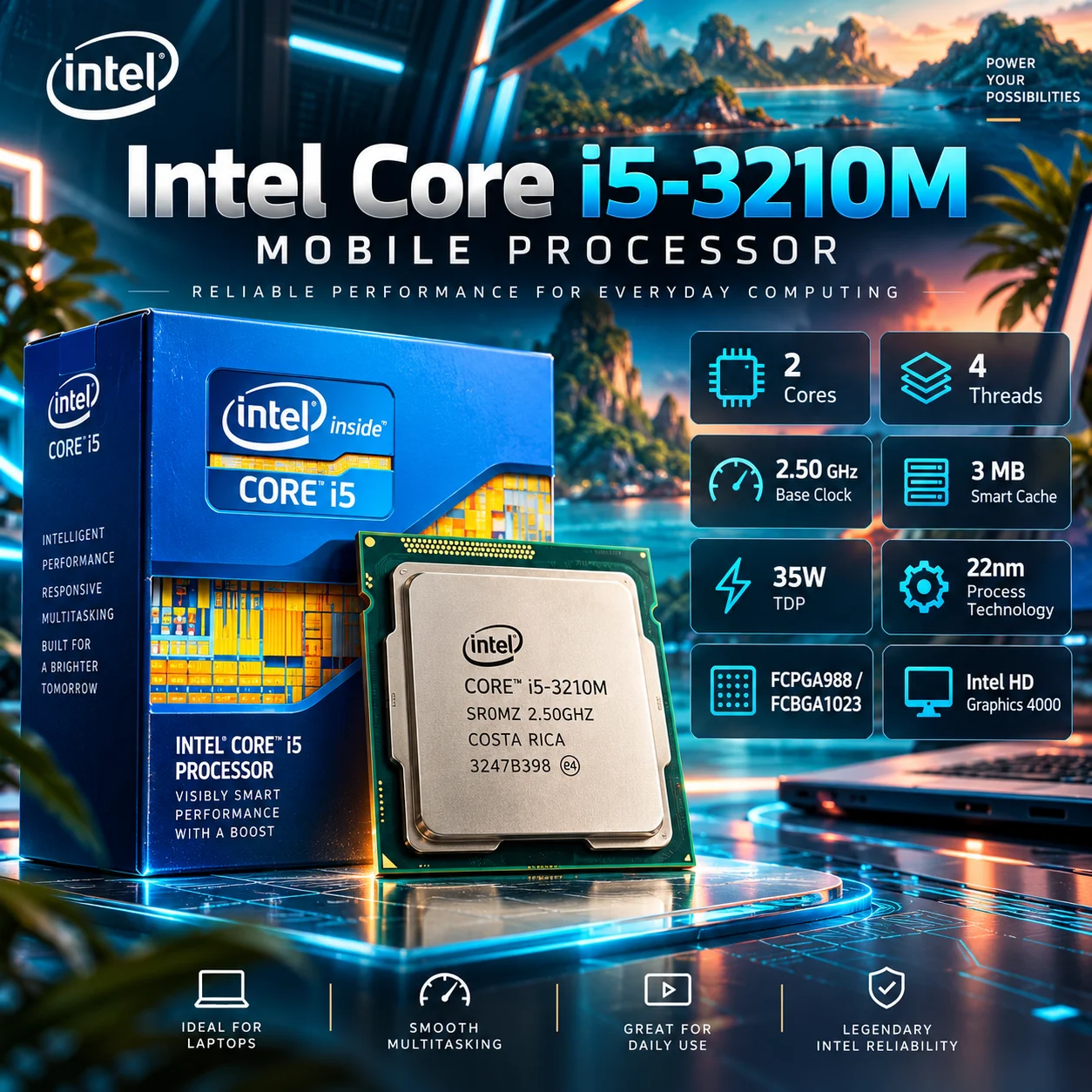
- 2 cores and 4 threads with Intel Hyper-Threading Technology
- 2.50 GHz base frequency with up to 3.10 GHz max turbo frequency
- Intel HD Graphics 4000 integrated graphics solution
- 35W TDP optimized for mainstream notebook designs
*Approximate regional retail guide prices. Pixahunt is an informational catalog.
CPU Benchmark Scores & Performance Analysis
TESTEDCinebench R23, Geekbench 6, PassMark CPU Mark scores & real-world gaming/office suitability tests.
Technical Specifications
Comprehensive hardware architecture and specifications
General
| Series | Core i5 |
| Model | i5-3210M |
| Cpu Cooler | Not Included |
| Code-Name | Ivy Bridge |
| Generation | 3rd Gen |
| Sockets Supported | rPGA988B |
Performance
| Base Frequency | 2.50 GHz |
| Turbo Frequency Max. | 3.10 GHz |
| Core | 2 |
| Threads | 4 |
| CPU Cache | 3 MB Intel Smart Cache |
| L1 Cache | 64 KB (per core) |
| L2 Cache | 256 KB (per core) |
| L3 Cache | 3 MB |
| TDP | 35 W |
| Lithography | 22 nm |
| Multiplier | 25.0x |
| Multiplier Unlocked | No |
| Processor Type | Core i5 |
Memory Support
| Memory Max. | 32 GB |
| Memory Type | DDR3/L/-RS 1333/1600 |
| Memory Speed | 1600 MHz |
| Memory Channel | 2 |
| Max Memory Bandwidth | 25.6 GB/s |
| ECC Memory Supported | No |
Graphics
| Built-in GPU | Yes |
| Processor Graphics | Intel HD Graphics 4000 |
| Graphics Base Frequency | 650 MHz |
| Graphics Dynamic Frequency | 1.10 GHz |
| Graphics Core Count | N/A |
| Max Video Memory | Shared |
| Max Resolution | eDP/DP/HDMI/SDVO/CRT |
Technical Info
| DirectX Support | 11 |
| OpenGL Support | 4.0 |
| Approx. Power Consumption | 35 W |
| Compatible Products / Chipsets | Intel Mobile Chipset series |
| PCI Express Version | 3.0 |
| PCI Express Lanes | 16 |
| Thermal Solution (MPK / Box) | N/A |
| Max. Operating Temperature (Tjmax) | 105°C |
Warranty
| Manufacturing Warranty | Discontinued Product / N/A |
Additional Info
| Specialty | Intel Turbo Boost Technology 2.0, Intel Hyper-Threading Technology, Intel Virtualization Technology (VT-x) |
| Others | Instruction Set 64-bit, AVX extensions |
| Country Of Origin | USA |
| Made in/ Assemble | China / Malaysia |
Editorial Overview & Review
In-depth insights, architecture summary, and performance evaluation
Introduction & Overview: A Blast from the Mobile Computing Past
Welcome back to the retro tech lab, gadget enthusiasts and consumer tech historians. Today, we are turning back the clock to examine a processor that defined an entire era of mainstream computing: the Intel Core i5-3210M. Released in 2012 as part of the third-generation Ivy Bridge family, this dual-core mobile processor was the beating heart of countless laptops that populated enterprise offices, college dorms, and family living rooms a decade ago. While the modern computing landscape is dominated by multi-core silicon, ultra-dense nodes, and specialized neural processing units, revisiting the i5-3210M allows us to appreciate just how far mobile engineering has evolved—and why this specific chip earned a reputation for steadfast reliability.
Architecture, Performance & Key Technologies
At its core, the Intel Core i5-3210M was built on a then-revolutionary 22-nanometer manufacturing process utilizing Intel's groundbreaking 3D Tri-Gate transistor technology. This transition from the previous Sandy Bridge architecture brought notable improvements in power efficiency and raw instructions-per-clock (IPC) performance.
- Core Configuration: Dual-core setup with four threads via Hyper-Threading technology, operating at a base frequency of 2.5 GHz with a maximum Turbo Boost frequency of 3.1 GHz.
- Graphics Integration: Equipped with Intel HD Graphics 4000, offering baseline DirectX 11 support and a significant graphical uplift over previous generations.
- Thermal Design Power (TDP): Rated at a standard 35W, perfectly calibrated for the mid-range mainstream notebook chassis of the early 2010s.
- Memory Support: Dual-channel memory controller supporting up to 32GB of DDR3/L memory types.
The engineering focus here was balance: delivering snappy response times for everyday tasks while keeping thermal output manageable for standard laptop cooling solutions.
Real-World Use Cases: Living with the i5-3210M
Back in its prime, a laptop powered by the Intel Core i5-3210M was the ultimate "do-it-all" machine for the average consumer. Let's look at how it handled various workloads:
- Daily Productivity: This is where the chip truly shined. Web browsing with dozens of tabs, heavy Microsoft Office suites, and multitasking between email clients and media streaming were handled with effortless grace.
- Gaming: While never intended as a high-end gaming rig, the integrated HD 4000 graphics could comfortably run esports staples of the era like League of Legends, Counter-Strike: Global Offensive (at lower settings), and classic titles like *Skyrim*.
- Content Creation: Light photo editing in Adobe Photoshop and basic 1080p video cutting were entirely feasible, though heavy rendering tasks pushed the dual-core architecture to its limits.
Strengths & Potential Considerations
Even legendary processors have their defining highlights and inherent limitations when viewed through a contemporary lens.
- Pros: Excellent durability and longevity; socketed PGA988 design allowing for physical CPU upgrades in certain laptops; robust driver stability; incredible value on the secondhand and refurbished market today.
- Cons: Limited to just two physical cores, making modern heavy multitasking and intensive multi-threaded applications a struggle; higher idle power consumption compared to modern ultra-low-voltage mobile chips; integrated graphics lack support for modern modern rendering APIs and hardware-accelerated video codecs like AV1.
Final Buying Verdict
So, who is the Intel Core i5-3210M for today? Clearly, it is no longer suited for cutting-edge gaming, professional 4K video editing, or modern enterprise workflows. However, for budget-conscious buyers, retro computing hobbyists, or those looking to rescue an older laptop for basic typing, web browsing, media consumption, and light Linux experimentation, a machine powered by the i5-3210M can still serve as a remarkably capable, low-cost secondary workstation. It stands as a testament to solid architectural design that continues to find useful life well beyond its originally intended lifespan.
OUR RATING CONSENSUS
The overall rating is based on review by our experts & industry benchmark suites
Quick Snapshot
- Overall Rating
- 4.5 / 10
- Brand
- Intel
- Category
- Processor
- Catalog Model
- i5-3210M
- Status
- Published
- Release Date
- Oct 10, 2026
Pixahunt Tech Community
Connect with hardware enthusiasts, compare benchmarks, and explore real user setups.
Explore Full Newsfeed →Related Gadgets
- 3.20 GHz Dual-Core Clock Speed for Reliable Everyday Computing
- Intel Hyper-Threading Technology Enabling 4 Parallel Threads
- Built-in Intel HD Graphics for Integrated Display Support
- 2 cores and 4 threads with Intel Hyper-Threading Technology
- 3.10 GHz base processor frequency
- 3 MB Intel Smart Cache
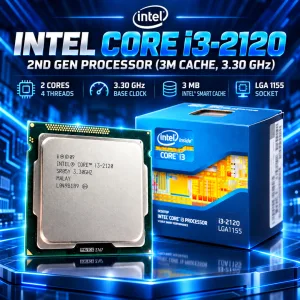
- 2 Cores and 4 Threads with Intel Hyper-Threading Technology
- 3.30 GHz Base Clock Frequency with 3 MB Intel Smart Cache
- Includes Intel HD Graphics 2000 integrated graphics
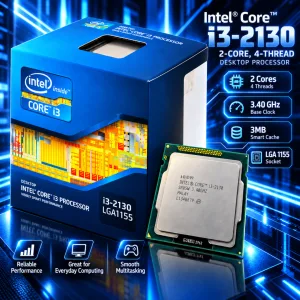
- 2 cores and 4 threads with Intel Hyper-Threading Technology
- 3.40 GHz processor base frequency with 3 MB Intel Smart Cache
- Integrated Intel HD Graphics 2000