

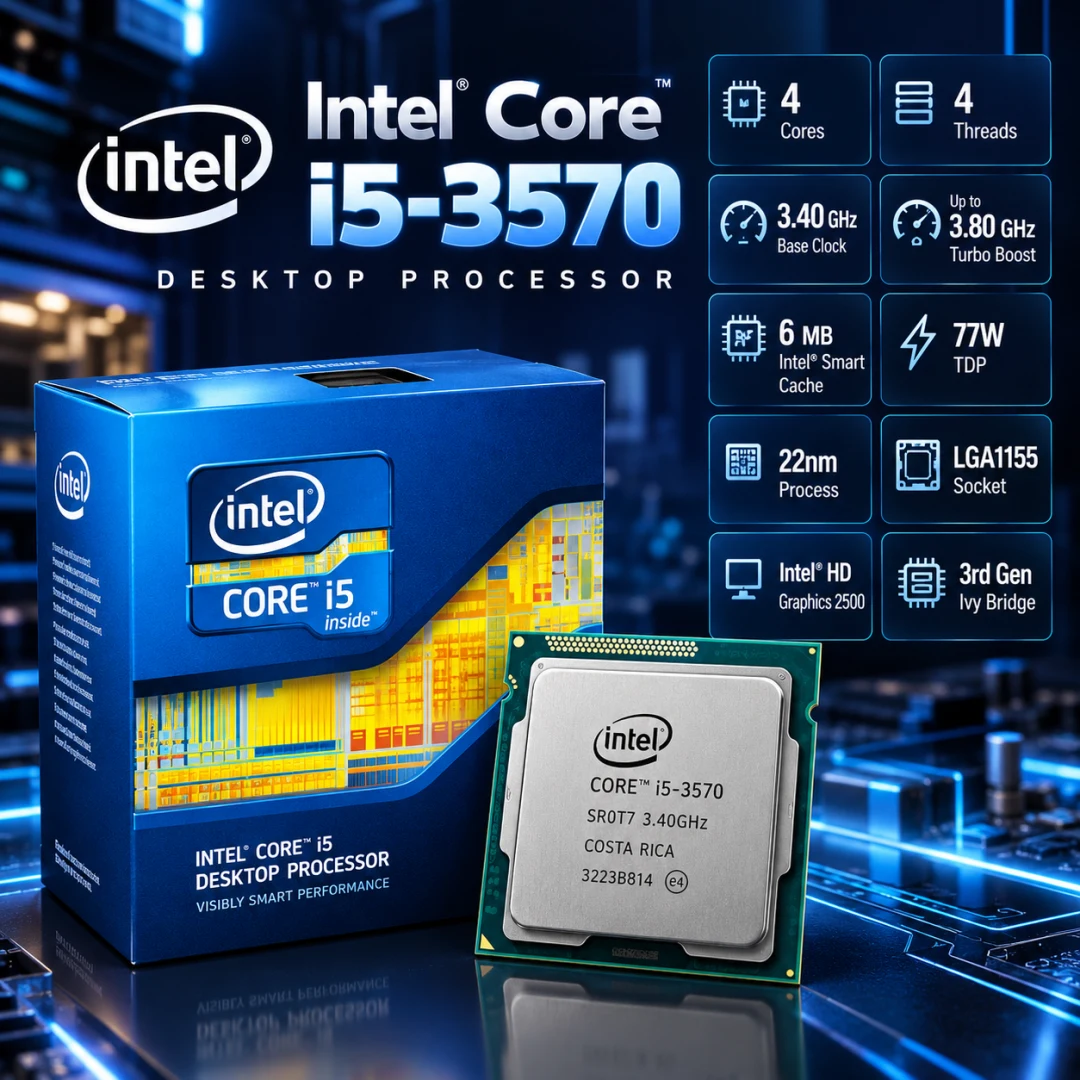
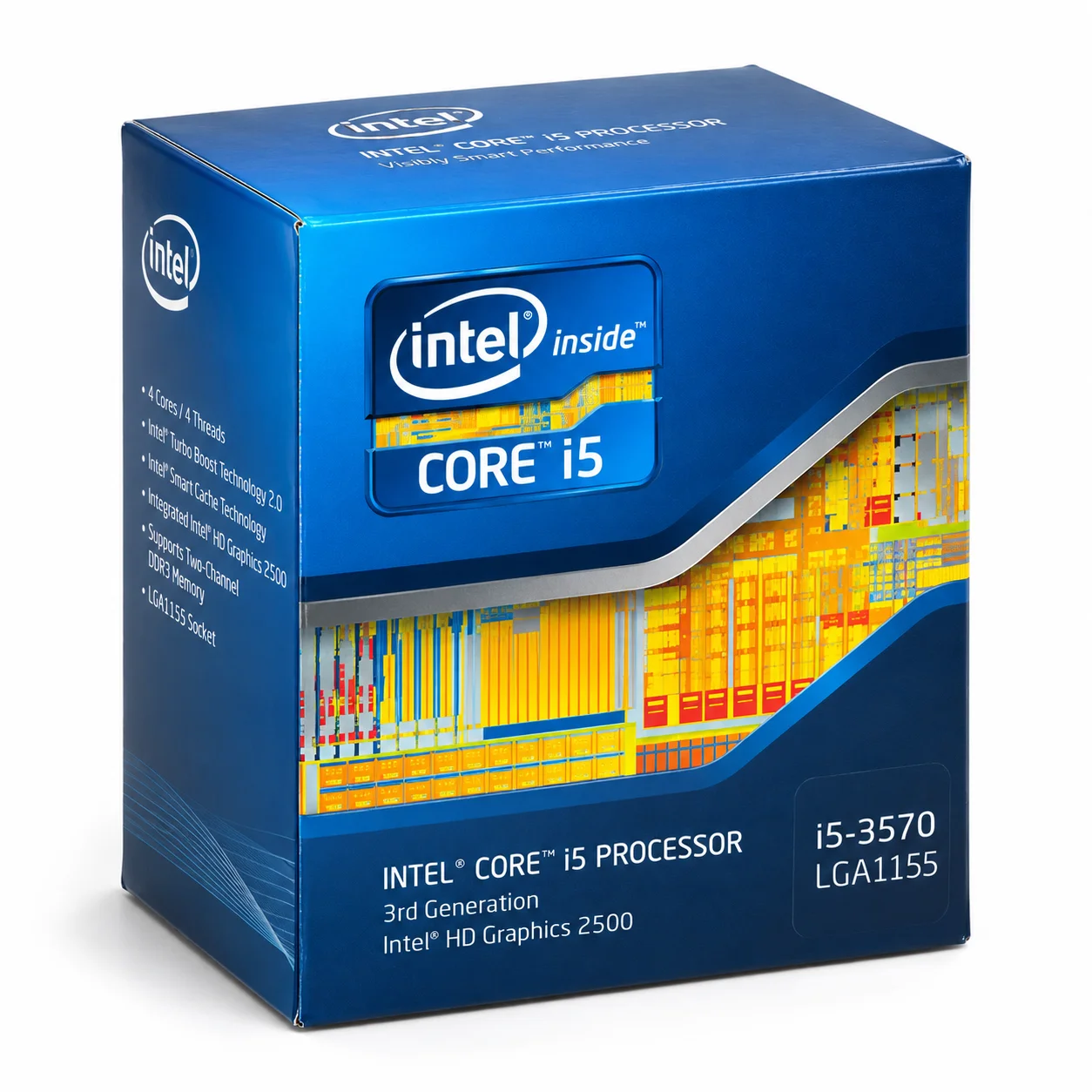
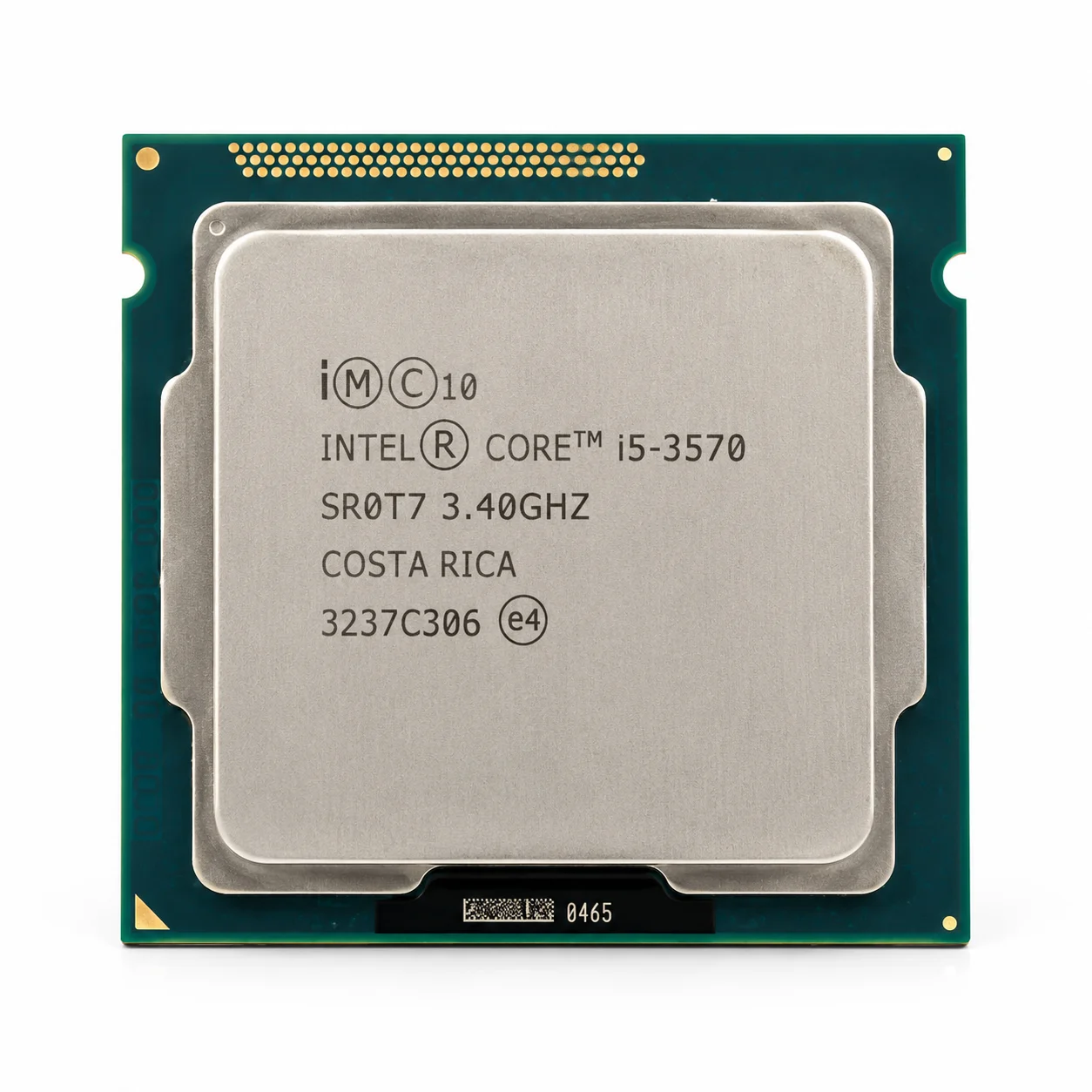
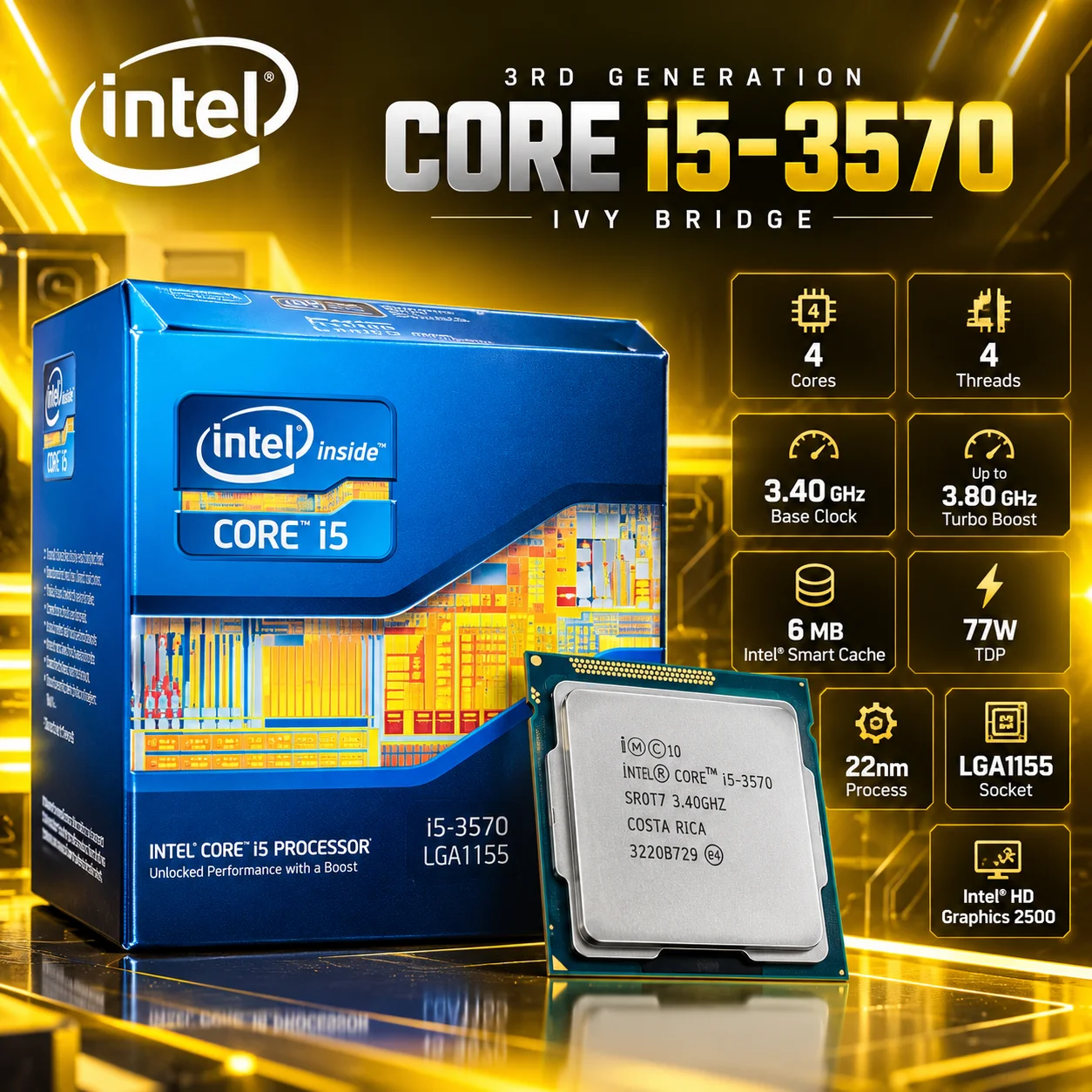
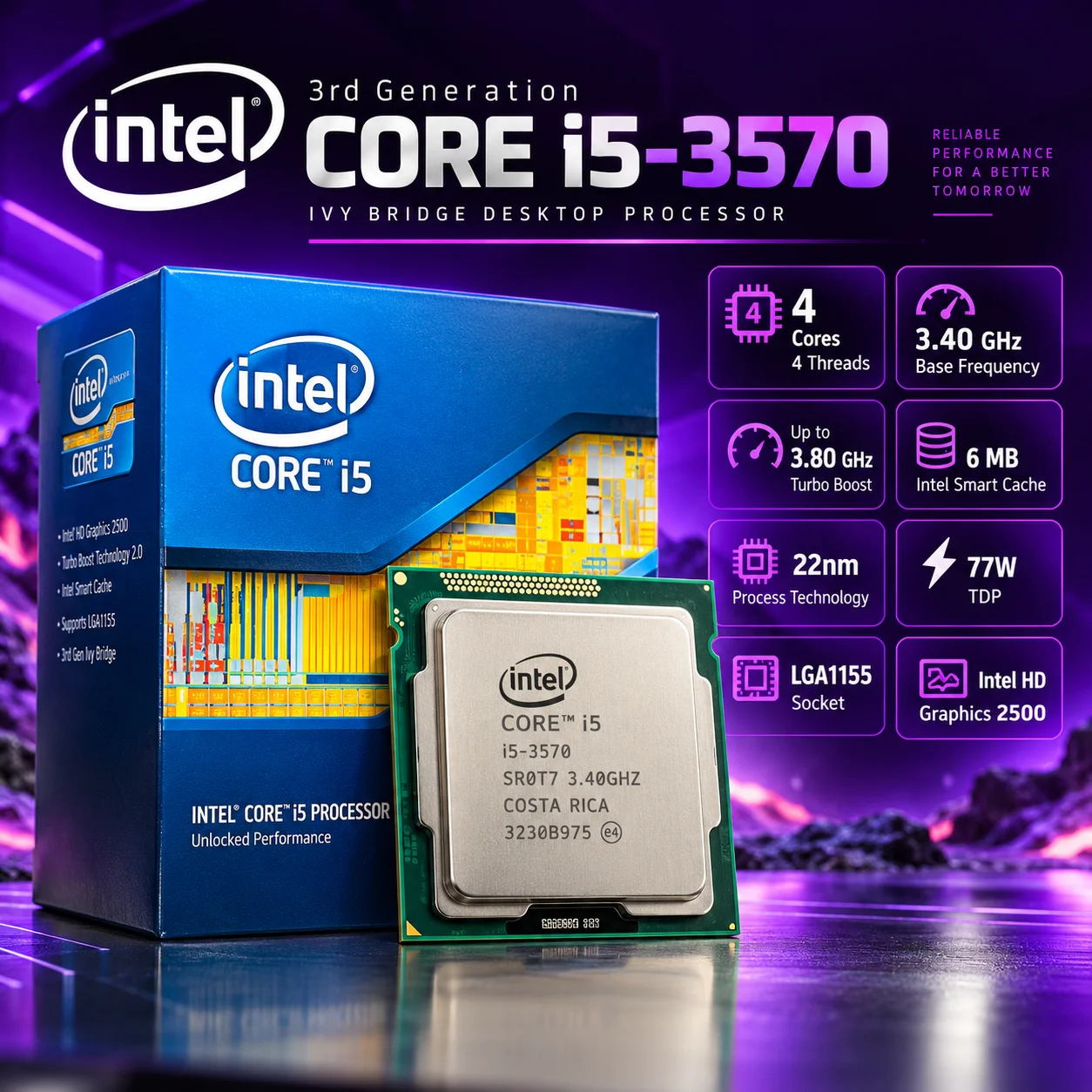
Intel Core i5-3570 Quad-Core Desktop Processor (6M Cache, up to 3.80 GHz)
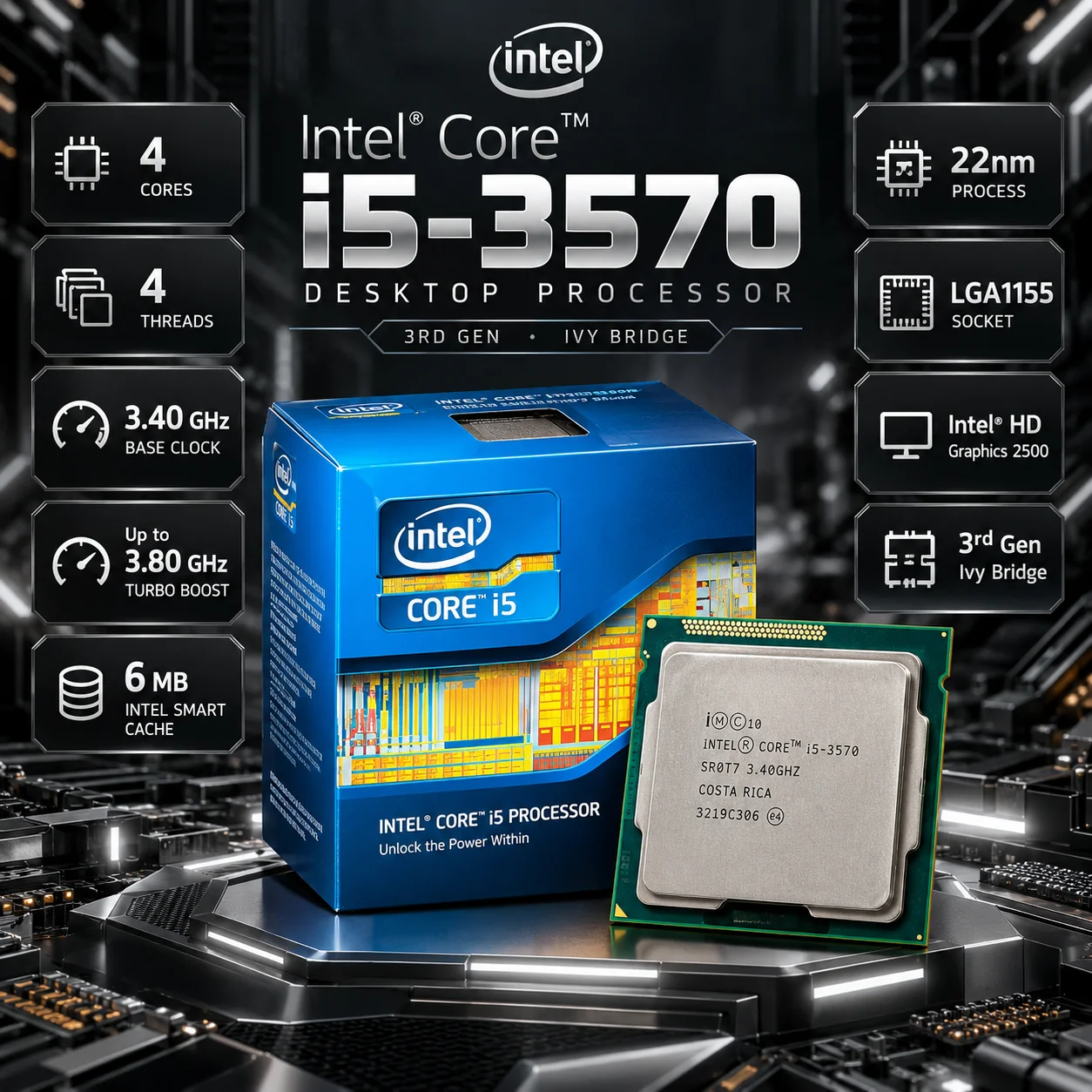
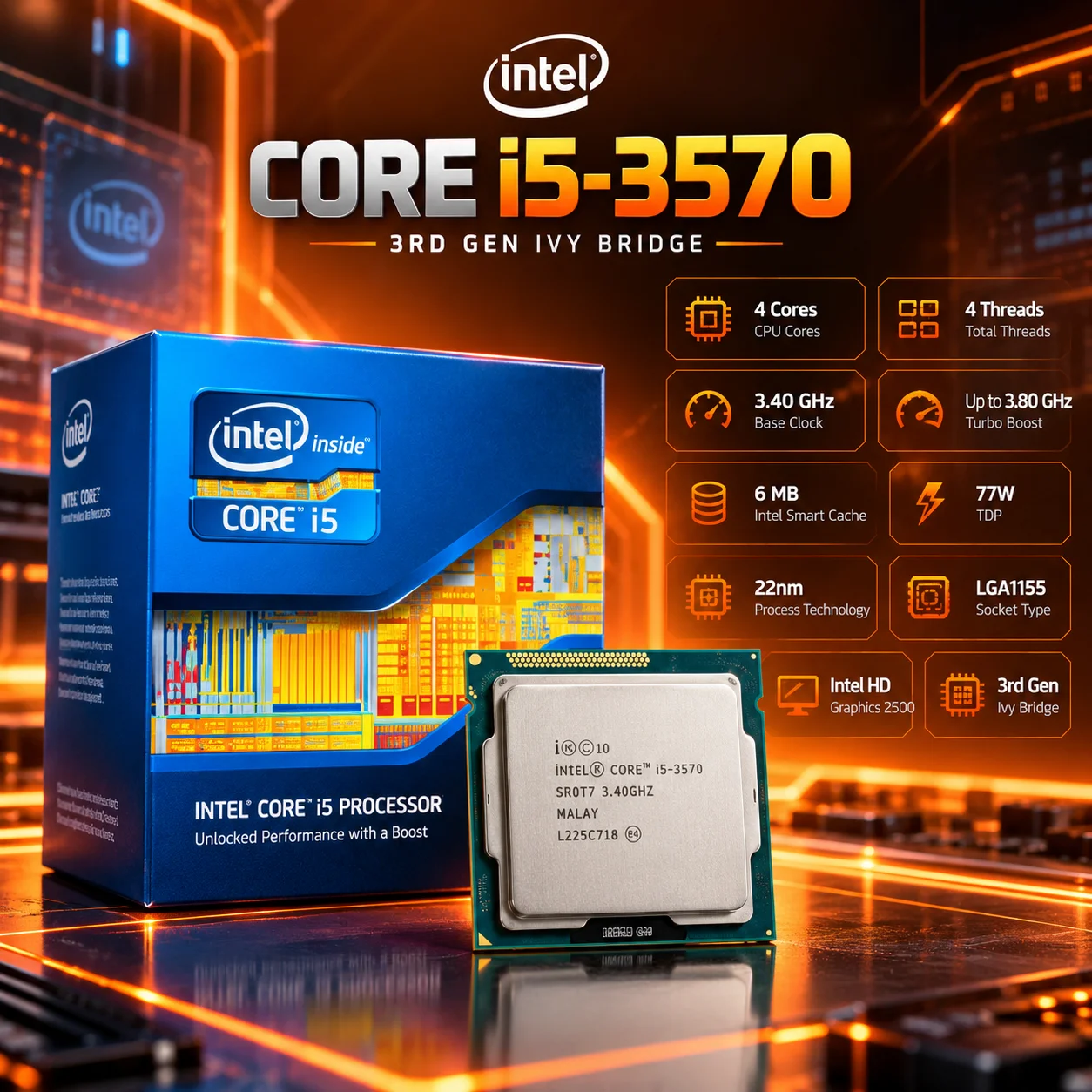
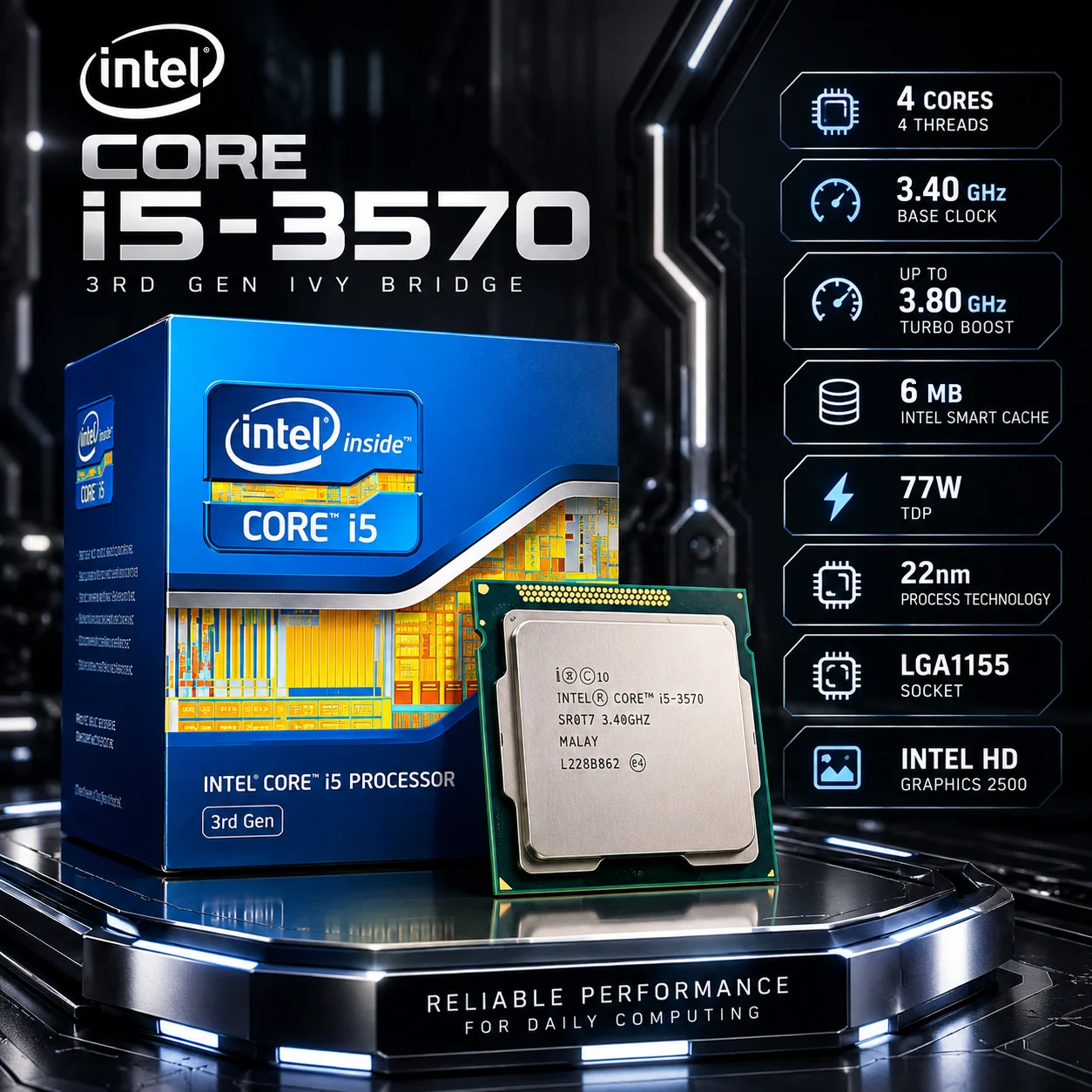
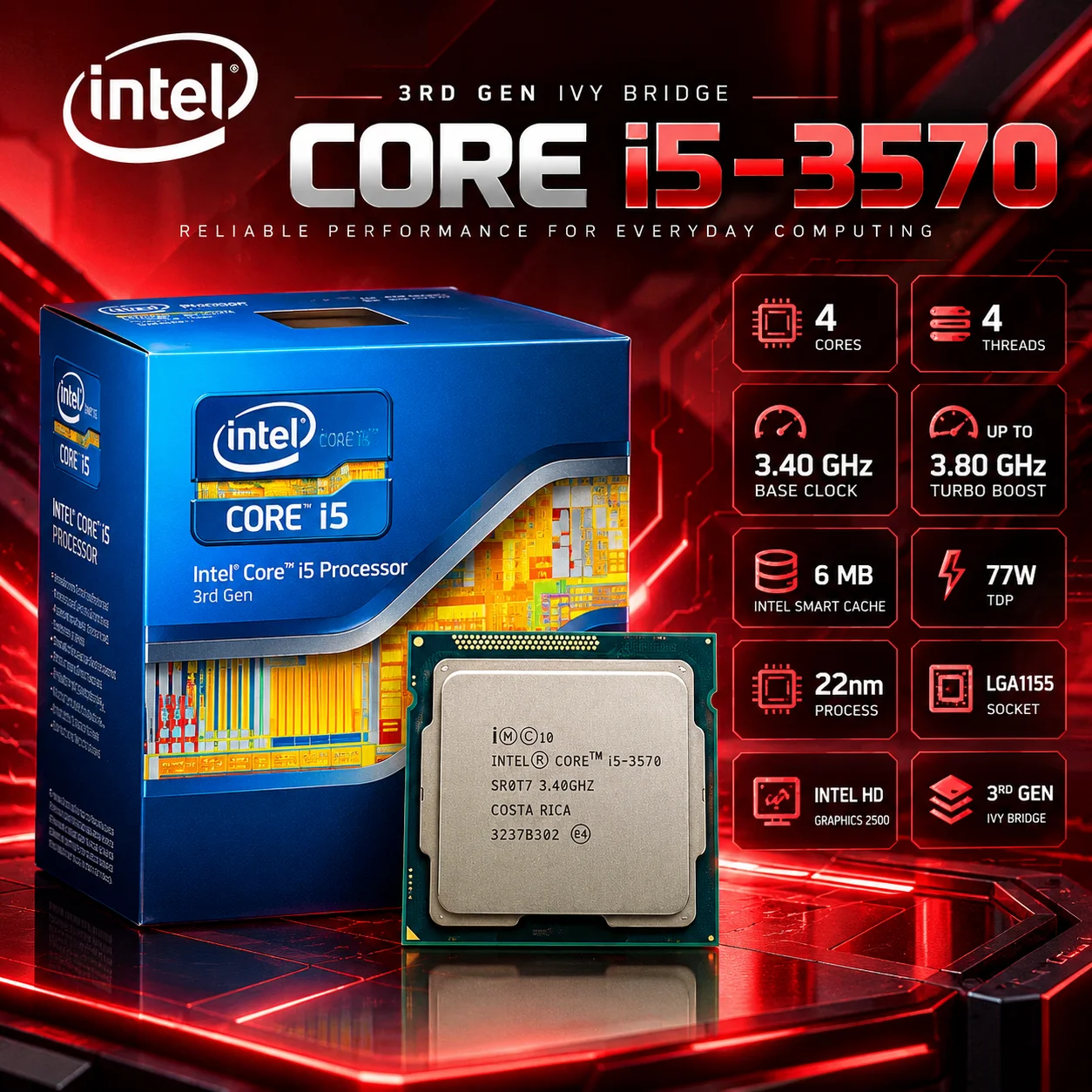
- 4 cores and 4 threads with a 3.40 GHz base frequency
- Intel Turbo Boost Technology 2.0 up to 3.80 GHz
- Equipped with Intel HD Graphics 2500
- Supports DDR3 memory up to 32 GB
*Approximate regional retail guide prices. Pixahunt is an informational catalog.
CPU Benchmark Scores & Performance Analysis
TESTEDCinebench R23, Geekbench 6, PassMark CPU Mark scores & real-world gaming/office suitability tests.
Technical Specifications
Comprehensive hardware architecture and specifications
General
| Series | Core i5 |
| Model | i5-3570 |
| Cpu Cooler | Not Included |
| Code-Name | Ivy Bridge |
| Generation | 3rd Gen |
| Sockets Supported | FCLGA1155 |
Performance
| Base Frequency | 3.40 GHz |
| Turbo Frequency Max. | 3.80 GHz |
| Core | 4 |
| Threads | 4 |
| CPU Cache | 6 MB Intel Smart Cache |
| L1 Cache | 64 KB per core |
| L2 Cache | 256 KB per core |
| L3 Cache | 6 MB |
| TDP | 77 W |
| Lithography | 22 nm |
| Multiplier | 34.0x |
| Multiplier Unlocked | No |
| Processor Type | Core i5 |
Memory Support
| Memory Max. | 32 GB |
| Memory Type | DDR3 1333/1600 |
| Memory Speed | 1600 MT/s |
| Memory Channel | 2 |
| Max Memory Bandwidth | 25.6 GB/s |
| ECC Memory Supported | No |
Graphics
| Built-in GPU | Yes |
| Processor Graphics | Intel HD Graphics 2500 |
| Graphics Base Frequency | 650 MHz |
| Graphics Dynamic Frequency | 1.15 GHz |
| Graphics Core Count | N/A |
| Max Video Memory | N/A |
| Max Resolution | N/A |
Technical Info
| DirectX Support | 11 |
| OpenGL Support | 4.0 |
| Approx. Power Consumption | 77W |
| Compatible Products / Chipsets | Intel 6 Series, Intel 7 Series |
| PCI Express Version | 3.0 |
| PCI Express Lanes | Up to 1x16, 2x8, 1x8 & 2x4 |
| Thermal Solution (MPK / Box) | 2011D |
| Max. Operating Temperature (Tjmax) | 67.4°C |
Warranty
| Manufacturing Warranty | Discontinued Product (End of Life) |
Additional Info
| Specialty | Intel Turbo Boost 2.0, Intel Virtualization Technology (VT-x, VT-d), AES New Instructions |
| Others | Legacy Desktop Processor |
| Country Of Origin | USA |
| Made in/ Assemble | China / Malaysia |
Editorial Overview & Review
In-depth insights, architecture summary, and performance evaluation
Introduction & Overview: The Legacy Workhorse
Back when the 3rd Generation Intel Core processors hit the market, the desktop computing landscape was undergoing a massive shift toward greater efficiency and smarter performance scaling. Positioned squarely in the mainstream performance tier, the Intel Core i5-3570 emerged as the go-to quad-core processor for gamers, power users, and enterprise professionals who wanted high-end responsiveness without the enthusiast price tag of the 'K-series' or Core i7 variants.
Built on the Ivy Bridge microarchitecture and utilizing the widely adopted FCLGA1155 socket, this processor was engineered to slide into Intel 6 and 7 series chipsets seamlessly. While it has long since reached its end-of-life status and manufacturer discontinuation, understanding the i5-3570 means looking at a defining piece of mainstream silicon that powered millions of custom rigs and pre-built office desktops through the 2010s.
Architecture, Performance & Key Technologies: The Ivy Bridge Leap
The transition from the previous Sandy Bridge generation to Ivy Bridge brought a monumental hardware milestone: the introduction of 22nm 3D Tri-Gate transistors. This shrinking of the lithography allowed Intel to pack more performance into a tight 77W TDP (Thermal Design Power) envelope while significantly curbing power consumption and thermal output.
Under the hood, the i5-3570 features 4 physical cores and 4 threads, intentionally omitting Hyper-Threading to segment it from the i7 line, yet offering more than enough muscle for concurrent workloads. It kicks off with a robust 3.40 GHz base frequency and utilizes Intel Turbo Boost 2.0 to dynamically scale up to 3.80 GHz when heavy compute demands arise. Paired with 6 MB of Intel Smart Cache and L1/L2 caches dedicated per core, data bottlenecking is kept to a strict minimum.
- PCI Express 3.0 Integration: Doubling the bandwidth of the previous generation, PCIe 3.0 support allowed the i5-3570 to feed discrete graphics cards with ample data throughput.
- Integrated Graphics: Equipped with Intel HD Graphics 2500, featuring a base clock of 650 MHz and a dynamic frequency up to 1.15 GHz, providing reliable display output, DirectX 11, and OpenGL 4.0 support without strictly demanding an external GPU for basic desktop tasks.
- Memory Controller: Dual-channel memory support optimized for DDR3 RAM up to 1600 MT/s, offering a maximum memory bandwidth of 25.6 GB/s across up to 32 GB of system memory.
- Instruction Set Enhancements: Includes AES New Instructions for faster data encryption and robust virtualization support (VT-x, VT-d).
Real-World Use Cases: What Can It Handle?
In its heyday—and even well into the budget secondhand market—the Intel Core i5-3570 represents a remarkably capable jack-of-all-trades. For daily productivity, office workflows, web browsing with dozens of tabs, and Microsoft Office multitasking, the processor glides through without breaking a sweat. The quad-core configuration ensures that background tasks never bog down foreground applications.
When it comes to gaming, the i5-3570 carved out a reputation as a legendary budget gaming CPU. Paired with a competent mid-range dedicated graphics card, it easily drove high frame rates in esports titles and AAA blockbusters of its era. Though modern, heavily threaded game engines will push its 4-core/4-thread limit, it remains a fantastic heart for retro-gaming rigs or budget-friendly eSports machines.
For light content creation—such as 1080p video editing, photo manipulation in Photoshop, and audio production—the chip holds its ground, though professionals relying heavily on intensive rendering will naturally find themselves bottlenecked compared to modern multi-core powerhouses.
Strengths & Potential Considerations (Pros & Cons)
Every piece of hardware has its architectural and generational trade-offs. Here is how the i5-3570 stacks up:
- Strong Core Performance: Solid 3.4 GHz base and 3.8 GHz turbo speeds provide snappy single-threaded and quad-core execution.
- Energy Efficient: The 22nm Ivy Bridge architecture operates coolly and sips power within a modest 77W thermal envelope.
- Mature Ecosystem: Widespread availability of compatible LGA1155 motherboards and affordable DDR3 memory makes system assembly inexpensive.
- PCIe 3.0 Support: Ensures good compatibility with a vast range of standard expansion cards.
- Locked Multiplier: The '3570' (non-K) suffix means overclocking headroom is virtually non-existent.
- Dated Specifications: Lacks native support for modern standards like DDR4/DDR5 memory, NVMe booting (without BIOS modding/workarounds), and Windows 11 official system requirements.
- End-of-Life Status: Long since discontinued by Intel, meaning zero manufacturer warranty or official microcode updates.
Final Buying Verdict: Is It Still Worth Looking At?
The Intel Core i5-3570 is a testament to resilient hardware engineering. While it is certainly a legacy product by today's hyper-fast computing standards, it remains an iconic chip in the secondhand and retro-building communities.
Who is it for? It is an ideal pick for hobbyists building an ultra-budget home server, a retro-gaming machine for older titles, or a cheap office productivity PC sourced entirely from used parts. However, for anyone looking to build a modern daily driver, engage in heavy contemporary gaming, or run the latest operating systems natively, it's time to look toward newer generations. As a slice of computing history that punched well above its weight class, the i5-3570 earns high marks for the incredible lifespan and value it has delivered to consumers over the years.
OUR RATING CONSENSUS
The overall rating is based on review by our experts & industry benchmark suites
Quick Snapshot
- Overall Rating
- 5.0 / 10
- Brand
- Intel
- Category
- Processor
- Catalog Model
- i5-3570
- Status
- Published
- Release Date
- Oct 10, 2026
Pixahunt Tech Community
Connect with hardware enthusiasts, compare benchmarks, and explore real user setups.
Explore Full Newsfeed →Related Gadgets
- 3.20 GHz Dual-Core Clock Speed for Reliable Everyday Computing
- Intel Hyper-Threading Technology Enabling 4 Parallel Threads
- Built-in Intel HD Graphics for Integrated Display Support
- 2 cores and 4 threads with Intel Hyper-Threading Technology
- 3.10 GHz base processor frequency
- 3 MB Intel Smart Cache
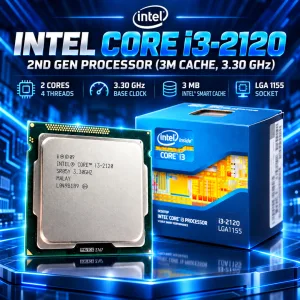
- 2 Cores and 4 Threads with Intel Hyper-Threading Technology
- 3.30 GHz Base Clock Frequency with 3 MB Intel Smart Cache
- Includes Intel HD Graphics 2000 integrated graphics
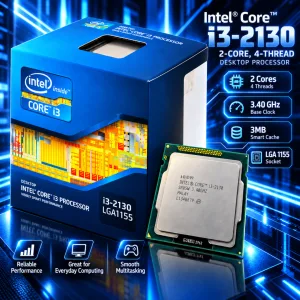
- 2 cores and 4 threads with Intel Hyper-Threading Technology
- 3.40 GHz processor base frequency with 3 MB Intel Smart Cache
- Integrated Intel HD Graphics 2000