

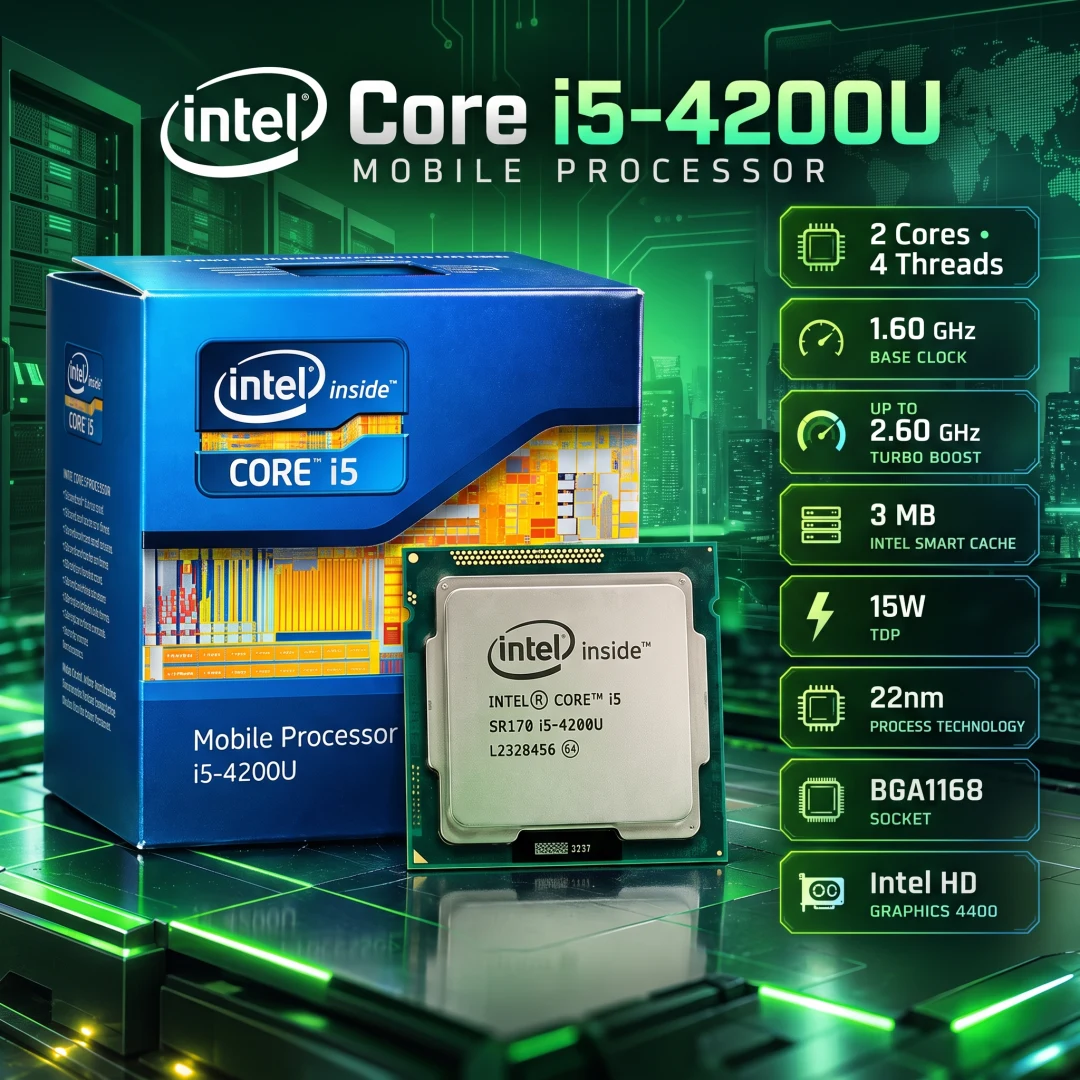
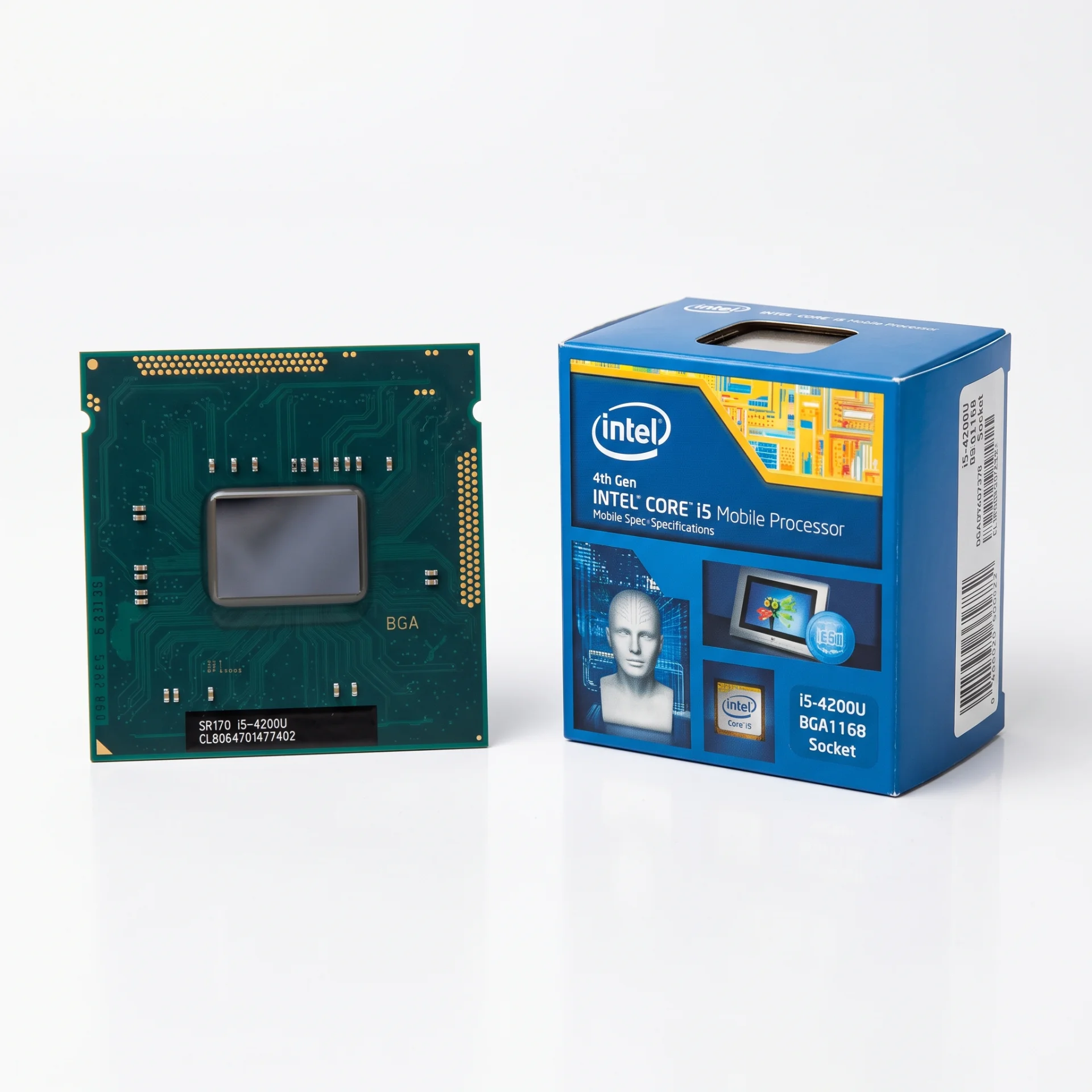
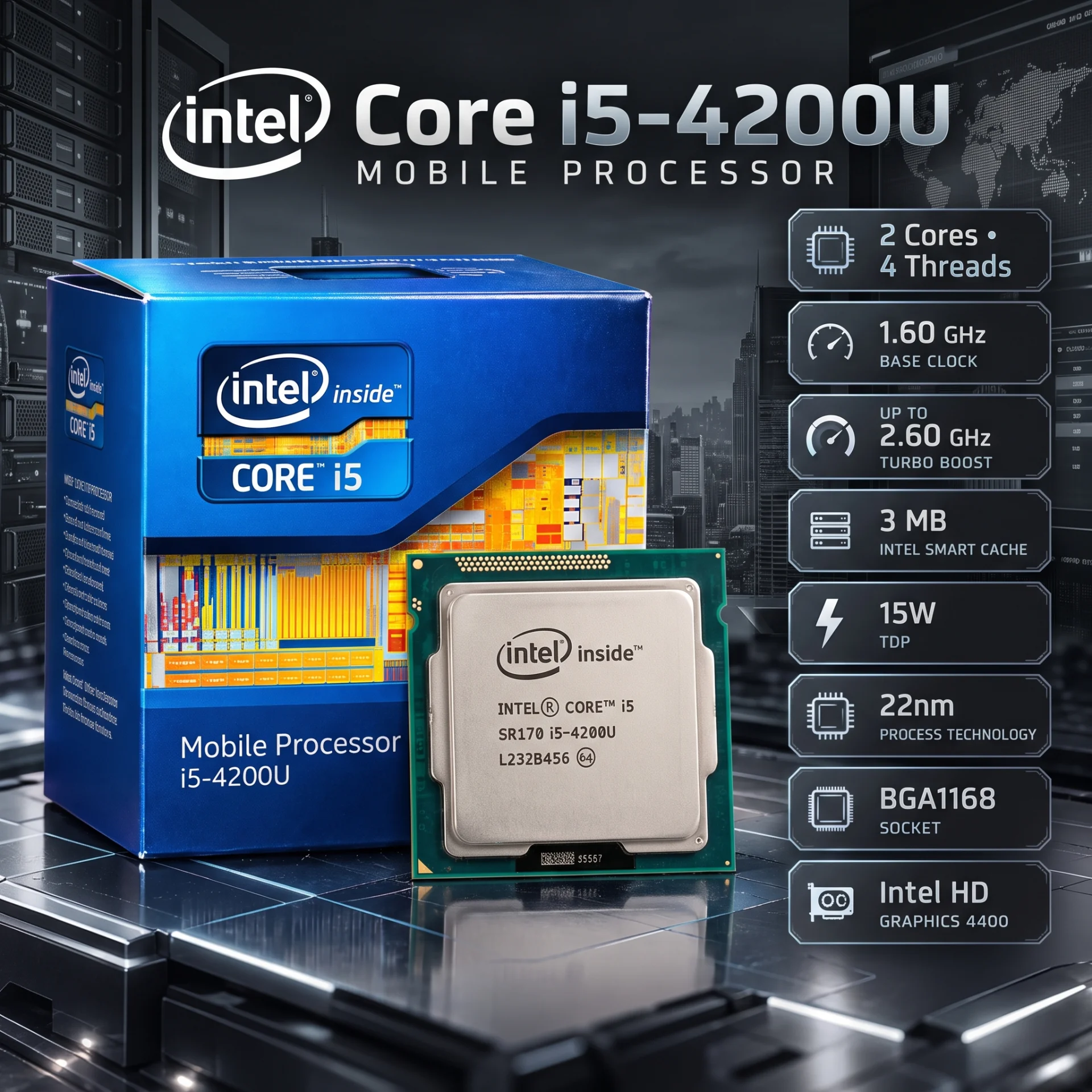
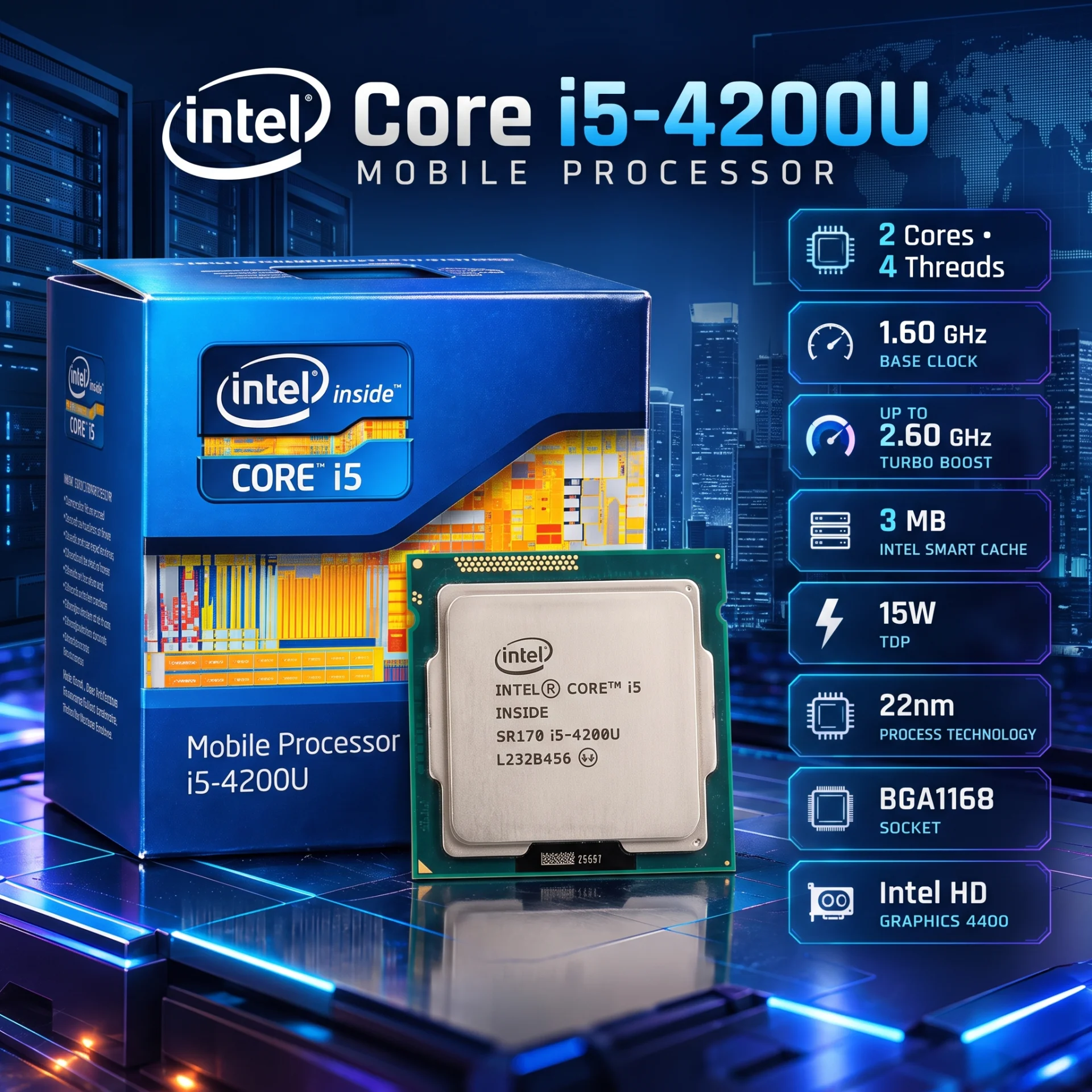
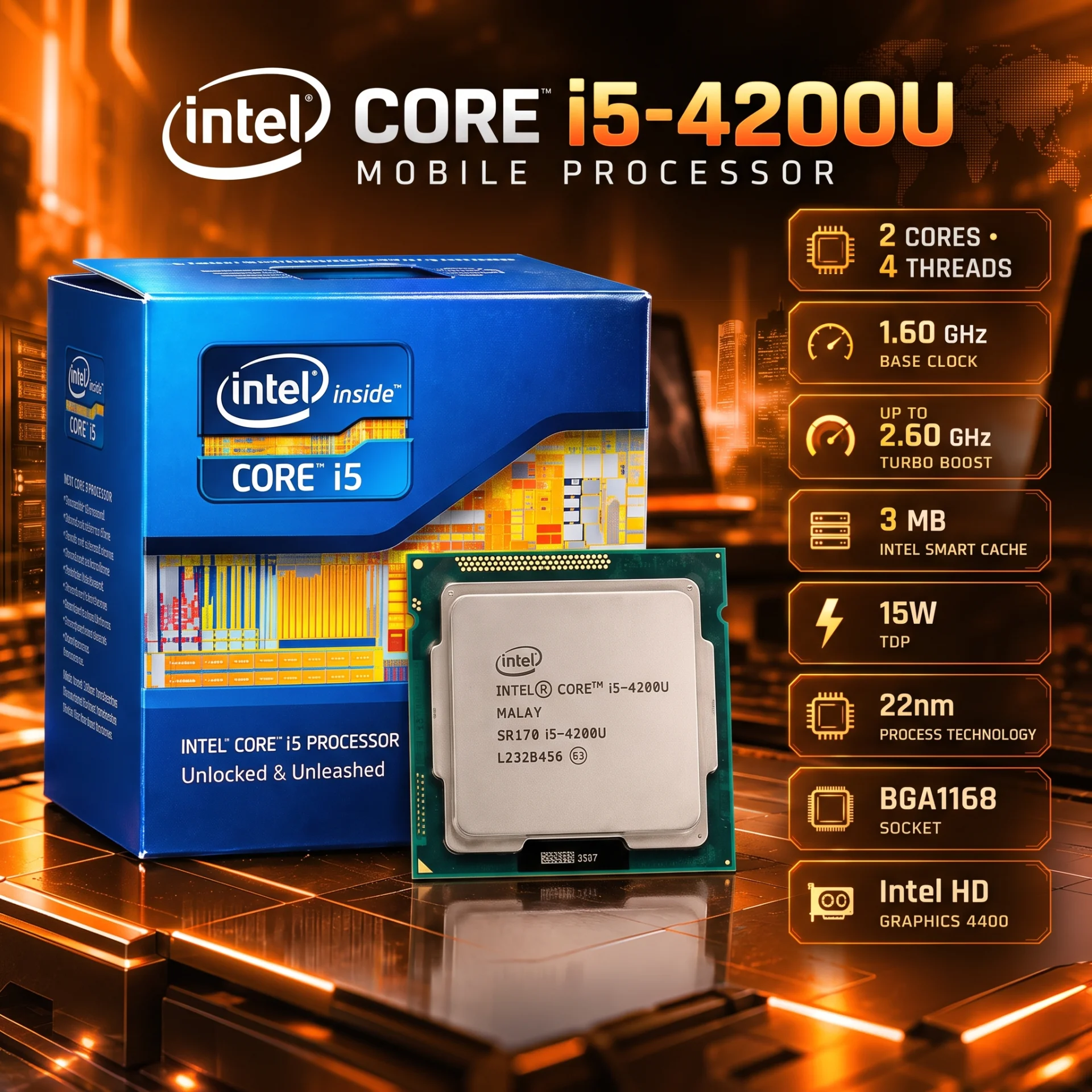
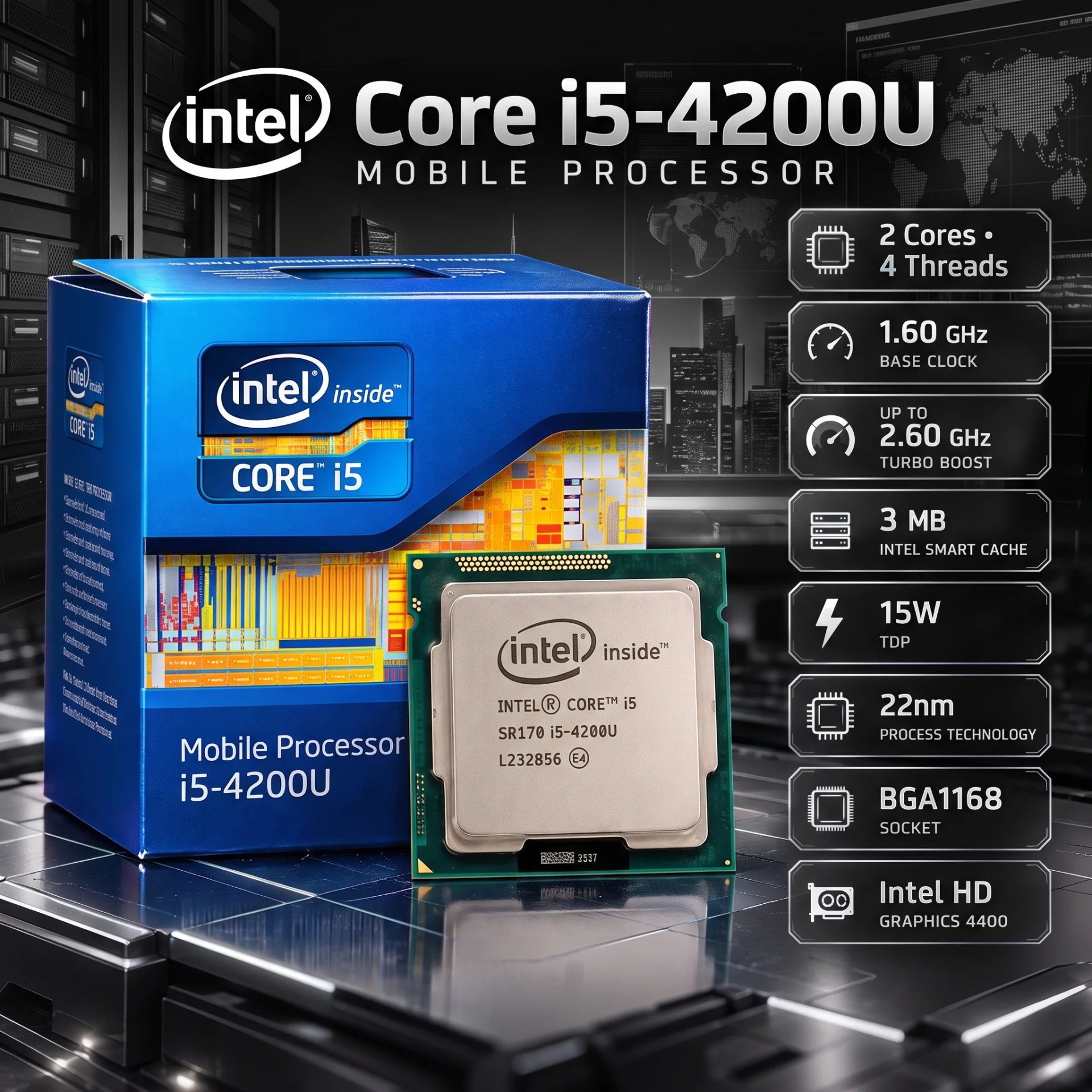
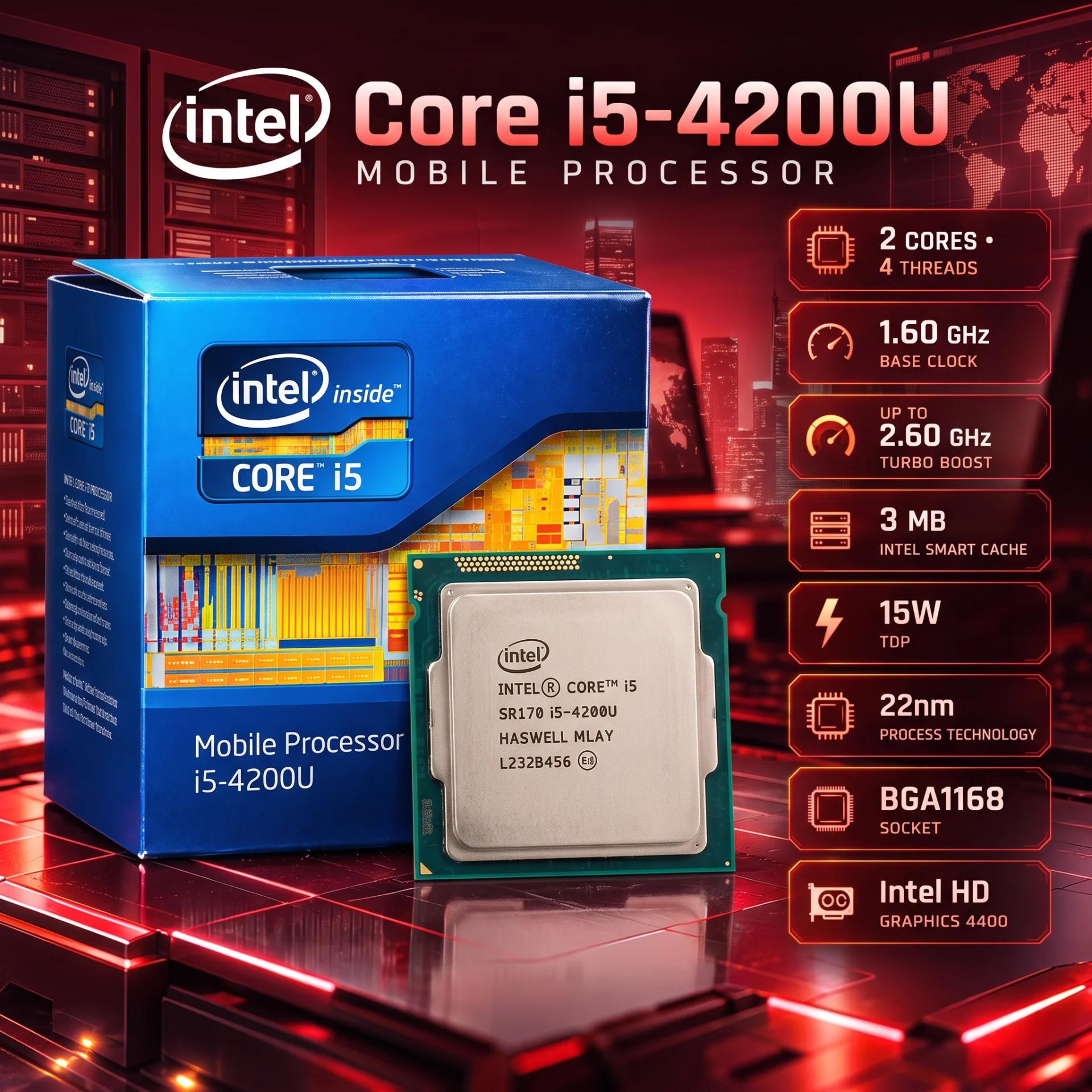
Intel Core i5-4200U 2-Core, 4-Thread Mobile Processor
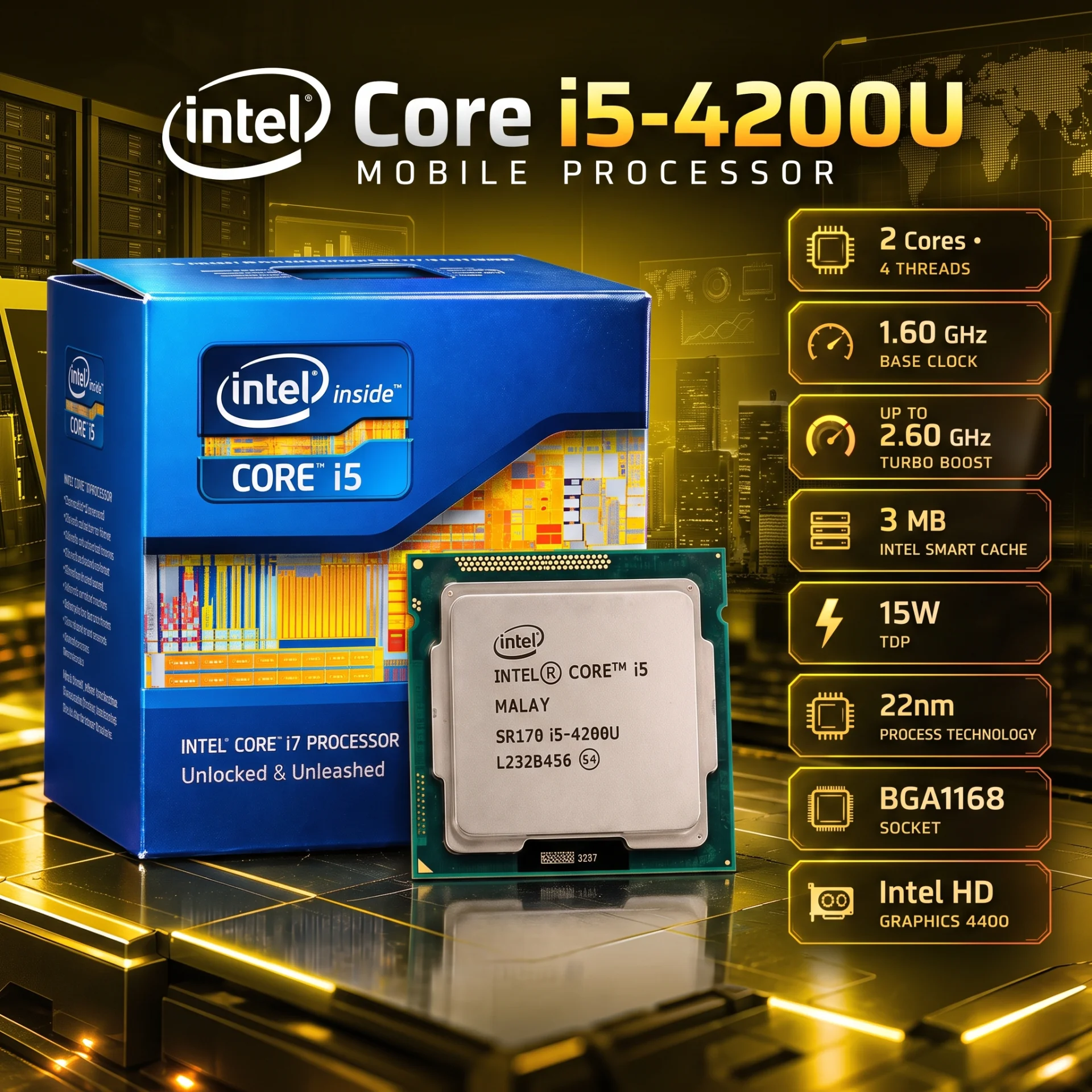
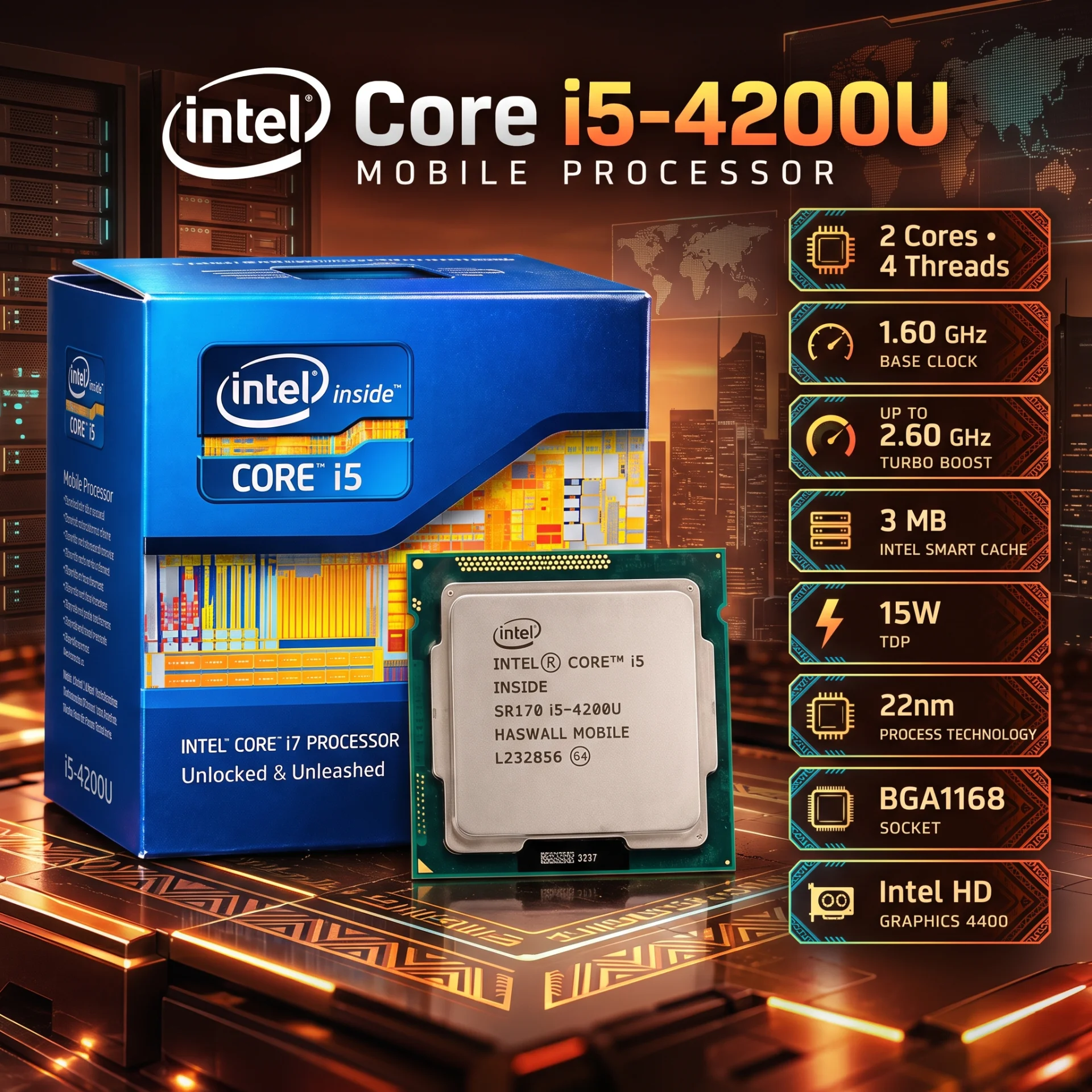
- 2 cores and 4 threads with Intel Hyper-Threading Technology
- 1.60 GHz base frequency with up to 2.60 GHz max turbo frequency
- Intel HD Graphics 4400 integrated graphics solution
- 15W Thermal Design Power (TDP) optimized for mobility
*Approximate regional retail guide prices. Pixahunt is an informational catalog.
CPU Benchmark Scores & Performance Analysis
TESTEDCinebench R23, Geekbench 6, PassMark CPU Mark scores & real-world gaming/office suitability tests.
Technical Specifications
Comprehensive hardware architecture and specifications
General
| Series | Core i5 |
| Model | i5-4200U |
| Cpu Cooler | Not Included |
| Code-Name | Haswell |
| Generation | 4th Gen |
| Sockets Supported | FCBGA1168 |
Performance
| Processor Type. | Core i5 |
| Base Frequency | 1.60 GHz |
| Turbo Frequency Max. | 2.60 GHz |
| Core | 2 |
| Threads | 4 |
| CPU Cache | 3 MB Intel Smart Cache |
| L1 Cache | 128 KB |
| L2 Cache | 512 KB |
| L3 Cache | 3 MB |
| TDP | 15 W |
| Lithography | 22 nm |
| Multiplier | 16.0x |
| Multiplier Unlocked | No |
Memory Support
| Memory Max. | 16 GB |
| Memory Type | DDR3L 1333/1600, LPDDR3 1333/1600 |
| Memory Speed | Up to 1600 MT/s |
| Memory Channel | 2 |
| Max Memory Bandwidth | 25.6 GB/s |
| ECC Memory Supported | No |
Graphics
| Built-in GPU | Yes |
| Processor Graphics | Intel HD Graphics 4400 |
| Graphics Base Frequency | 200 MHz |
| Graphics Dynamic Frequency | 1.00 GHz |
| Graphics Core Count | N/A |
| Max Video Memory | 2 GB |
| Max Resolution | HDMI: 3280x2000@60Hz, DP: 3200x2000@60Hz |
Technical Info
| DirectX Support | 11.2/12 |
| OpenGL Support | 4.3 |
| Approx. Power Consumption | 15 W |
| Compatible Products / Chipsets | Intel 8 Series Chipset Family |
| PCI Express Version | 2.0 |
| PCI Express Lanes | 12 |
| Thermal Solution (MPK / Box) | Not Included |
| Max. Operating Temperature (Tjmax) | 100°C |
Warranty
| Manufacturing Warranty | Discontinued Product (OEM Warranty Varies) |
Additional Info
| Specialty | Intel Hyper-Threading Technology, Intel Turbo Boost Technology 2.0, Intel Virtualization Technology (VT-x) |
| Others | Discontinued Product / End of Servicing Lifetime |
| Country Of Origin | USA |
| Made in/ Assemble | China / Malaysia |
Editorial Overview & Review
In-depth insights, architecture summary, and performance evaluation
1. Introduction & Overview
The Intel Core i5-4200U stands as a landmark processor in the evolution of modern ultrabooks. Built on Intel's acclaimed 4th Generation "Haswell" architecture, this low-power mobile processor was engineered specifically to redefine thin, light, and battery-efficient computing. Designed for mid-range ultrabooks, sleek 2-in-1 convertibles, and compact productivity laptops, the i5-4200U bridged the gap between ultra-portable form factors and dependable daily performance.
Positioned squarely in the mainstream consumer market, the chip targeted professionals, students, and mobile workers who needed reliable power for office suites, multi-tab web browsing, and media consumption without being tethered to a wall outlet. While the processor is now classified as a Discontinued / End of Servicing Lifetime product, understanding its architectural footprint provides critical context for evaluating legacy machines, refurbished buys, or ultra-budget second-hand hardware.
2. Architecture, Performance & Key Technologies
At the heart of the Core i5-4200U is Intel's 22nm Haswell microarchitecture, which brought revolutionary power efficiency gains compared to the previous Ivy Bridge generation. Utilizing 3D Tri-Gate transistor technology, Haswell integrated the voltage regulator onto the die (FIVR), drastically reducing idle power draw and allowing for significantly thinner chassis designs.
- Core Architecture: Features 2 physical cores and 4 threads powered by Intel Hyper-Threading Technology, allowing effective parallel execution for everyday applications.
- Clock Speeds: Operates at a base frequency of 1.60 GHz, dynamically scaling up to a peak 2.60 GHz Turbo Boost frequency for single-threaded dynamic bursts.
- Thermal Envelope: Rated at a low 15 W TDP (Thermal Design Power), making it ideal for fanless or low-noise active cooling implementations with a max operating temperature (Tjmax) of 100°C.
- Cache Memory: Packed with 128 KB L1, 512 KB L2, and 3 MB Intel Smart Cache (L3) to streamline data throughput.
- Graphics Subsystem: Integrated Intel HD Graphics 4400 with a base clock of 200 MHz boosting up to 1.00 GHz. It supports DirectX 11.2/12 (feature level limited) and OpenGL 4.3, capable of powering external displays via HDMI (3280x2000 @ 60Hz) and DisplayPort (3200x2000 @ 60Hz).
- Memory Controller: Dual-channel memory engine supporting up to 16 GB of DDR3L or LPDDR3 RAM at speeds up to 1600 MT/s, delivering a max memory bandwidth of 25.6 GB/s.
- Form Factor: Packaged in an FCBGA1168 socket, meaning the CPU is permanently soldered onto the system motherboard and non-upgradable.
3. Real-World Use Cases
In practice, the Intel Core i5-4200U shines brightest in routine, light-to-moderate computing tasks. For everyday office productivity—such as managing heavy spreadsheets, drafting documents, participating in standard-definition video calls, and running multiple browser tabs—the 4-thread execution keeps the operating system responsive and nimble.
When it comes to multimedia and content consumption, the integrated HD 4400 graphics easily handles 1080p high-bitrate video playback and multi-monitor productivity setups. However, modern 4K AV1 or VP9 hardware decoding will strain the chip, offloading much of the heavy lifting onto the CPU cores.
For gaming and heavy content creation, expectations must be kept low. The HD Graphics 4400 is not designed for modern AAA games. Legacy titles from the early 2010s (such as Portal 2, Counter-Strike: Source, or Elder Scrolls V: Skyrim) can run at 720p resolution on low graphical settings. Heavy video rendering or 3D modeling will hit the physical limits of the dual-core architecture quickly, though basic photo editing in light desktop applications remains entirely functional.
4. Strengths & Potential Considerations
Strengths
- Exceptional Efficiency: The 15W TDP brought multi-hour battery life leaps to 4th-gen laptops without generating excessive heat.
- Hyper-Threading Advantage: 2 cores / 4 threads prevent system lockups during background task execution.
- Solid I/O Capability: Supports up to 12 PCIe 2.0 lanes and dual-channel DDR3L memory up to 16GB.
- Intel Turbo Boost 2.0: Dynamically ramps performance up to 2.60 GHz when quick bursts of speed are needed.
Potential Considerations
- Dual-Core Limitation: Struggles with modern heavily multi-threaded workloads, heavy multitasking, or contemporary video codecs.
- Soldered BGA Design: Because it relies on the FCBGA1168 socket, upgrading the processor down the road is impossible.
- End of Life Status: As a discontinued OEM component, it no longer receives official security patches, microcode updates, or active driver support from Intel.
- Weak Integrated Graphics: Intel HD 4400 lacks the compute units required for modern 3D gaming or GPU-accelerated video editing.
5. Final Buying Verdict
The Intel Core i5-4200U represents a historical high point for mobile CPU power-efficiency. In its prime, it defined the modern ultrabook experience. Today, as an legacy processor, it is no longer a viable target for a primary modern computing setup if bought new.
Who should consider it today? If you are browsing the secondary market for an ultra-budget used laptop, a basic home automation node, or an inexpensive Linux workstation under $100, a laptop powered by the i5-4200U (especially when paired with an SSD and 8GB or 16GB of RAM) can still deliver a surprisingly usable web-browsing and document-editing experience. For any serious modern productivity, gaming, or content creation, however, investing in a newer multi-core architecture is strongly recommended.
OUR RATING CONSENSUS
The overall rating is based on review by our experts & industry benchmark suites
Quick Snapshot
- Overall Rating
- 4.5 / 10
- Brand
- Intel
- Category
- Processor
- Catalog Model
- i5-4200U
- Status
- Published
- Release Date
- Oct 10, 2026
Pixahunt Tech Community
Connect with hardware enthusiasts, compare benchmarks, and explore real user setups.
Explore Full Newsfeed →Related Gadgets
- 3.20 GHz Dual-Core Clock Speed for Reliable Everyday Computing
- Intel Hyper-Threading Technology Enabling 4 Parallel Threads
- Built-in Intel HD Graphics for Integrated Display Support
- 2 cores and 4 threads with Intel Hyper-Threading Technology
- 3.10 GHz base processor frequency
- 3 MB Intel Smart Cache
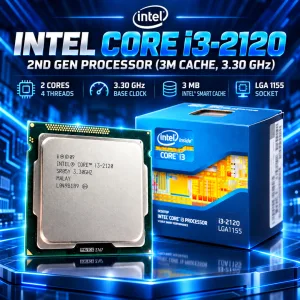
- 2 Cores and 4 Threads with Intel Hyper-Threading Technology
- 3.30 GHz Base Clock Frequency with 3 MB Intel Smart Cache
- Includes Intel HD Graphics 2000 integrated graphics
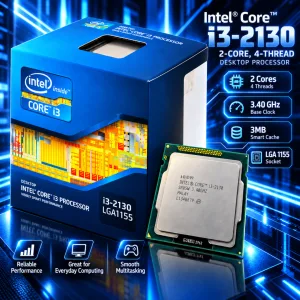
- 2 cores and 4 threads with Intel Hyper-Threading Technology
- 3.40 GHz processor base frequency with 3 MB Intel Smart Cache
- Integrated Intel HD Graphics 2000