

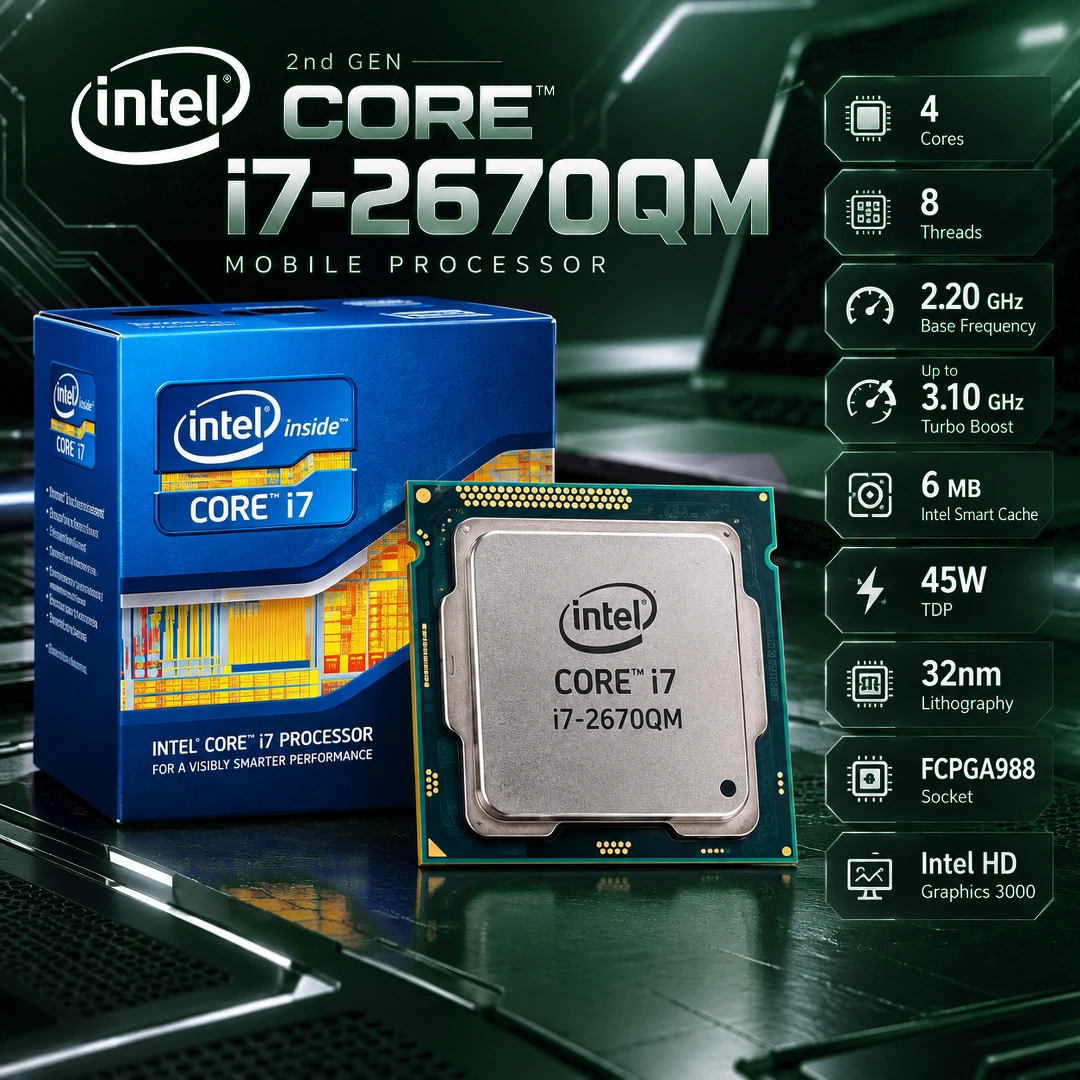
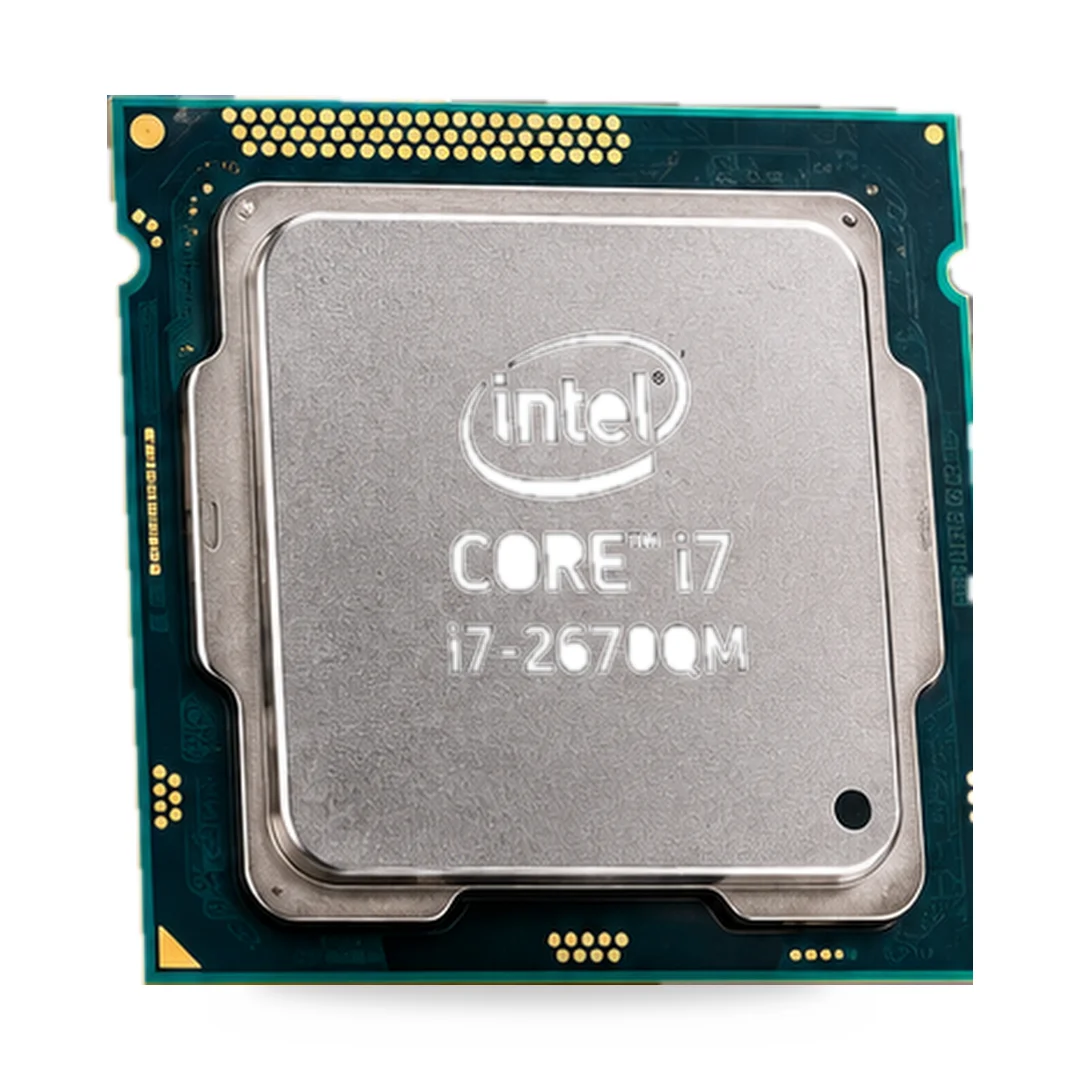
Intel Core i7-2670QM 4-Core, 8-Thread Mobile Processor
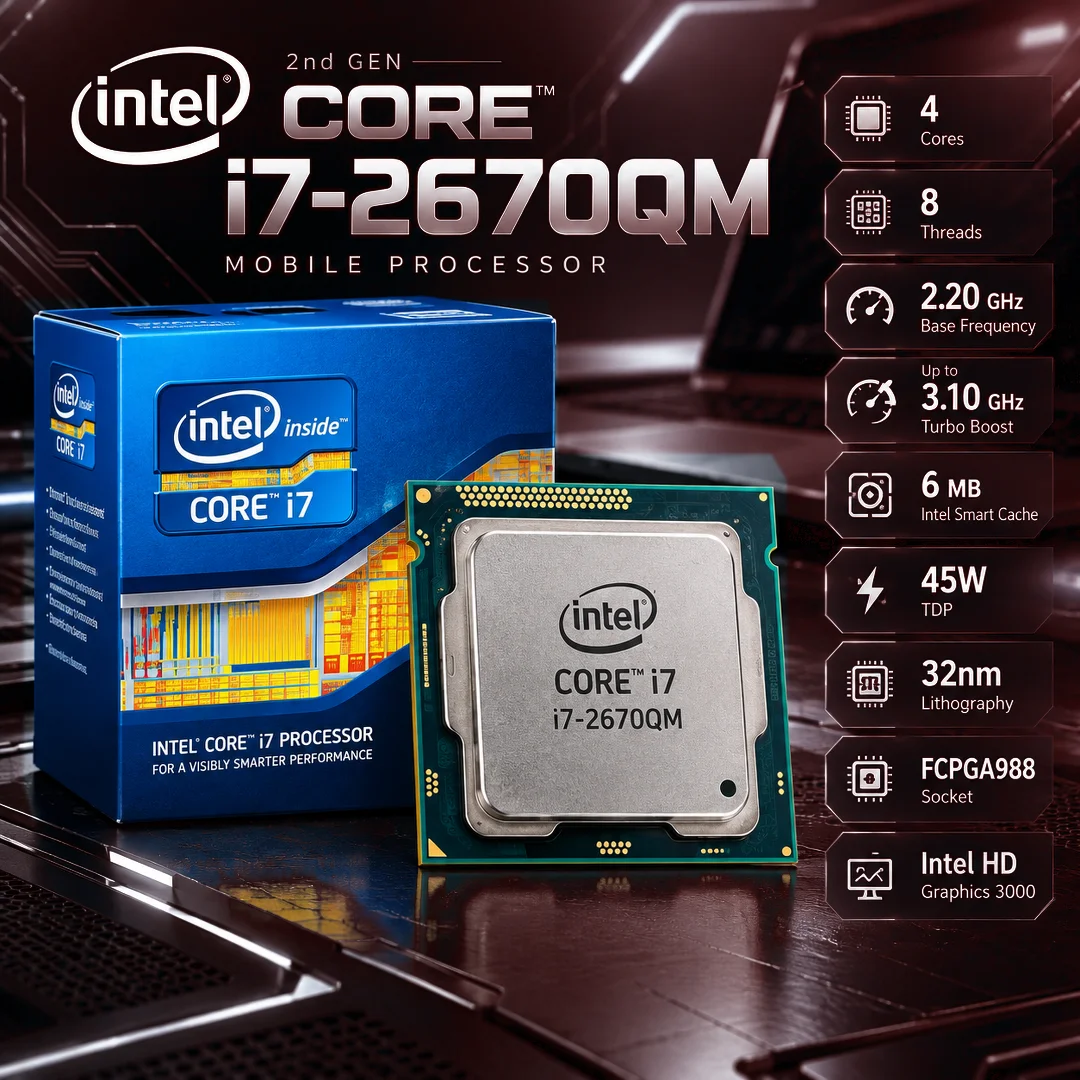
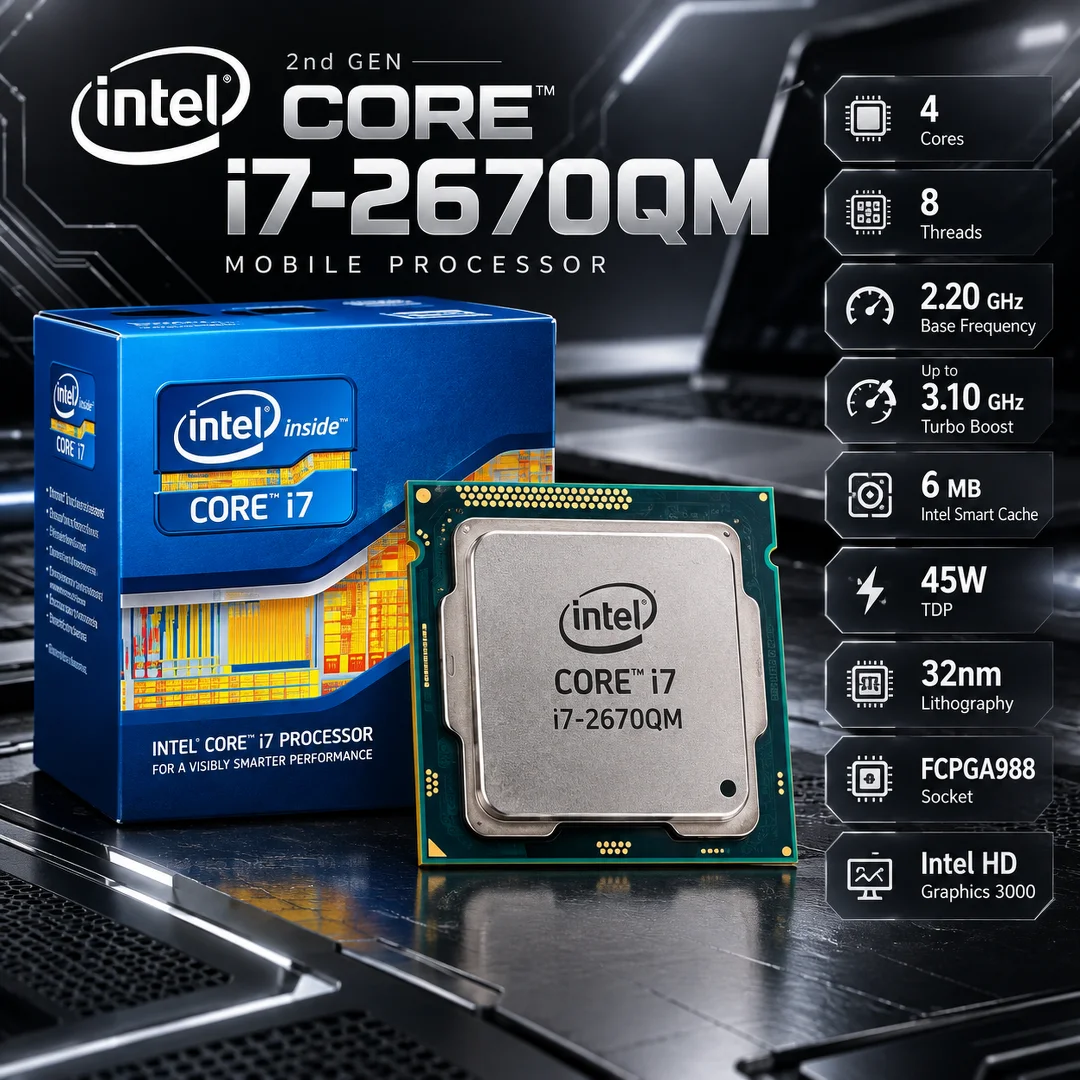
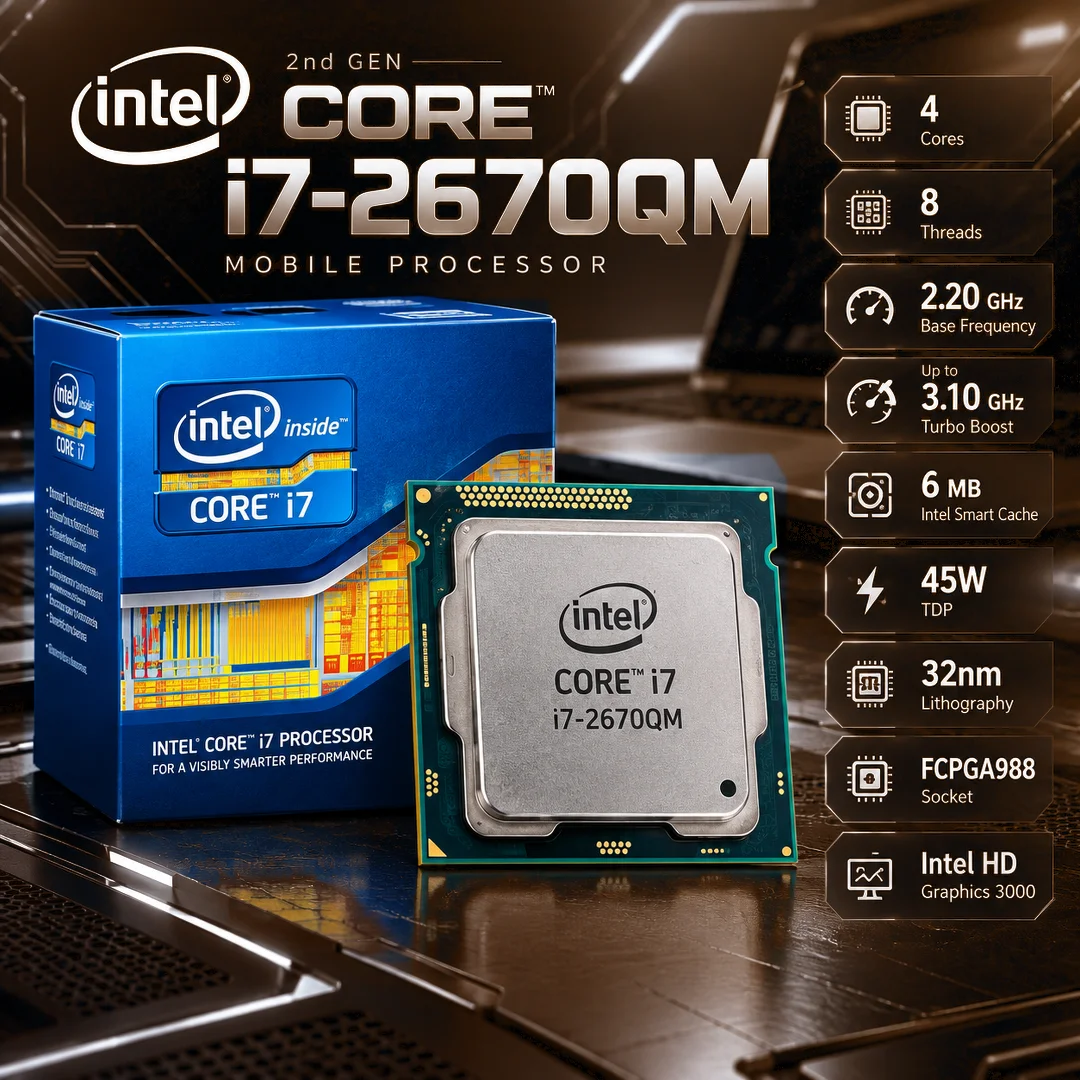
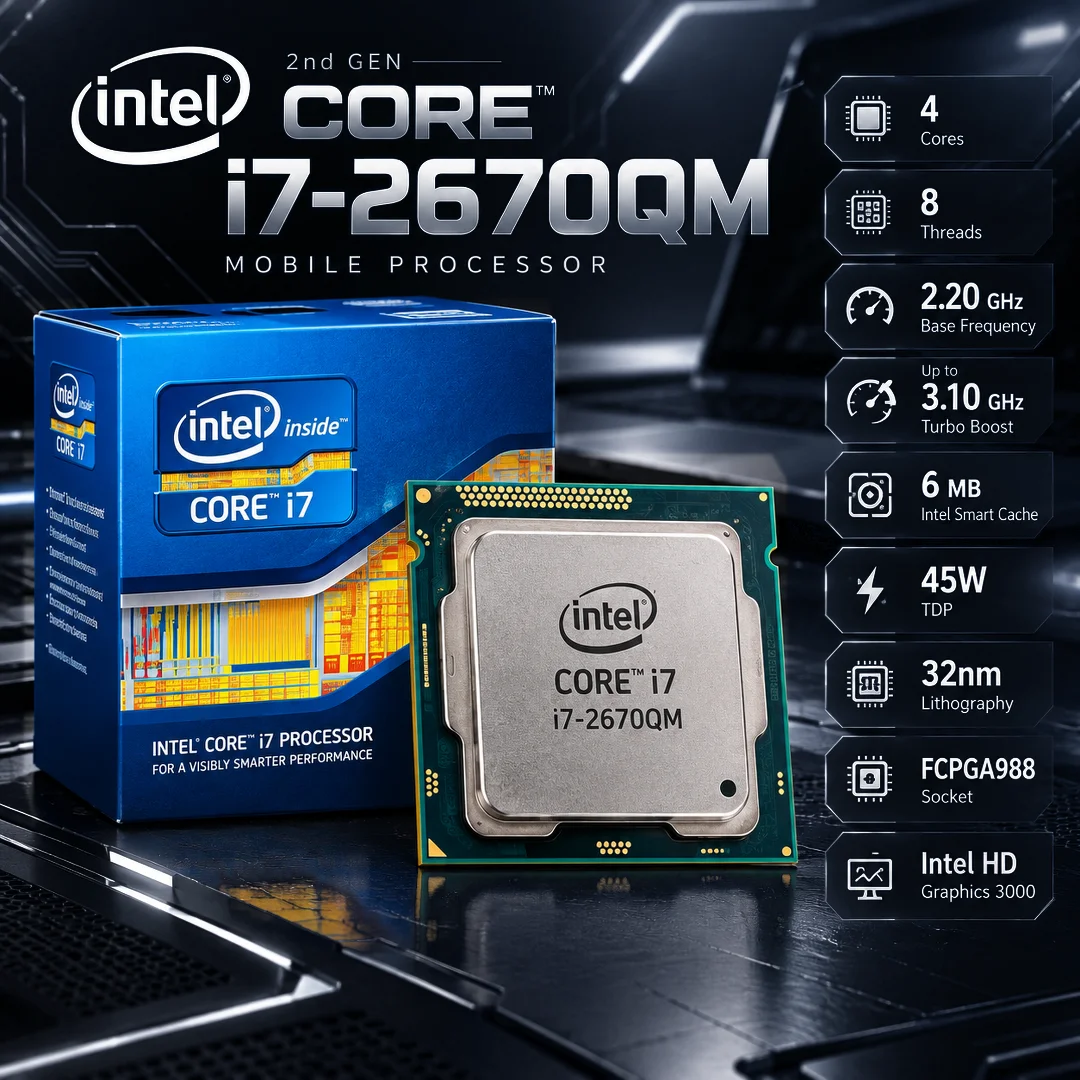
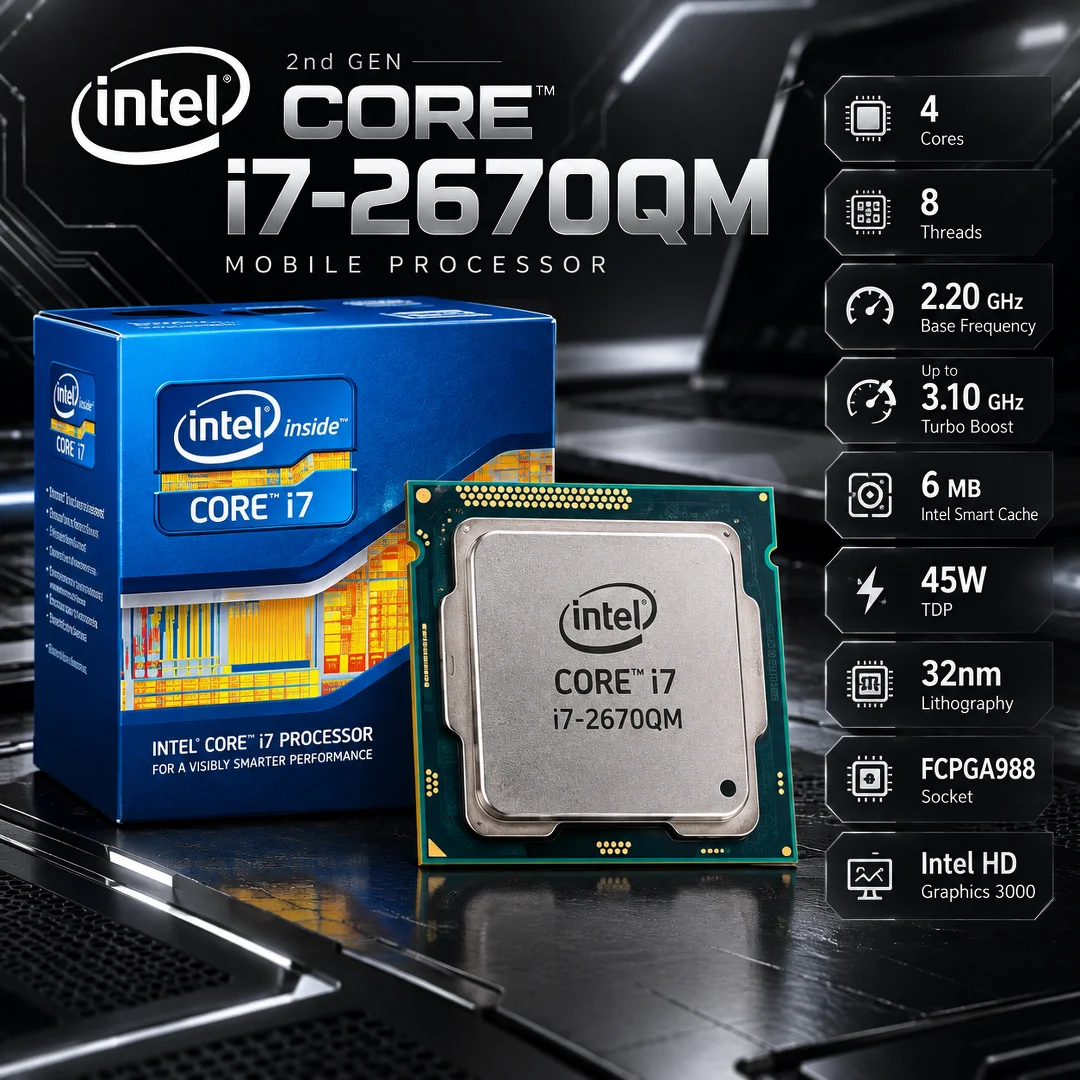
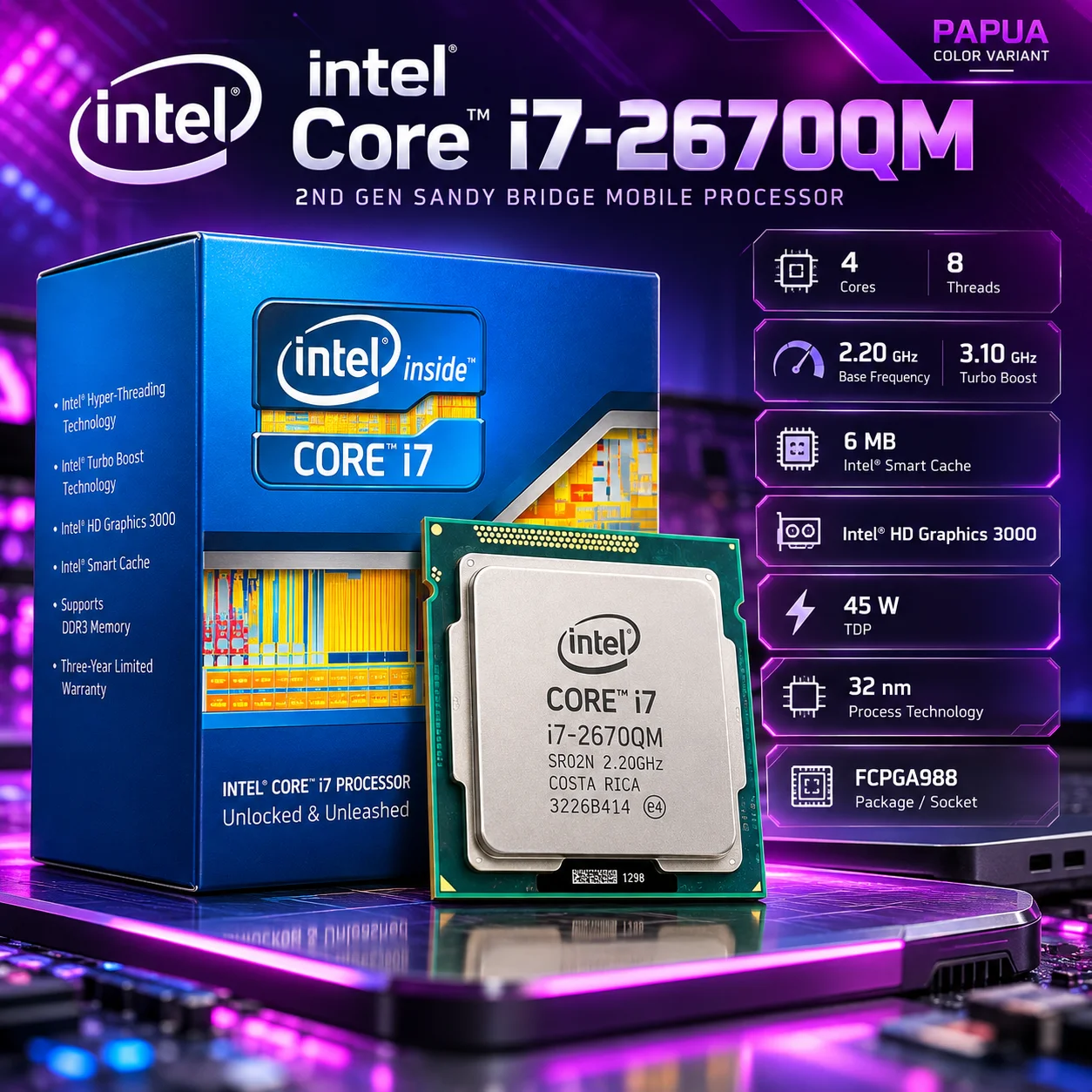
- 4 cores and 8 threads with Intel Hyper-Threading Technology
- 2.20 GHz base frequency with up to 3.10 GHz max turbo frequency
- 6 MB Intel Smart Cache with 45W TDP
- Integrated Intel HD Graphics 3000
*Approximate regional retail guide prices. Pixahunt is an informational catalog.
CPU Benchmark Scores & Performance Analysis
TESTEDCinebench R23, Geekbench 6, PassMark CPU Mark scores & real-world gaming/office suitability tests.
Technical Specifications
Comprehensive hardware architecture and specifications
General
| Series | Core i7 |
| Model | i7-2670QM |
| Cpu Cooler | Not Included |
| Code-Name | Sandy Bridge |
| Generation | 2nd Gen |
| Sockets Supported | FC-BGA1023, PPGA988 |
Performance
| Base Frequency | 2.20 GHz |
| Turbo Frequency Max. | 3.10 GHz |
| Core | 4 |
| Threads | 8 |
| CPU Cache | 6 MB Smart Cache |
| L1 Cache | 256 KB |
| L2 Cache | 1 MB |
| L3 Cache | 6 MB |
| TDP | 45 W |
| Lithography | 32 nm |
| Multiplier | 22.0x |
| Multiplier Unlocked | No |
| Processor Type | Core i7 |
Memory Support
| Memory Max. | 32 GB |
| Memory Type | DDR3 1066/1333 |
| Memory Speed | 1333 MHz |
| Memory Channel | 2 |
| Max Memory Bandwidth | 21.3 GB/s |
| ECC Memory Supported | No |
Graphics
| Built-in GPU | Yes |
| Processor Graphics | Intel HD Graphics 3000 |
| Graphics Base Frequency | 650 MHz |
| Graphics Dynamic Frequency | 1.10 GHz |
| Graphics Core Count | N/A |
| Max Video Memory | N/A |
| Max Resolution | N/A |
Technical Info
| DirectX Support | 10.1 |
| OpenGL Support | 3.1 |
| Approx. Power Consumption | 45 W |
| Compatible Products / Chipsets | Intel HM65, HM67, QM67, QS67 Express Chipsets |
| PCI Express Version | 2.0 |
| PCI Express Lanes | 16 |
| Thermal Solution (MPK / Box) | Not Included |
| Max. Operating Temperature (Tjmax) | 100°C |
Warranty
| Manufacturing Warranty | Discontinued Product (No Active Warranty) |
Additional Info
| Specialty | Intel Hyper-Threading, Intel Turbo Boost 2.0, Intel Quick Sync Video |
| Others | 64-bit Instruction Set, AVX Extensions |
| Country Of Origin | USA |
| Made in/ Assemble | China / Malaysia |
Editorial Overview & Review
In-depth insights, architecture summary, and performance evaluation
Introduction & Overview
As a tech journalist who has watched the laptop industry evolve over more than a decade, looking back at landmark hardware architectural shifts always brings a sense of nostalgia—and profound respect. Released during the heyday of Intel’s legendary "Sandy Bridge" microarchitecture, the Intel Core i7-2670QM represents a defining moment for mobile computing. Positioned firmly as a performance-tier quad-core processor for the second-generation Core family, this CPU was designed to bring desktop-class muscle into portable form factors.
Targeted squarely at power users, mobile workstations, and mid-to-high-end gaming laptops of its era, the i7-2670QM aimed to satisfy the demands of software developers, video editors, and gamers who refused to be chained to a desktop tower. While it is now a legacy, discontinued component, understanding its architecture and design philosophy provides a masterclass in how Intel successfully democratized multi-core performance for laptops.
Architecture, Performance & Key Technologies
At its core, the i7-2670QM is built on a mature 32nm lithography process. Featuring 4 physical cores and 8 threads thanks to Intel Hyper-Threading technology, this processor changed the rules of mobile multitasking. Out of the box, it operates at a modest 2.20 GHz base frequency, but when thermal headroom and workloads allow, Intel Turbo Boost 2.0 kicks in, dynamically ramping the clock speed up to an impressive 3.10 GHz.
The chip is backed by a generous 6 MB of Intel Smart Cache, which drastically minimizes latency when fetching frequently accessed data. Built for mobile efficiency without completely abandoning performance, it features a Thermal Design Power (TDP) rating of 45W, making it standard issue for 15-inch and 17-inch performance chassis of the early 2010s.
Graphics are handled by the integrated Intel HD Graphics 3000, operating at a base frequency of 650 MHz and stretching up to 1.10 GHz dynamically. While rudimentary by today's standards, it was a capable IGP for its time, featuring crucial hardware acceleration like Intel Quick Sync Video for rapid video transcoding. Furthermore, the processor natively supports up to 32 GB of dual-channel DDR3 memory running at 1333 MHz, paired smoothly with Intel’s HM65, HM67, QM67, or QS67 Express chipsets via a PCIe 2.0 interface.
Real-World Use Cases
How does a quad-core Sandy Bridge processor hold up across various applications? Historically and practically, the i7-2670QM was built to chew through demanding tasks:
- Daily Productivity & Multitasking: With 8 threads at its disposal, office workflows featuring dozens of Chrome tabs, heavy Excel spreadsheets, and background communication apps run fluidly without stutter.
- Content Creation & Media: Armed with AVX (Advanced Vector Extensions) and Intel Quick Sync, video editing in software like Adobe Premiere Pro and rendering in CAD applications became genuinely viable on a laptop for mainstream professionals.
- Gaming: While the integrated HD Graphics 3000 is limited to older titles and casual esports at lower settings, laptops featuring the i7-2670QM were almost always paired with discrete graphics cards (such as NVIDIA GeForce GT or GTX 500/600 series). In this configuration, the CPU served as a solid gaming companion, preventing bottlenecks in titles of that generation.
Strengths & Potential Considerations
To give you a balanced overview of the i7-2670QM, let's break down its primary advantages and structural limitations:
-
Pros:
- Robust quad-core, eight-thread performance that still handles basic daily computing with ease.
- Impressive thermal and performance scaling with Intel Turbo Boost 2.0 up to 3.10 GHz.
- Support for up to 32 GB of DDR3 memory, extending the longevity of older motherboards.
- Included Intel Quick Sync Video significantly accelerates legacy video encoding tasks. Cons:
- Outdated 32nm manufacturing node yields higher power consumption relative to modern sub-10nm architectures.
- Integrated GPU lacks support for modern DirectX APIs (caps out at DirectX 10.1 and OpenGL 3.1).
- Discontinued status means zero active warranty or manufacturer support; upgrade paths are strictly bound to socket-compatible (FC-BGA1023, PPGA988) legacy boards.
Final Buying Verdict
The Intel Core i7-2670QM is a monument to durable, high-performance engineering from the Sandy Bridge era. For the average consumer looking to buy a brand-new primary machine today, this processor is obviously far past its prime and superseded by generations of architectural advancements.
However, for retro hardware enthusiasts, budget tinkerers restoring older laptops, or anyone looking to squeeze every last drop of performance out of a legacy 2nd-Gen Intel machine for basic office work, media streaming, or light retro gaming, the i7-2670QM remains an iconic piece of tech. It delivers surprising baseline capability that proves some well-engineered silicon stands the test of time.
OUR RATING CONSENSUS
The overall rating is based on review by our experts & industry benchmark suites
Quick Snapshot
- Overall Rating
- 4.5 / 10
- Brand
- Intel
- Category
- Processor
- Catalog Model
- i7-2670QM
- Status
- Published
- Release Date
- Oct 10, 2026
Pixahunt Tech Community
Connect with hardware enthusiasts, compare benchmarks, and explore real user setups.
Explore Full Newsfeed →Related Gadgets
- 3.20 GHz Dual-Core Clock Speed for Reliable Everyday Computing
- Intel Hyper-Threading Technology Enabling 4 Parallel Threads
- Built-in Intel HD Graphics for Integrated Display Support
- 2 cores and 4 threads with Intel Hyper-Threading Technology
- 3.10 GHz base processor frequency
- 3 MB Intel Smart Cache
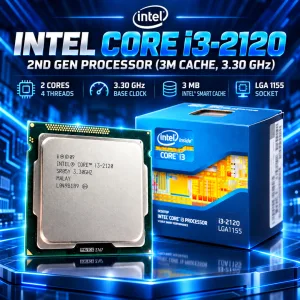
- 2 Cores and 4 Threads with Intel Hyper-Threading Technology
- 3.30 GHz Base Clock Frequency with 3 MB Intel Smart Cache
- Includes Intel HD Graphics 2000 integrated graphics
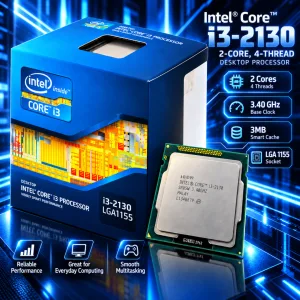
- 2 cores and 4 threads with Intel Hyper-Threading Technology
- 3.40 GHz processor base frequency with 3 MB Intel Smart Cache
- Integrated Intel HD Graphics 2000