

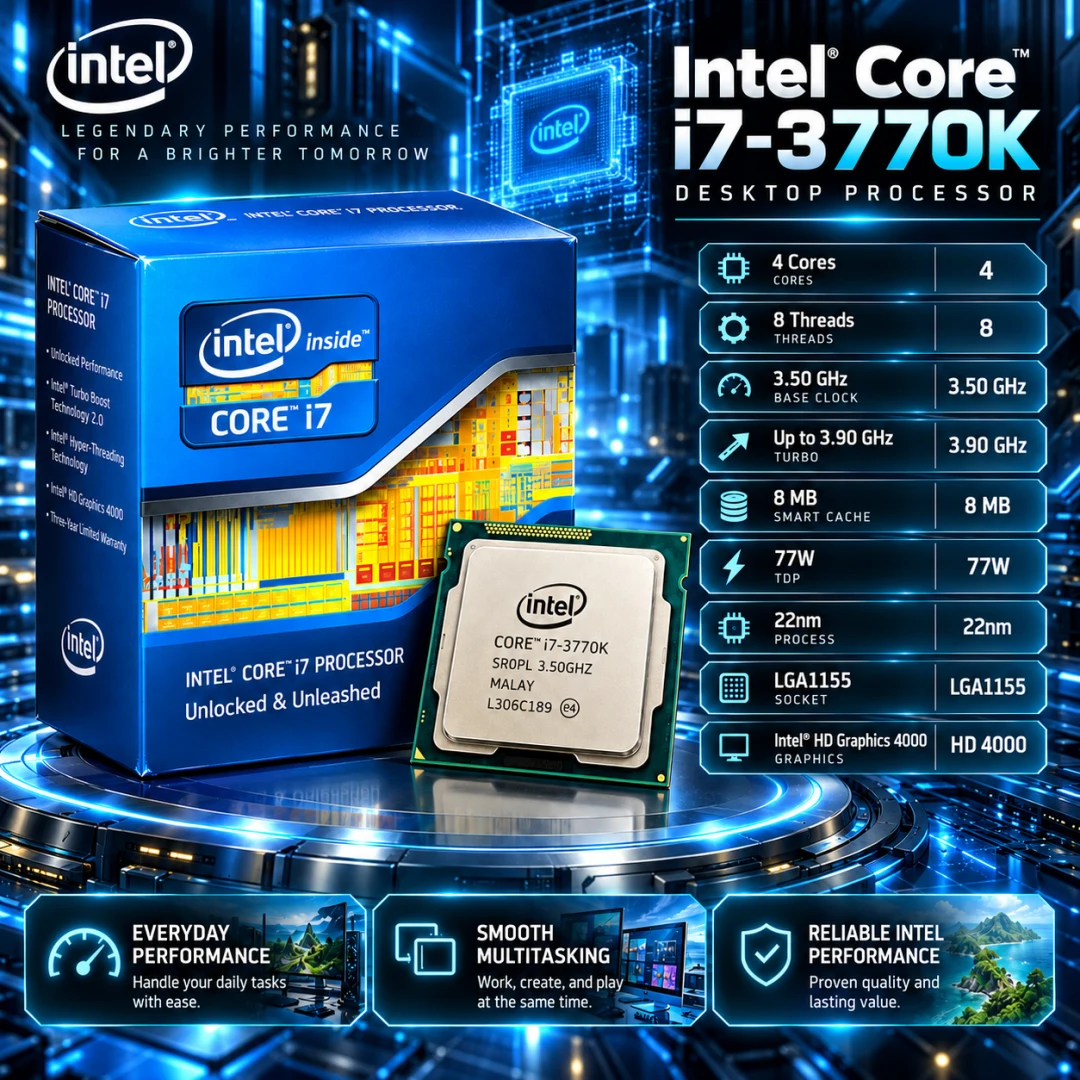
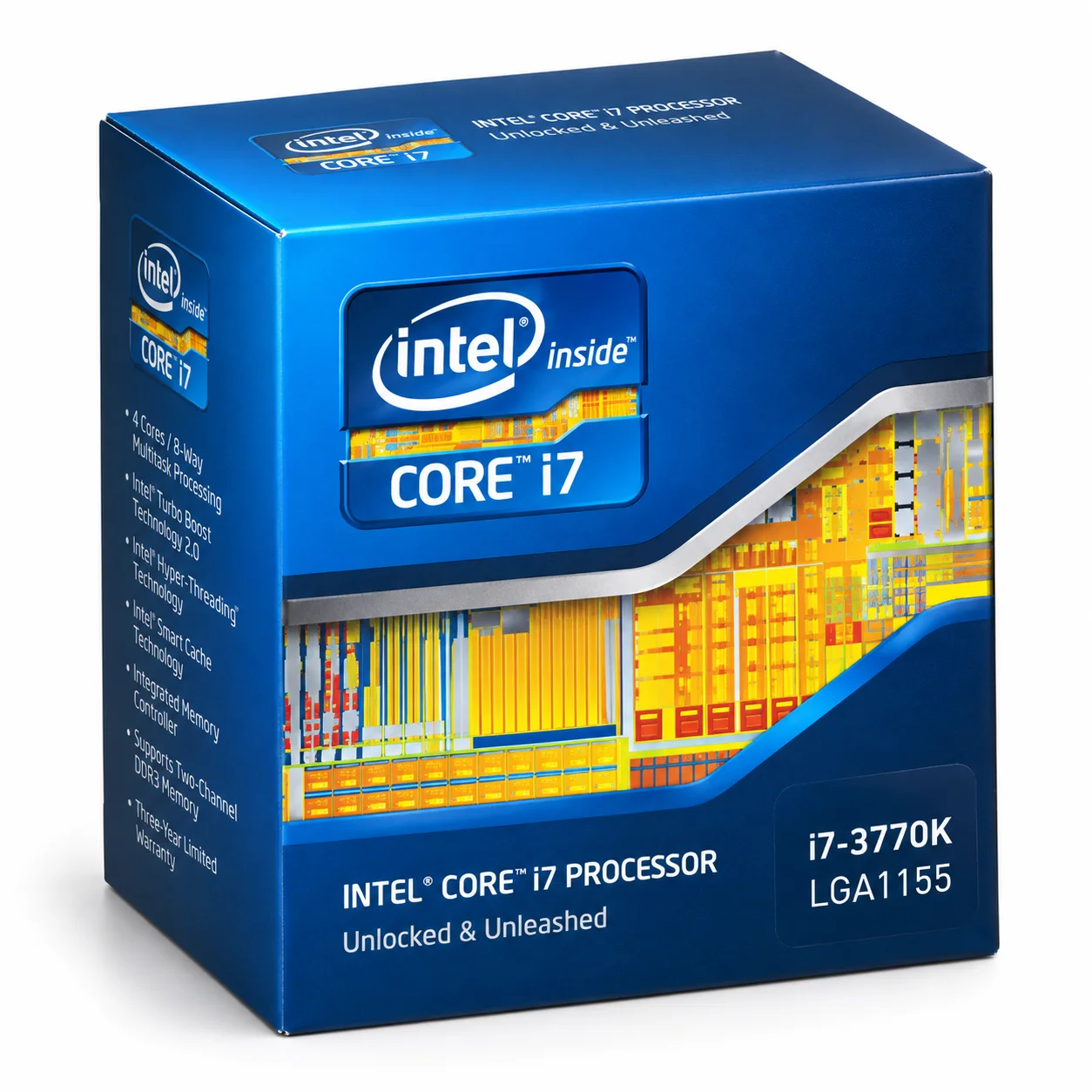
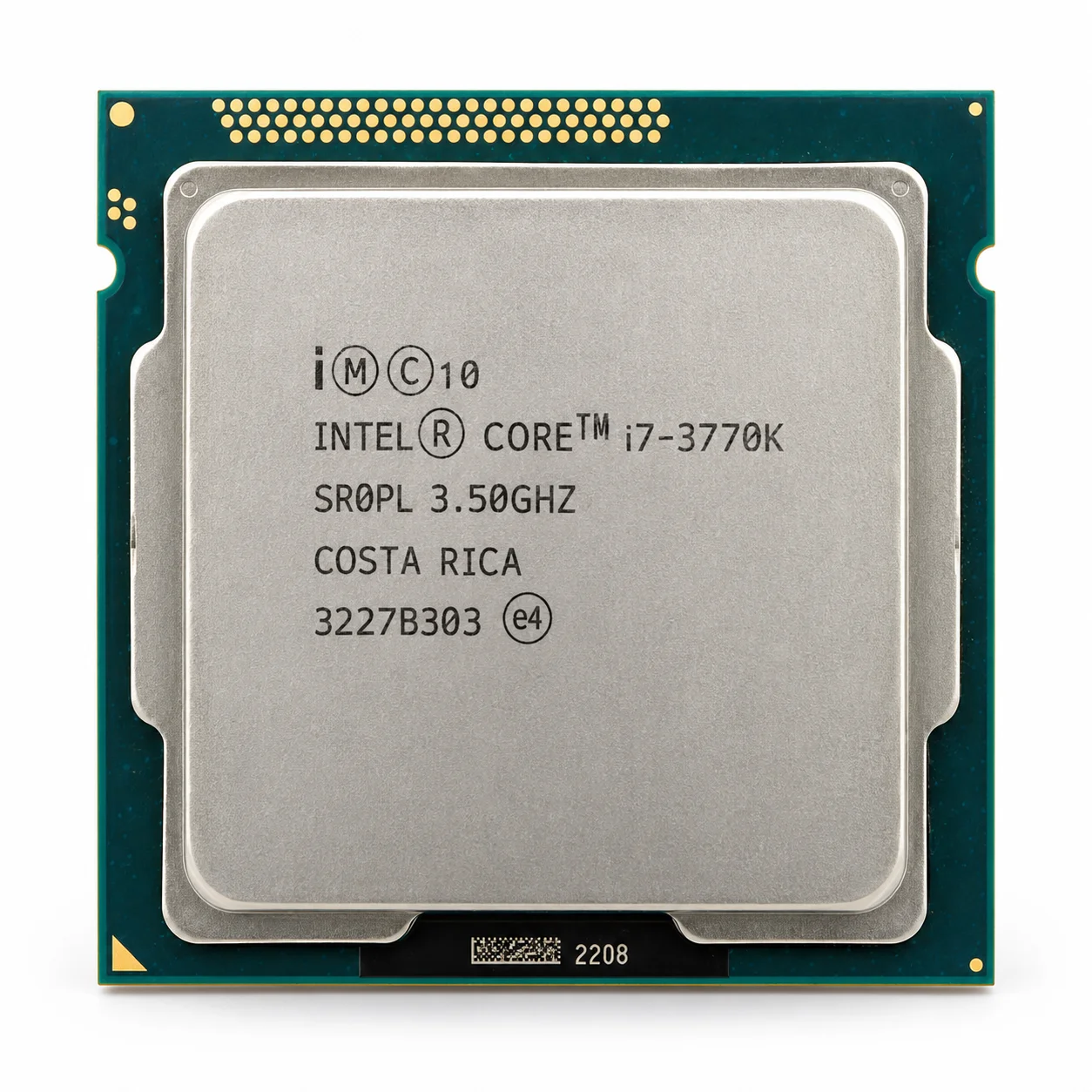
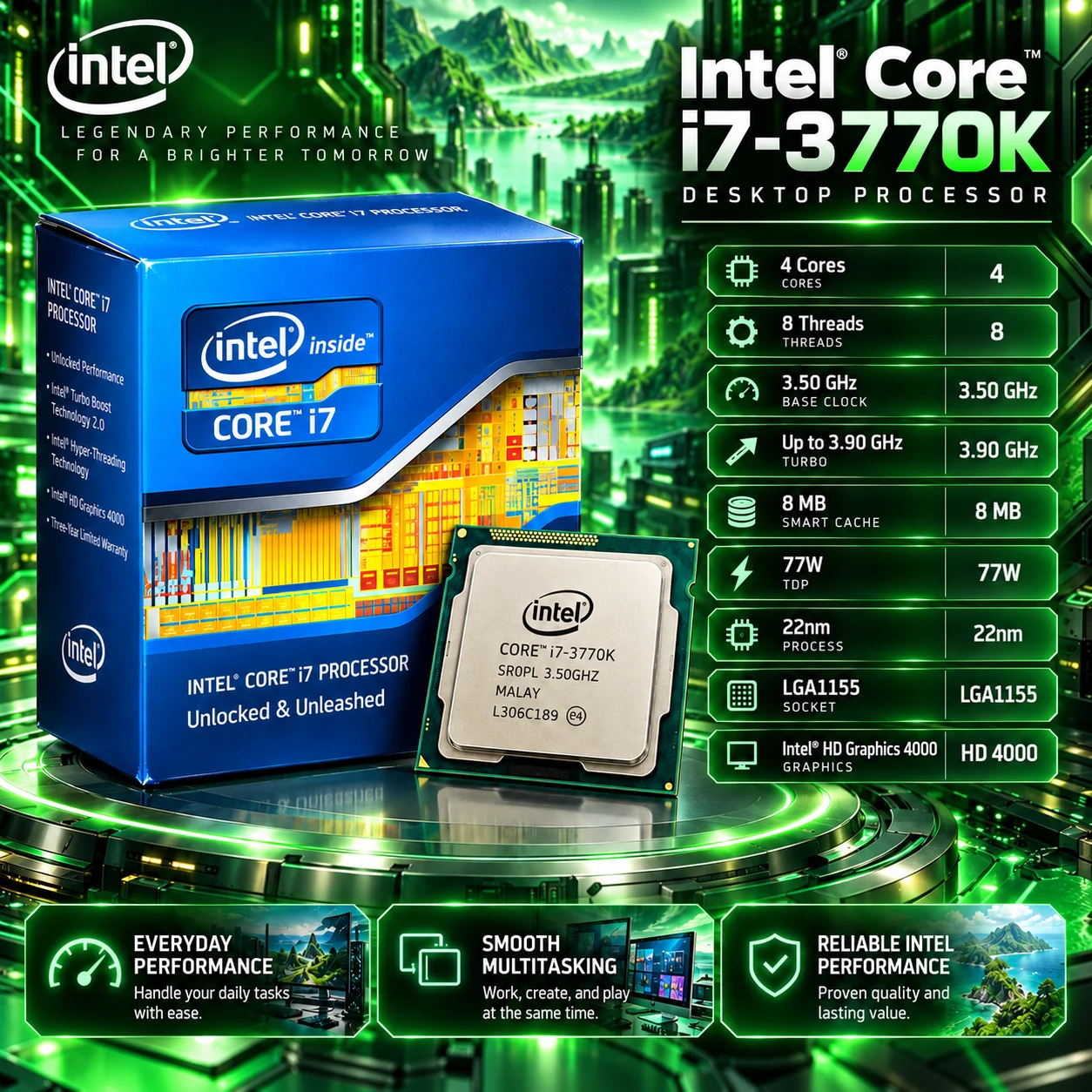
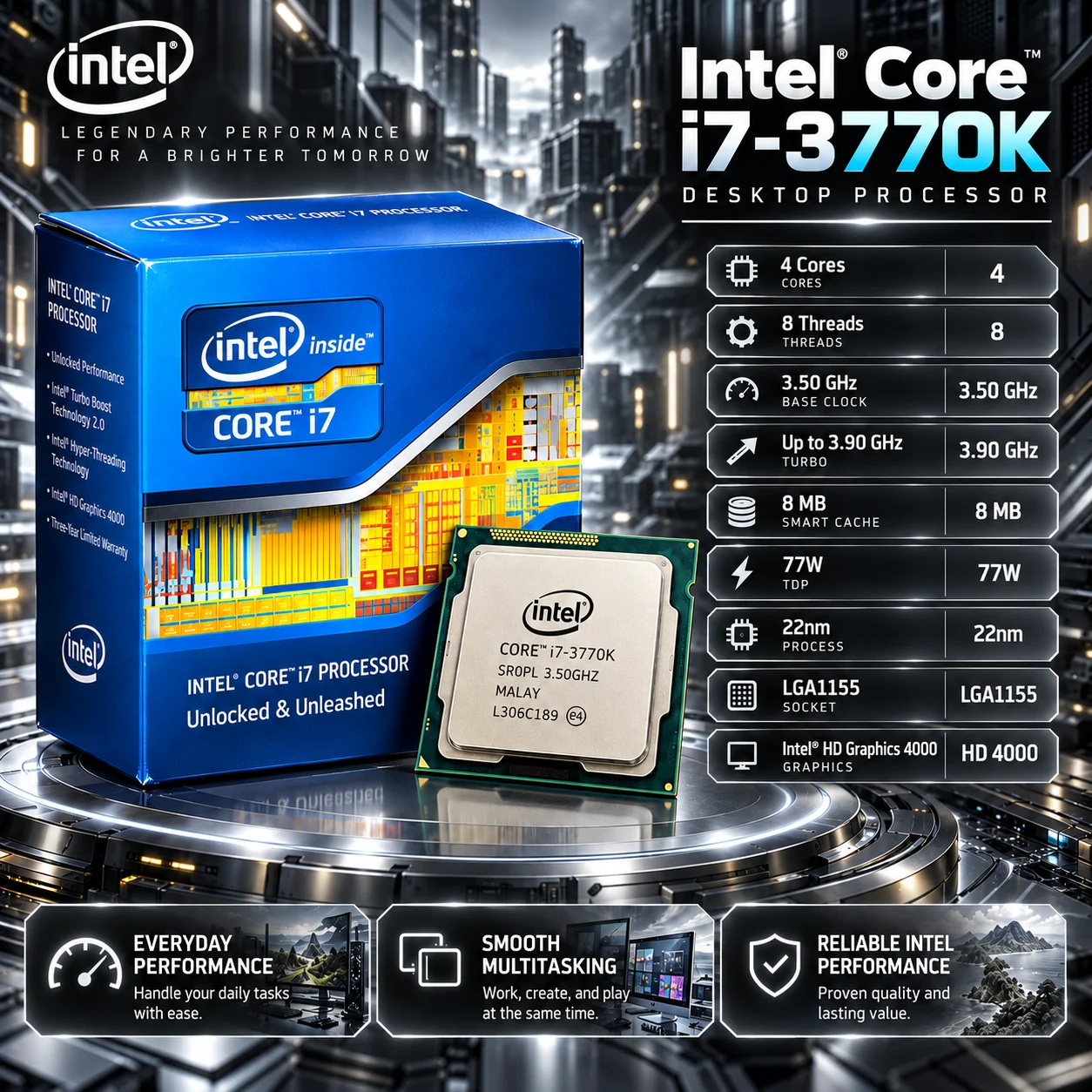
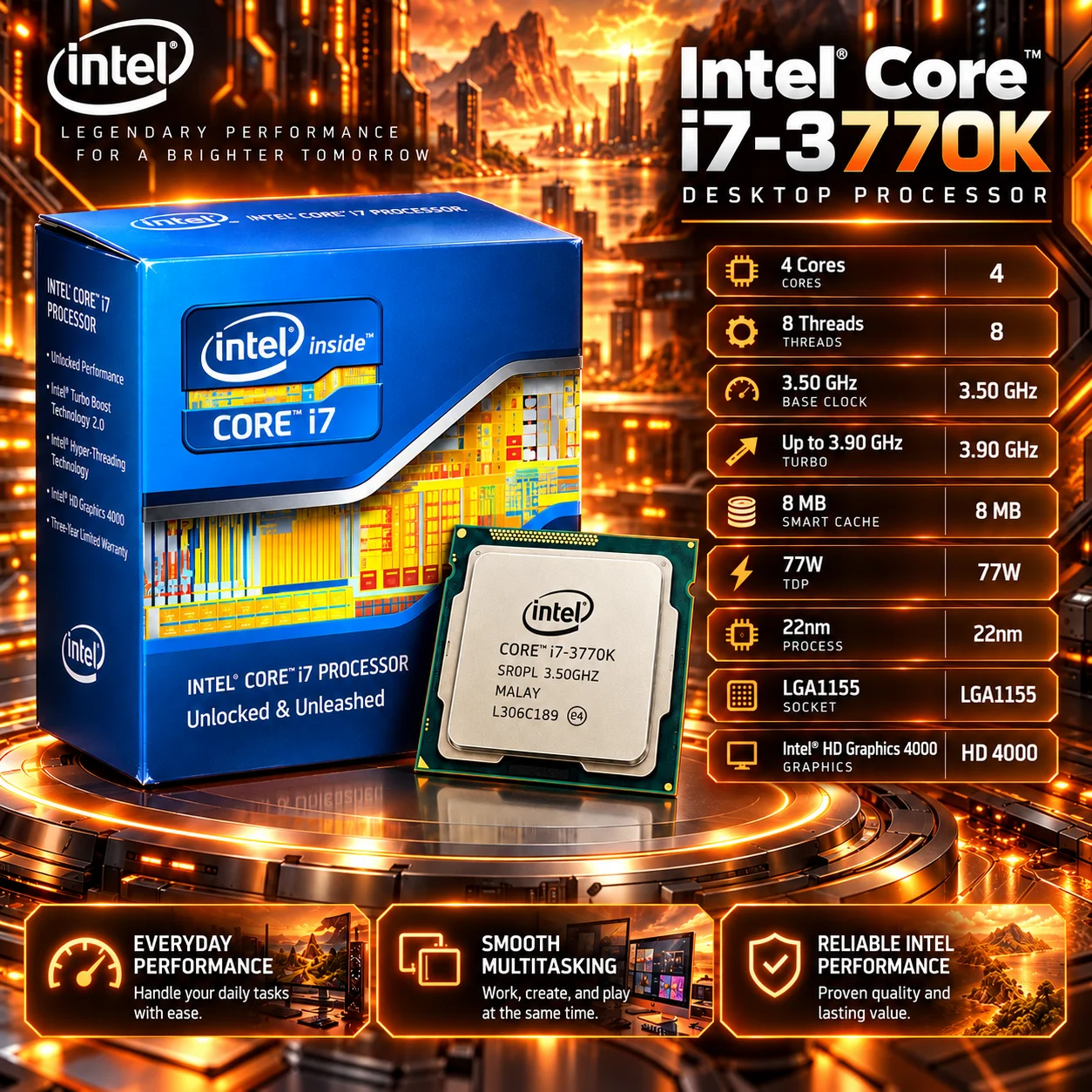
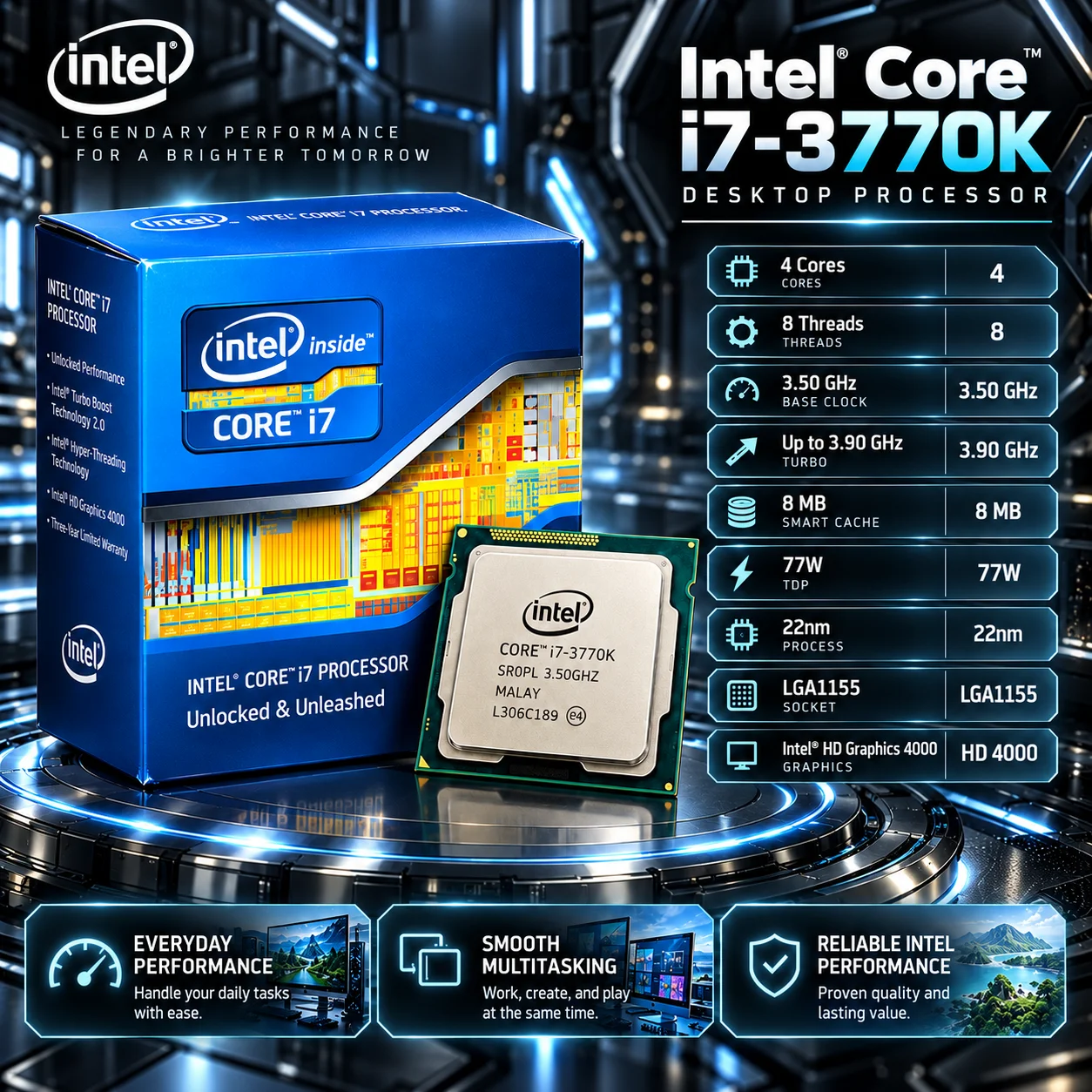
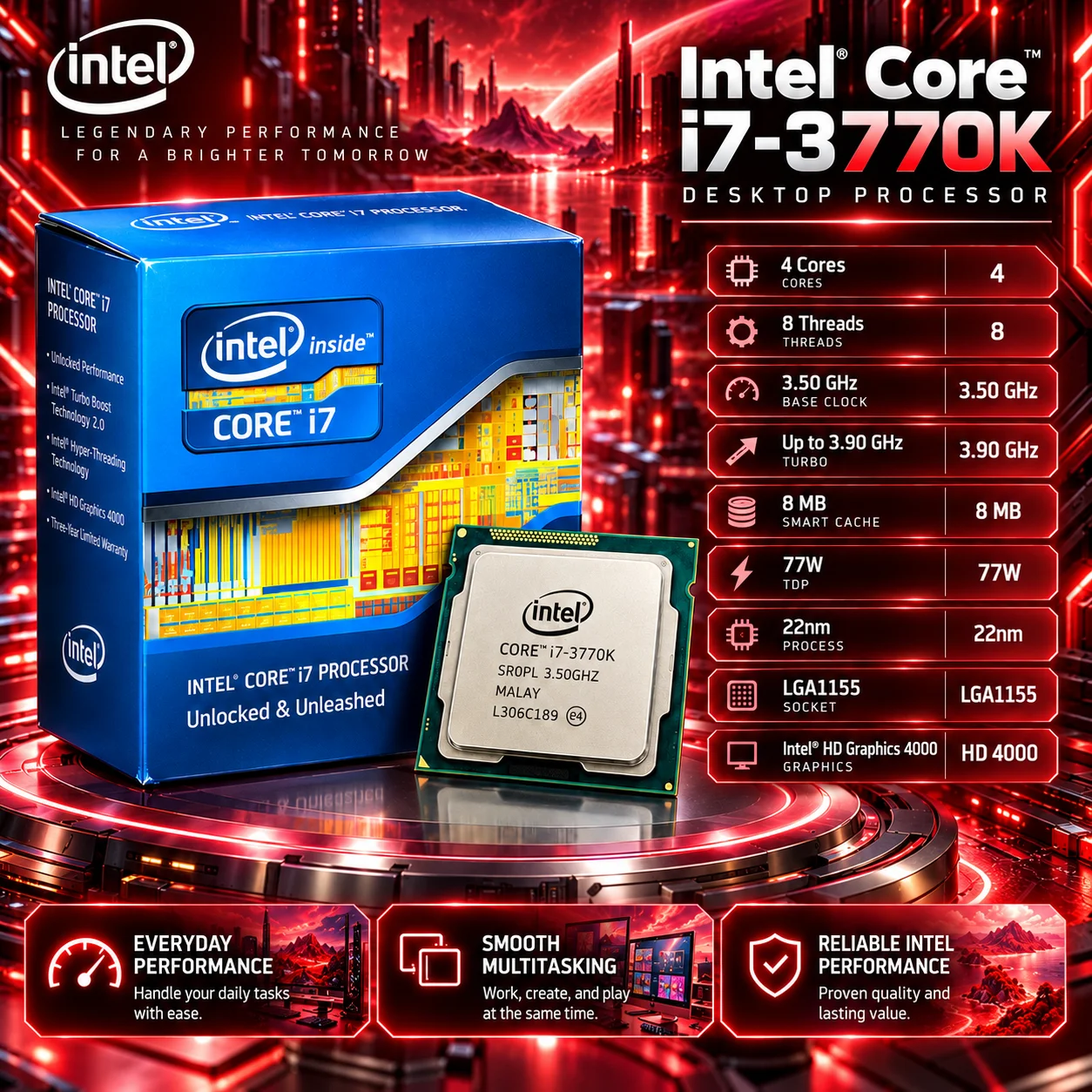
Intel Core i7-3770K Processor 8M Cache, up to 3.90 GHz
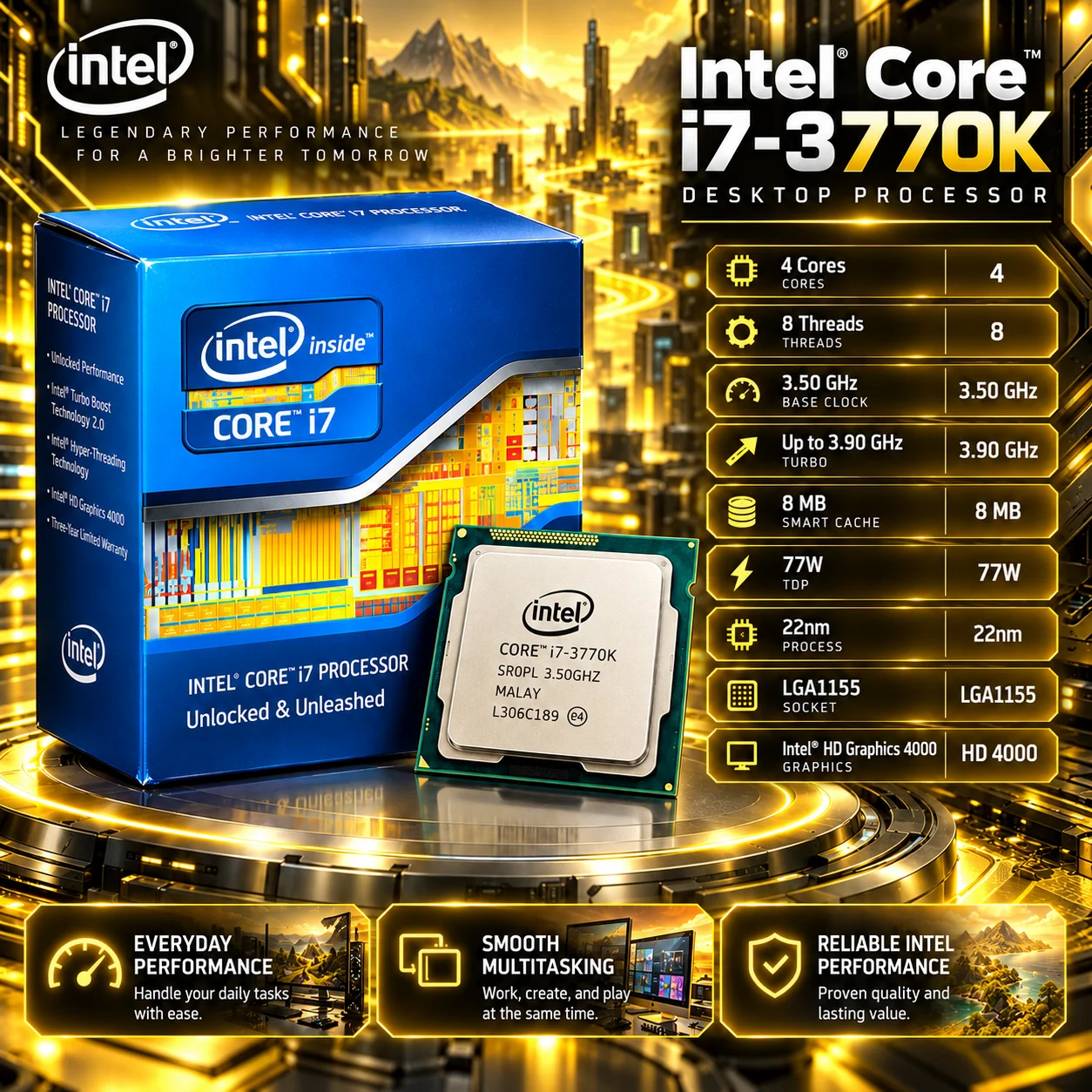
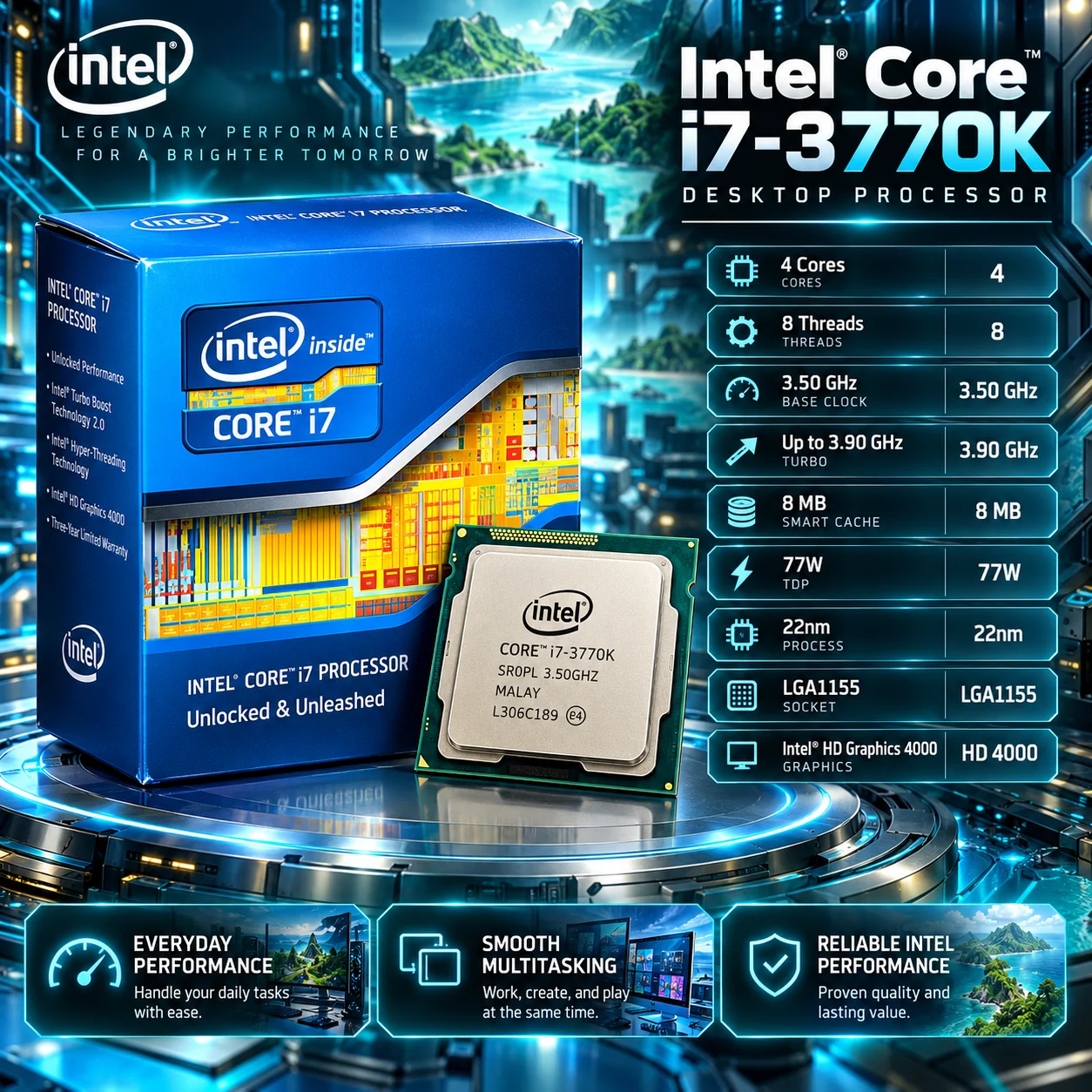
- 4 Cores and 8 Threads with Hyper-Threading Technology
- 3.50 GHz Base Frequency with up to 3.90 GHz Max Turbo Frequency
- Unlocked multiplier for simplified and flexible overclocking
- Intel HD Graphics 4000 integrated graphics solution
*Approximate regional retail guide prices. Pixahunt is an informational catalog.
CPU Benchmark Scores & Performance Analysis
TESTEDCinebench R23, Geekbench 6, PassMark CPU Mark scores & real-world gaming/office suitability tests.
Technical Specifications
Comprehensive hardware architecture and specifications
General
| Series | Core i7 |
| Model | i7-3770K |
| Cpu Cooler | Not Included |
| Code-Name | Ivy Bridge |
| Generation | 3rd Gen |
| Sockets Supported | FCLGA1155 |
Performance
| Base Frequency | 3.50 GHz |
| Turbo Frequency Max. | 3.90 GHz |
| Core | 4 |
| Threads | 8 |
| CPU Cache | 8 MB Intel Smart Cache |
| L1 Cache | 64 KB per core |
| L2 Cache | 256 KB per core |
| L3 Cache | 8 MB shared |
| TDP | 77 W |
| Lithography | 22 nm |
| Multiplier | 35.0x |
| Multiplier Unlocked | Yes |
| Processor Type | Core i7 |
Memory Support
| Memory Max. | 32 GB |
| Memory Type | DDR3 |
| Memory Speed | 1333/1600 MT/s |
| Memory Channel | 2 |
| Max Memory Bandwidth | 25.6 GB/s |
| ECC Memory Supported | No |
Graphics
| Built-in GPU | Yes |
| Processor Graphics | Intel HD Graphics 4000 |
| Graphics Base Frequency | 650 MHz |
| Graphics Dynamic Frequency | 1.15 GHz |
| Graphics Core Count | N/A |
| Max Video Memory | N/A |
| Max Resolution | N/A |
Technical Info
| DirectX Support | 11 |
| OpenGL Support | 4.0 |
| Approx. Power Consumption | 77 W |
| Compatible Products / Chipsets | Intel 7 Series Chipset |
| PCI Express Version | 3.0 |
| PCI Express Lanes | up to 1x16, 2x8, 1x8 & 2x4 |
| Thermal Solution (MPK / Box) | N/A |
| Max. Operating Temperature (Tjmax) | 67.4°C |
Warranty
| ManufacturingWarranty | N/A |
Additional Info
| Specialty | Intel Turbo Boost Technology 2.0, Intel Hyper-Threading Technology, Unlocked Multiplier |
| Others | OS Support: Windows, Linux |
| Country Of Origin | USA |
| Made in/ Assemble | Malaysia / China |
Editorial Overview & Review
In-depth insights, architecture summary, and performance evaluation
Introduction & Overview: The Crown Jewel of Its Era
When Intel launched the 3rd Generation Core processor family—codenamed Ivy Bridge—the tech landscape was shifting dramatically toward power efficiency and refined microarchitecture. At the absolute apex of this consumer lineup sat the Intel Core i7-3770K, a processor that would go on to define high-end desktop computing for years. Built on an advanced 22nm lithography process using pioneering 3D Tri-Gate transistors, the i7-3770K was targeted squarely at enthusiasts, hardcore gamers, and power users who demanded uncompromising performance. Featuring an unlocked multiplier (signified by the coveted "K" suffix), it became the undisputed darling of the overclocking community, setting a gold standard for DIY PC builds on the FCLGA1155 socket paired with Intel 7 Series chipsets.
Architecture, Performance & Key Technologies: Engineering Excellence
Under the heatspreader, the i7-3770K packs a formidable punch with 4 physical cores and 8 threads, courtesy of Intel Hyper-Threading Technology. Out of the box, it operates at a base frequency of 3.50 GHz, which dynamically scales up to 3.90 GHz via Intel Turbo Boost Technology 2.0 when heavy workloads demand extra horsepower. It is equipped with 8 MB of shared Intel Smart Cache, alongside dedicated L1 and L2 caches per core, ensuring minimal latency during intensive data retrieval.
One of the most remarkable architectural achievements of Ivy Bridge was its power efficiency. Despite packing massive compute capabilities, the processor maintained a remarkably low Thermal Design Power (TDP) of just 77 W. Furthermore, the introduction of PCI Express 3.0 support provided double the bandwidth of the previous generation, removing bottlenecks for high-end discrete graphics cards.
For graphics, the integrated Intel HD Graphics 4000 delivered competent native media processing and DirectX 11 support, running at a base frequency of 650 MHz and scaling up to 1.15 GHz. While enthusiasts would inevitably pair this chip with a dedicated GPU, the onboard graphics offered robust fallback and casual gaming utility.
Memory handling is managed via a dual-channel memory controller supporting up to 32 GB of DDR3 RAM at speeds of 1333/1600 MT/s, delivering a maximum memory bandwidth of 25.6 GB/s.
Real-World Use Cases: How It Performs
In the real world, the i7-3770K earned a reputation as an absolute workhorse. Here is how its hardware specifications translated into daily performance:
- Gaming: Paired with a capable discrete graphics card, the i7-3770K effortlessly handled demanding AAA game titles of its era and well beyond. The 4 cores and 8 threads prevented micro-stuttering and ensured smooth frame rates, while its overclocking headroom allowed users to push clock speeds well past the stock 3.90 GHz threshold.
- Productivity & Multitasking: Office workflows, heavy spreadsheet calculations, and intense web browsing with dozens of tabs open were handled with zero friction. Hyper-Threading shone brightly here, allowing the system to juggle background applications without missing a beat.
- Content Creation: Video editing, photo manipulation in Adobe Creative Suite, and light 3D rendering benefited immensely from the 8 MB Smart Cache and multi-threading capabilities, cutting down render times significantly compared to standard Core i5 counterparts.
Strengths & Potential Considerations
Even the most legendary pieces of hardware have their nuances. Here is a balanced look at the i7-3770K:
- Pros:
- Fully unlocked multiplier for easy and rewarding overclocking.
- Incredible energy efficiency with a modest 77 W TDP on a 22nm process.
- Robust multi-threaded performance via Intel Hyper-Threading.
- Introduction of native PCI Express 3.0 support for faster expansion cards.
- Included Intel HD 4000 graphics for reliable video output and quick sync tasks.
- Cons:
- CPU cooler is not included in the box, requiring users to purchase aftermarket cooling solutions—especially important for overclockers.
- Limited to DDR3 memory architecture by modern standards.
- Maximum operating temperature (Tjmax) of 67.4°C means thermal management requires careful attention during aggressive overclocks.
- Platform longevity is limited by the legacy FCLGA1155 socket.
Final Buying Verdict: The Legacy Icon
The Intel Core i7-3770K is more than just a piece of silicon; it is a milestone in consumer desktop processor history. It delivered a masterclass in combining high clock speeds, thermal efficiency, and overclocking freedom into a single accessible package. While modern computing has marched forward into higher core counts and DDR5 memory standards, the i7-3770K remains an iconic vintage champion. For retro-builders, budget enthusiasts tinkering with older hardware, or anyone looking to understand the golden age of CPU evolution, the i7-3770K stands out as a timeless engineering triumph that punched well above its weight class.
OUR RATING CONSENSUS
The overall rating is based on review by our experts & industry benchmark suites
Quick Snapshot
- Overall Rating
- 5.0 / 10
- Brand
- Intel
- Category
- Processor
- Catalog Model
- i7-3770K
- Status
- Published
Pixahunt Tech Community
Connect with hardware enthusiasts, compare benchmarks, and explore real user setups.
Explore Full Newsfeed →Related Gadgets
- 3.20 GHz Dual-Core Clock Speed for Reliable Everyday Computing
- Intel Hyper-Threading Technology Enabling 4 Parallel Threads
- Built-in Intel HD Graphics for Integrated Display Support
- 2 cores and 4 threads with Intel Hyper-Threading Technology
- 3.10 GHz base processor frequency
- 3 MB Intel Smart Cache
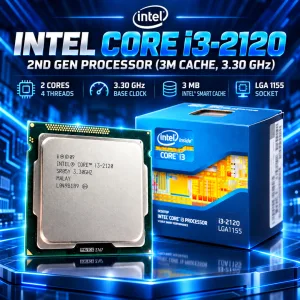
- 2 Cores and 4 Threads with Intel Hyper-Threading Technology
- 3.30 GHz Base Clock Frequency with 3 MB Intel Smart Cache
- Includes Intel HD Graphics 2000 integrated graphics
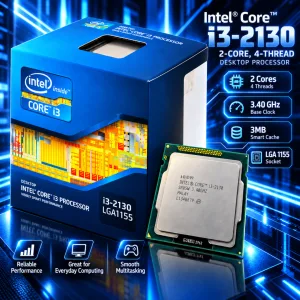
- 2 cores and 4 threads with Intel Hyper-Threading Technology
- 3.40 GHz processor base frequency with 3 MB Intel Smart Cache
- Integrated Intel HD Graphics 2000